
As of April 2026, the tech sector exhibits classic signs of a semiconductor bubble nearing a tipping point. With Forward P/E multiples reaching 120x for ARM and 81x for Intel, valuations have completely decoupled from fundamental reality. The “Circular AI Economy”—where hyperscalers fund loss-making startups to drive chip demand—suggests a precarious house of cards. I anticipate a violent 20-30% correction in the coming months as earnings expectations become mathematically impossible to meet.

It is April 2026, and I must confess, I am experiencing a financial déjà vu that keeps me awake at night. As I sit before my trading terminals, watching the astronomical valuations of companies that were considered “cyclical and boring” just three years ago, I cannot help but issue a stern warning: we are living through the peak of a semiconductor bubble that will make the dot-com crash look like a minor market hiccup. My position is unwavering: we have gone too far. The hype surrounding Artificial Intelligence (AI) has shifted from a quest for real-world productivity into a purely speculative frenzy, sustained by a liquidity environment that willfully ignores credit risk and market saturation.
If we examine the technical data I’ve compiled today, the evidence is overwhelming. We are witnessing a parabolic move—a 51.29% surge in a mere 28 days for the broader sector. Even more alarming is the Relative Strength Index (RSI), which is currently screaming at 81.22. For any analyst with a shred of objectivity, this is “extreme overbought” territory. The market is “buying the top” with a greed so blinding that it ignores how violently prices have deviated from the long-term moving averages. When financial gravity finally reasserts itself—and it always does—the descent won’t be an “adjustment”; it will be an abyss.
1. The Anatomy of an Illusion: Multiples That Defy Gravity
Fundamental analysis teaches us that the price we pay for an asset determines our future return. However, in 2026, it seems the market has collectively decided to shred the Benjamin Graham playbook. Analyzing the most recent filings and growth projections, we are faced with a dystopian reality where “hope” is the primary valuation metric.
Take AMD, for example. With a Forward P/E of 51x, the stock demands that investors believe in a perfect future, leaving zero margin for error in execution or supply chain logistics. Even more egregious is Intel. Despite a business model still in the throes of a painful, multi-year restructuring, it is trading at 81 times forward earnings—the highest multiple in its corporate history, eclipsing even the irrational excesses of the year 2000. How can a company facing margin compression and consistent market share loss be worth this much? The answer is simple: smoke and mirrors.
Even ARM Holdings, the crown jewel of chip architecture, has hit a Forward P/E of 120x. Yes, their royalty model is magnificent, but paying 120 years of anticipated profits for a company dependent on third-party scaling is, at best, a breach of fiduciary prudence. We are feeding a semiconductor bubble where “fair value” has become a subjective variable adjusted to fit the narrative of the day.
2. The Danger of Concentration: The Top 25 Carrying the World
When I analyze the top holdings of the major sector ETFs, the level of risk concentration is terrifying. We have reached a point where the global economy’s perceived health rests on the shoulders of fewer than ten companies.
Comparative Valuation Table: The “Big Tech” Chip Stalwarts
| Company | Ticker | Index Weight | Forward P/E (April 2026) | Analyst Status |
| Broadcom Inc. | AVGO | 8.37% | 31x | Rally Exhaustion |
| NVIDIA Corp. | NVDA | 7.17% | 25x | Fair Value, Macro Risk |
| AMD | AMD | 7.24% | 51x | Speculative Bubble |
| Intel Corp. | INTC | 4.66% | 81x | Critical Risk |
| ARM Holdings | ARM | 5.20% | 120x | Maximum Irrationality |
| Monolithic Power | MPWR | 4.43% | 75x | Extreme Overvaluation |
Broadcom (AVGO), which now commands over 8% of the weight in many specialized funds, recently reported record-breaking results with AI chip sales growing at 106% year-over-year. However, I have to ask: how much of this growth is organic and how much is simply inventory front-running driven by the fear of future shortages? History teaches us that the semiconductor sector is inherently cyclical; when demand slows, the “bullwhip effect” of excess inventory destroys margins with terrifying speed.
3. The AI CAPEX Abyss: A Circular Economy Warning
A cornerstone of my bearish thesis for the coming months lies in what I call the “Circular AI Economy.” Recently, we observed Google announcing an indirect “bailout” of Anthropic to the tune of $40 billion. In practice, this capital enters Anthropic and immediately exits to pay… Google, for the use of its cloud computing infrastructure.
This circular funding model artificially inflates the revenues of hyperscalers and, by extension, the demand for chips from NVIDIA and Broadcom. But herein lies the danger: companies like Anthropic and OpenAI remain deeply unprofitable. If AI models do not begin generating tangible, bottom-line profits for the enterprises using them, the CAPEX (Capital Expenditure) spigot will be slammed shut. I have previously discussed this investment precipice in my analysis of whether Amazon is an AI powerhouse or a CAPEX abyss, and the logic applies here with even greater urgency. If Amazon or Microsoft decide to prune their data center budgets, semiconductor stocks will fall like a row of dominos.
4. The Federal Reserve and Liquidity: The Trigger for Correction
In early 2026, the Federal Reserve finds itself in a precarious position. While inflation has shown some signs of cooling, “tariff shocks” and ongoing geopolitical instability in the Middle East keep interest rates at a level that does not support 100x multiples. According to the latest Morningstar economic reports, expectations for rate cuts this year are shrinking faster than a foundry’s margins during a recession.
Without the “oxygen” of cheap liquidity, the current valuations of the semiconductor bubble become mathematically unsustainable. The opportunity cost of holding stocks trading at 80x earnings, while Treasury bonds offer attractive real yields, will eventually weigh on the portfolios of large institutional funds. I predict that a rotation into defensive sectors or overlooked software stocks—which have been unfairly punished—will be the catalyst for a violent sell-off.
5. The Exception That Proves the Rule? The Qualcomm Case
Not everything is irrational, but the exceptions are few and far between. Qualcomm (QCOM) still trades at a Forward P/E of 14x. Why? Because the market stubbornly views it as a legacy “handset chip” company, ignoring its massive pivot into the data center and automotive sectors. However, in a systemic sector crash, even “cheap” companies aren’t spared. When panic sets in and the semiconductor bubble bursts, the correlation between assets tends toward 1.0. Investors sell what they can, not just what they want.
6. Technical Red Flags: The Charts Don’t Lie
I want to draw your attention back to the price action. When a stock or a sector moves up 50% in a month while the underlying revenue grows at 15-20%, we are witnessing multiple expansion driven by FOMO (Fear Of Missing Out), not fundamentals.
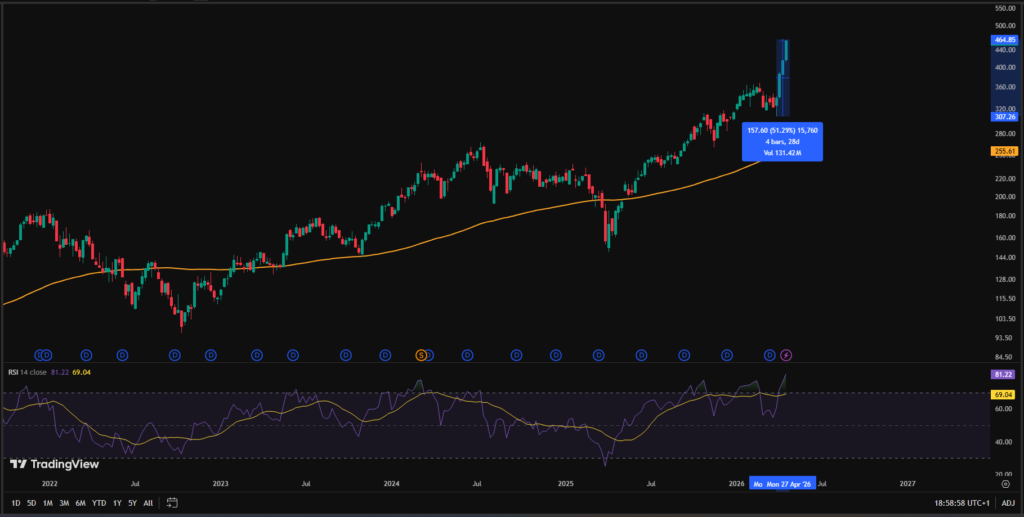
- RSI Divergence: While prices are making new highs, the momentum indicators are beginning to lag. This “bearish divergence” is often the final signal before a trend reversal.
- The 200-Day Gap: The semiconductor index is currently trading nearly 40% above its 200-day moving average. Statistically, such a “stretch” is unsustainable. Mean reversion is not a possibility; it is a mathematical certainty.
Frequently Asked Questions (FAQ)
What defines the current “Semiconductor Bubble”?
The bubble is defined by extreme valuation multiples (often exceeding 50x or 100x Forward P/E), parabolic price growth decoupled from earnings, and a total reliance on AI CAPEX spending that has yet to prove its ROI for the end-user.
Should I liquidate all my chip stocks immediately?
In my personal opinion, reducing exposure to high-multiple names like Intel, AMD, and ARM is a necessary act of prudence. Holding core positions in NVIDIA or TSMC may be acceptable, but only with tight stop-losses given the current overbought conditions.
What role does NVIDIA play in a potential crash?
NVIDIA is the sector’s bellwhip. While its fundamentals are the strongest in the group, its $5 trillion market cap leaves no room for error. If NVIDIA misses a quarterly projection by even 1%, the entire sector could correct by 10% in a single session.
When do you expect the correction to occur?
Based on technical indicators (RSI > 80) and typical market seasonality, the next 3 to 6 months will be the “danger zone.” A saturation in manufacturing capacity and downward revisions of AI budgets by Big Tech are the most likely triggers.
Conclusion: Brace for Impact
I firmly believe we are heading toward a painful reckoning. The current euphoria is fueled by a narrative of “infinite growth” that history has debunked time and time again. The 2026 semiconductor bubble is no different from the radio craze of the 1920s or the internet boom of the 90s. The technology is indeed revolutionary, but the price being paid for it today is a historic blunder.
I am aggressively trimming my positions. I would much rather miss out on the “last cent” of the rally than be left holding an asset trading at 120 times its earnings when the market finally wakes up to reality. The declines will be violent, swift, and unforgiving. Anyone ignoring the signs of technical exhaustion and the fundamental fragility of the AI “circular economy” is quite simply playing Russian roulette with their capital.
The semiconductor market will survive and thrive in the long run, but the “long run” for someone who buys at the peak of a bubble can mean a decade of negative returns. Exercise extreme caution. The “Chip Winter” is coming.
Disclaimer: This article reflects exclusively my personal opinion and market analysis. It does not constitute financial advice, nor a recommendation to buy or sell securities. Investing in the stock market involves high risk and the potential loss of capital. Always consult a certified financial advisor before making any investment decisions.
Related posts:
 The Greenland Crisis: How Trump’s New Tariffs Could Wreck Your Tech Portfolio Today
 NVIDIA in 2026: Record-Breaking Results and an 18 P/E — The Crossroads of Dominance and Cyclicality
 The Civil War at the Federal Reserve: Is Jerome Powell’s Resistance the Last Stand for Economic Stability?
 Trade War 2.0 Greenland: How to Shield Your Portfolio Against New NATO Tariffs and Arctic Volatility