
Amazon concluded 2025 with a record $717 billion in revenue and $80 billion in operating income. However, Free Cash Flow (FCF) retreated to $11 billion due to a massive $200 billion investment in AI and infrastructure projected for 2026. AWS reached a $142 billion run rate, fueled by proprietary chips (Trainium) and the new Mantle architecture, signaling a pivotal shift toward vertical integration and generative AI dominance.
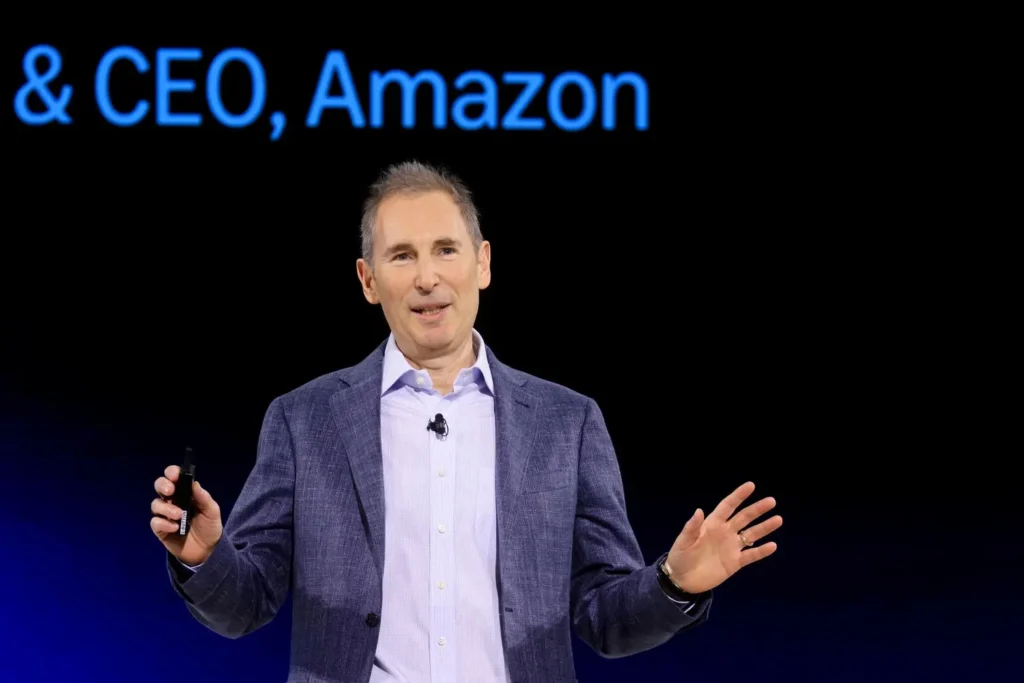
When analyzing Andy Jassy’s latest shareholder letter, released earlier this year, it is impossible not to feel the weight of responsibility carried by someone managing one of the largest commercial empires in human history. As an investor who closely monitors Wall Street’s ebbs and flows and the evolution of fundamental metrics, I see Amazon as a fascinating case study in survival through constant reinvention. Jassy’s central premise, inspired by the New Zealand band The Beths, is that “the straight line was a lie.” In the financial world, we tend to project linear growth charts, but the reality of 2025 and the projections for 2026 show that progress is made of “zigzags,” plateaus, and brutal redirections.
In this article, I intend to dissect Amazon’s financial health, the impact of Artificial Intelligence (AI) on its margins, and why, despite maintaining a cautious 1% position in my personal portfolio, I am eager for an opportunity to scale up if the market offers a more attractive entry point.
1. The 2025 Financial X-Ray: Record Revenue vs. Cash Flow Pressure
To understand Amazon’s future, we must look at the cold numbers from the last fiscal year. In 2025, the company demonstrated remarkable resilience in its top line. Total revenue grew 12%, jumping from $638 billion to **$717 billion**. This growth was not uniform but sustained by different pillars: North America grew 10%, the International segment 13%, and the crown jewel, AWS, advanced 20%, reaching $129 billion.
However, the figure that has analysts scratching their heads is Free Cash Flow (FCF). FCF dropped drastically from $38 billion to just **$11 billion**. This nearly 71% decline is not due to operational inefficiency—operating income actually rose 17% to $80 billion—but rather a strategic decision to invest in fixed assets (Capex). Amazon increased its purchases of property and equipment by **$50.7 billion** in a single year, reflecting almost entirely its bet on AI infrastructure.
Data Table: Financial Performance (2024 vs. 2025)
| Metric ($ Billions) | 2024 | 2025 | YoY Change |
| Total Revenue | 638 | 717 | +12% |
| AWS Revenue | 108 | 129 | +20% |
| Operating Income | 69 | 80 | +17% |
| Operating Margin | 10.8% | 11.2% | +40 bps |
| Free Cash Flow (FCF) | 38 | 11 | -71% |
| Capex (Investment) | – | 200 (Proj. 2026) | N/A |
Source: Data extracted from the 2025 Shareholder Letter.
As an analyst, I view this scenario as a test of conviction. Amazon is investing approximately $200 billion in 2026. This isn’t a “hunch,” as Jassy puts it, but a response to real contractual commitments from customers, such as the $100 billion+ deal with OpenAI. The AWS cash cycle requires paying for land, energy, and chips long before the customer is billed. If the AWS growth rate continues to accelerate, FCF may suffer in the short term, but these assets have lifespans ranging from 30 years (datacenters) to 5-6 years (servers and chips).
2. AWS and the Silent Revolution of Proprietary Chips
AWS is no longer just a hosting service; it has become the central nervous system of global AI. In the first quarter of 2026, the annualized revenue for AI-related services in AWS has already surpassed $15 billion. To put this in perspective, this value is 260 times higher than what AWS was generating three years after its initial launch.
My fundamental analysis focuses on a point many retail investors overlook: the verticalization of chip production. Amazon is reducing its dependence on NVIDIA through its own processors:
- Graviton: Now in its fourth generation, it is used by 98% of the top 1,000 EC2 customers and offers a price-performance ratio 40% superior to traditional x86 processors.
- Trainium: The chip focused on AI training. Trainium3, launched in early 2026, is 30-40% more efficient than its predecessor and is already almost entirely oversubscribed.
- Margin Impact: The scale of these chips could save Amazon tens of billions of dollars in Capex annually and add hundreds of basis points to the operating margin compared to using third-party silicon.
Amazon’s chip business already has a billing rate exceeding $20 billion per year. If it were a standalone company, its market valuation would be astronomical. Jassy even suggests that Amazon might start selling chip racks to third parties in the future, which would open a massive and lucrative new revenue stream.
3. Retail, Robotics, and “Last Mile” Logistics
While AI dominates the headlines, Amazon’s retail business remains its largest volume engine, approaching $600 billion in gross sales. However, efficiency is the name of the game. The implementation of robotics reached a historic milestone: over one million robots are now operating in fulfillment centers.
This automation isn’t just about cutting costs; it’s about speed. Amazon managed to deliver over 500 million units on the same day in 2026, thanks to the new Same-Day Delivery Centers (SSDs). Furthermore, expansion into rural areas, with a $4 billion investment, shows the company isn’t ignoring hard-to-reach markets.
Grocery Integration and Prime Air
One of the points I highlight in my portfolio analysis (which you can check in detail in my April 2026 Portfolio Report) is the maturation of the grocery business. Amazon is now the second-largest food retailer in the U.S., with sales exceeding $150 billion. Integrating fresh products into the same-day delivery network has caused perishable sales to grow 40-fold since 2025.
Parallel to this, Prime Air finally seems ready for scale, with plans to deliver half a million packages by the end of this decade, many of them in under 30 minutes. This convergence of drones, robotics, and AI creates an economic moat that traditional competitors will find nearly impossible to bridge.
4. The Leap into Space: Amazon Leo (Project Kuiper)
Many investors forget that Amazon is on the verge of becoming a global telecommunications operator. Amazon Leo (formerly known as Project Kuiper) already has more than 200 satellites in orbit, making it the third-largest LEO network in the world.
The official launch is set for mid-2026, but the financial commitments are already tangible. Delta Airlines has selected Amazon Leo for its fleet’s Wi-Fi starting in 2028, joining giants like AT&T and Vodafone. For AWS, this means governments and corporations can move data from remote locations directly into the Amazon cloud seamlessly. This is the ultimate expansion of infrastructure.
Personal Opinion and Investment Strategy
Currently, I maintain a 1% position in Amazon (AMZN) in my portfolio. You might ask: if I am so bullish, why such a small allocation? The answer lies in financial prudence and risk management amid the 2026 macroeconomic landscape.
I recognize that Amazon is going through an “investment peak” that invites scrutiny. The drastic drop in Free Cash Flow to $11 billion leaves the stock vulnerable to volatility if AWS revenue growth disappoints even for a single quarter. However, my view is long-term. As Jeff Bezos noted in his original 1997 letter—which Jassy makes a point to republish every year—“it’s all about the long term.”
I firmly believe Amazon is building the foundations for the next decade of technological dominance. The transition from Alexa to Alexa+ (utilizing generative AI) and the new Mantle infrastructure on Bedrock are clear signs the company isn’t afraid to “go back to the drawing board” to redesign products that are already successful.
I hope the market, in its usual myopia, gives me the opportunity to double down on this position. If we see a correction in the tech sector that brings Amazon’s stock to more reasonable multiples relative to its 2027/2028 FCF potential, I will not hesitate to increase my exposure to 3% or 5%. For now, my focus is on watching the execution of the $200 billion Capex and the monetization of AI capabilities.
You can read the full, original 2025 letter at this official source.
FAQ: Frequently Asked Questions about Amazon’s Future
Is Amazon overinvesting in AI and putting its cash at risk?
While the $200 billion Capex for 2026 is massive, it is backed by real customer commitments (like OpenAI) and long-lived assets. Short-term risk exists for FCF, but the Return on Invested Capital (ROIC) tends to be superior in the long run.
What is the “Mantle” architecture mentioned by Andy Jassy?
Mantle is the new inference engine for the Amazon Bedrock service. It was developed in just 76 days by a small team using agentic coding tools (Kiro), allowing it to process more tokens in Q1 2026 than in all previous years combined.
Is Amazon still a retail company or has it become a chip company?
Amazon is an ecosystem. While retail generates nearly $600 billion, the chip division already bills over **$20 billion** and is essential for keeping AWS margins competitive against Microsoft and Google.
Conclusion: The Tenacity of “Day 1”
Reading the 2025 letter reinforces the idea that Amazon continues to operate with a “Day 1” mentality. The willingness to be “misunderstood for long periods of time” is what allowed AWS to go from a ridiculed idea in 2006 to a $142 billion annualized revenue giant in 2026.
We are at a technological inflection point—AI—which Jassy compares to the impact of Edison’s electricity. The difference is that while electricity took 40 years to reorganize the world, AI is moving ten times faster. For the patient investor, the volatility caused by heavy Capex is noise; for the strategist, it is the signal that the leadership of the future is being bought today.
I hold my 1% with absolute conviction but keep my finger on the trigger for the “buy the dip” moment. Amazon’s history teaches us that betting against its ability to invent the future has been, consistently, an expensive mistake.
This article reflects my personal opinion and does not constitute financial advice. Always consult a professional before making investment decisions.
Related posts:
 The Civil War at the Federal Reserve: Is Jerome Powell’s Resistance the Last Stand for Economic Stability?
 Trade War 2.0 Greenland: How to Shield Your Portfolio Against New NATO Tariffs and Arctic Volatility
 The Greenland Crisis: How Trump’s New Tariffs Could Wreck Your Tech Portfolio Today
 2026 AI IPOs: The Triumph of FOMO or the Next Dot-Com Burst?