
Qualys, Inc. (NASDAQ: QLYS) emerges in 2026 as an exceptional value play within the cybersecurity sector. Following a 64% correction from its all-time highs, the company is trading at historically low P/E (Price-to-Earnings) multiples despite maintaining a ROIC above 25% and consistent double-digit growth. With the launch of Agent Val (agentic AI), Qualys is reaffirming its technological dominance. This analysis concludes that the market is overlooking robust fundamentals in favor of short-term narratives.
1. Introduction: The Qualys Paradox and Market Fear
Within the investment landscape, a peculiar psychological phenomenon occurs: most investors claim they want to own “the world’s best companies,” but only when they are trading at record valuations. When Qualys (NASDAQ: QLYS) was trading at exuberant multiples, it was the “darling” of every Silicon Valley analyst. Today, following a sharp decline, many claim the company is “dead money.” I strongly disagree.
My experience has taught me that it is precisely in these scenarios of exacerbated pessimism—where the RSI indicates extreme oversold conditions—that wealth is truly built. Qualys is not merely a survivor; it is a cash-generating machine currently being re-rated by the market in a way that I view as fundamentally irrational. In this article, I will dissect why I am initiating positions in this tech powerhouse and how its transition to native AI is set to redefine the cybersecurity game.
2. What Qualys Does: The Cloud Sentinel
2.1. History and Evolution
Founded in 1999, Qualys was a pioneer in the SaaS (Software as a Service) model applied to security. While competitors were still installing heavy hardware in customer data centers, Qualys was already delivering vulnerability management via the cloud. This long-term vision allowed them to build the Enterprise TruRisk Platform, a unified solution now utilized by over 10,000 global customers, including a majority of the Fortune 100.
2.2. The Competitive Moat
What sets Qualys apart is its single-agent architecture. Unlike other security suites that require dozens of different installations, Qualys uses a single sensor to collect inventory, vulnerability, and compliance data. This creates massive stickiness: once a corporation integrates Qualys into its IT workflow, the switching costs are prohibitive.
3. The Numbers Don’t Lie: A Detailed Fundamental Analysis
To understand the intrinsic value of Qualys, we must look at the cold, hard data. Below, I present the financial evolution of recent years, based on the company’s official 10-K and 10-Q filings.
Table: Qualys Financial Performance (2021 – 2025)
| Metric | 2021 | 2022 | 2023 | 2024 | 2025 | Evolution (%) |
| Revenue ($ Millions) | 411.2 | 489.7 | 554.2 | 610.0 | 673.2 | +63.7% (Total) |
| Non-GAAP EPS ($) | 3.22 | 3.72 | 5.27 | 6.13 | 7.07 | +119.5% |
| EBITDA Margin (%) | 46% | 45% | 48% | 47% | 47% | Stable/High |
| Free Cash Flow ($M) | 176 | 183 | 244 | 288 | 304 | +72.7% |
| Net Debt | Negative | Negative | Negative | Negative | Negative | Excellent |
Note: The growth of EPS significantly outpaced revenue growth, demonstrating massive operational leverage and impeccable cost management.
3.1. EPS Dynamics and Margins
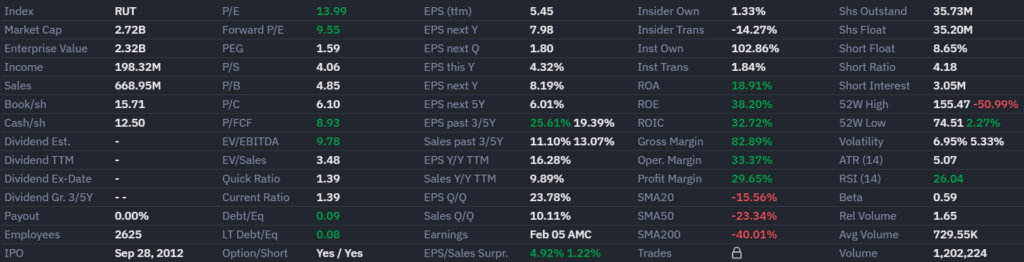
The growth of Non-GAAP EPS from $3.22 in 2021 to $7.07 in 2025 is, in my view, the most impressive metric. This represents a compound annual growth rate (CAGR) of approximately 22%. How can a company that more than doubled its earnings per share in five years be sold at a 64% discount? The answer lies not in fundamentals, but in multiple compression.
3.2. Debt, Dividends, and Buybacks
Qualys is one of the few tech companies that maintains negative net debt. They do not pay dividends, and I prefer it that way. Why? Because management has been a master of share repurchases. In February 2026, they announced a $200 million increase to the buyback program. When a company repurchases its own stock during a drawdown, it transfers value directly to remaining shareholders, increasing our slice of the final pie.
4. Anatomy of a Crash: From “Darling” to “Discarded”
At its all-time highs, Qualys was trading at a P/E ratio exceeding 60x. At the time, the consensus was unanimous: “it’s a must-own growth stock.” I saw danger. Paying 60 times earnings for a company growing revenue at 10-15% is an invitation for disaster, regardless of business quality.
The 64% correction was a necessary reality check. The market swung from blind optimism to irrational pessimism. Today, the market punishes Qualys for the slowdown in revenue growth (which stabilized at 10%), ignoring that profitability has never been higher. It is a classic case of “throwing the baby out with the bathwater.”
“The stock market is a device for transferring money from the impatient to the patient.” – Warren Buffett.
This quote has never made more sense than in the analysis of Qualys in 2026. The company isn’t “broken”; its valuation has simply been sanitized of speculators.
5. Efficiency and ROIC: The Invisible Engine
Many investors focus solely on top-line revenue growth, but I focus on ROIC (Return on Invested Capital). Qualys’s ROIC has consistently remained above 25%.
This means that for every dollar Qualys reinvests in its business, it generates 25 cents of operating profit. This is a clear indicator of a sustainable competitive advantage. A company with high ROIC and no debt is, financially speaking, a tank. Even if growth isn’t 30% per year, the efficiency with which they generate capital ensures long-term prosperity.
6. The Impact of Artificial Intelligence: Agent Val
The biggest criticism against Qualys was that AI might render vulnerability management obsolete. The company’s March 2026 report answered this with the launch of Agent Val.
What do official reports say about AI?
In its Investor Relations (IR) portal, Qualys details how Agent Val is the industry’s first AI agent for safe exploit validation and autonomous remediation. Instead of just flagging a problem, the AI now:
- Validates if the vulnerability is actually exploitable in production.
- Executes autonomous mitigation.
- Reduces remediation noise by up to 40%.
This isn’t “marketing AI”; it is AI applied to the core product to reduce customer operating costs. By integrating the “AI risk fabric,” Qualys positions itself not as a victim of AI, but as its primary beneficiary.
7. Technical Analysis: Where Price Meets Value
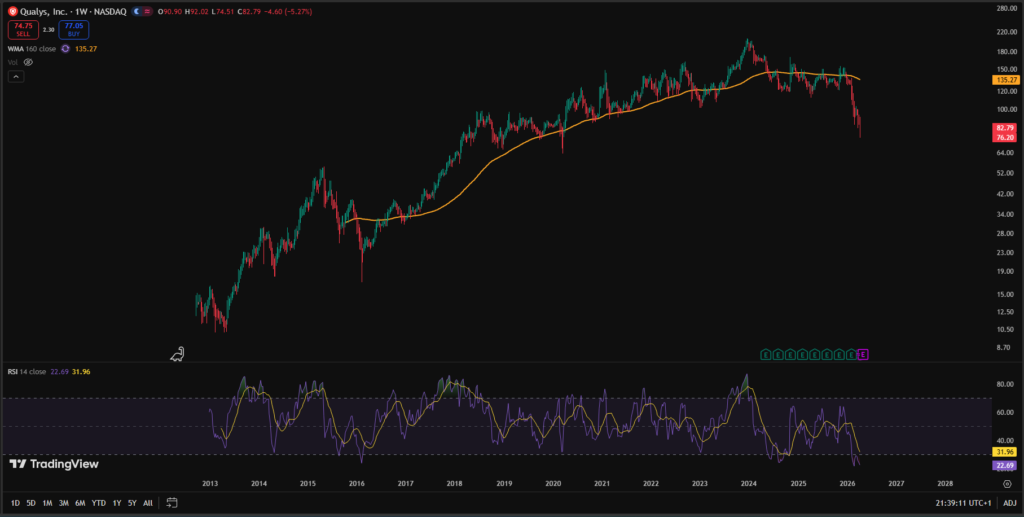
As an investor who combines fundamentals with technicals, I cannot ignore the charts. Currently, Qualys presents a scenario of historic technical oversold conditions.
- RSI (Relative Strength Index): Currently sitting below 30 on the weekly chart, a level rarely visited in the last decade.
- Support Levels: We are testing price levels from 2019/2020, erasing years of gains despite the company being financially twice the size it was then.
- My Strategy: This is the moment I begin initiating positions. As I mentioned in my analysis of Amazon as the best entry opportunity, I look for “blood in the streets” when fundamentals remain intact.
8. FAQ – Frequently Asked Questions about Qualys
Is Qualys at risk of bankruptcy due to this crash?
No. The company has negative net debt, is highly profitable, and generates over $300 million in annual Free Cash Flow. The drop is strictly in stock valuation, not financial health.
Why has revenue growth slowed down?
The cybersecurity market is more mature, and Qualys is prioritizing profitability and efficiency over growth at any cost. A 10% growth rate in this environment is sustainable and highly lucrative.
Will AI replace Qualys products?
On the contrary. Qualys is integrating AI (like Agent Val) to make its products faster and more effective, actually increasing the barrier to entry for new competitors.
9. Conclusion: My Strong Conviction
After deeply analyzing the numbers, technology, and market sentiment, my conclusion is clear: Qualys is a screaming value buy. We are looking at a company growing earnings at 20% annually, with zero debt, aggressive share buybacks, and a leadership position in AI-driven cybersecurity. The market is offering us a high-quality business at “clearance sale” prices simply because the narrative shifted from “hyper-growth” to “value and efficiency.”
I am buying. Not because I expect the stock to pop tomorrow, but because I know that by 2028 or 2030, the market will look back and realize that selling Qualys at these multiples was a historic mistake. Digital security is a basic necessity of the modern economy, and Qualys is the backbone of that security.
Disclaimer: This article represents my personal opinion and does not constitute financial advice. Investing in capital markets involves risk. Conduct your own due diligence before making any investment decisions. The author may hold or plan to initiate positions in the assets mentioned.
Related posts:
 Ferrari Stock: Why I’m Buying Ultra-Luxury at a 40% Discount?
 Skin in the Game: Portfolio January 2026 – Why I Doubled Down on Constellation Software (CSU)
 S&P Global’s 10% Dip: Generative AI Threat or a Generational Buying Opportunity?
 April 2026 Portfolio Report: Why I’ve Gone Overweight on Treasuries and Entered Gold at $4,400