In March 2026, gold investment is driven by a critical need for capital preservation against unsustainable fiscal deficits, highlighted by U.S. military spending of $1 billion per day in the Iran conflict. Following a speculative peak at $5,500 and a healthy correction to $4,400, this strategic entry focuses on systemic protection. Gold serves as a definitive hedge against both AI-driven structural deflation and aggressive monetary debasement, acting as the ultimate store of value.
1. Returning to Fundamentals: Why Gold, Why Now?
My decision to initiate a new long-term gold position at this specific juncture in 2026 is not a byproduct of market hype; rather, it is a cold, calculated response to a macroeconomic environment that has moved beyond the point of traditional “normalization.” Over the past several months, I have watched the retail markets get swept up in a tidal wave of irrational exuberance. For those who follow my work, you know I have long preached that timing and conviction are the two pillars of wealth preservation. While the masses were frantically “FOMO-ing” into the market as gold tested the psychological $5,500 barrier, I remained on the sidelines, waiting for the speculative froth to evaporate.
Gold remains the only financial asset that carries zero counterparty risk and has survived every sovereign debt crisis and monetary collapse in human history. In our current 2026 reality, where global central banks have arguably lost the narrative on “inflation targeting,” owning a physical, scarce, and universally recognized asset is a non-negotiable requirement for any serious portfolio. My current market entry serves one singular, unshakeable purpose: the preservation of purchasing power in an era where fiat currency is being treated as a disposable political tool.
One of the most frequent mistakes I see investors making is the false equivalence between gold and silver. They assume that since both are precious metals, they will follow the same trajectory. However, as I dissected in my previous analysis, Silver could be history’s biggest trap, silver carries industrial sensitivities and liquidity constraints that gold simply transcends. Gold is the currency of central banks and sovereigns; silver, unfortunately, often becomes the playground for speculators who find themselves trapped when the liquidity doors slam shut.
2. The Printing Press and the 2026 Fiscal Abyss
We cannot discuss gold positions without addressing the “elefant in the room”: unbridled, runaway government expenditures. We have entered a dark epoch where the term “budget constraint” has seemingly been deleted from the political lexicon. The most recent data regarding the United States military expenditure in the ongoing Iran conflict is nothing short of catastrophic for the dollar’s long-term health. We are witnessing an estimated real-time expenditure of approximately $1,000,000,000 per day.
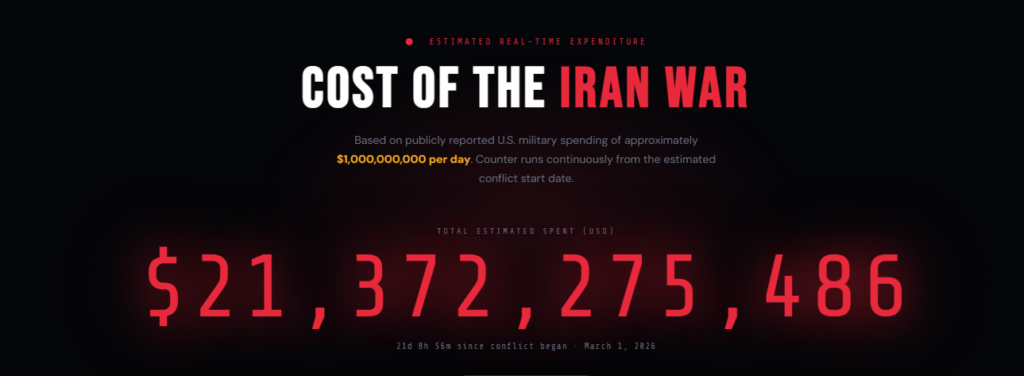
Think about that figure: one billion dollars every 24 hours channeled into non-productive, destructive consumption. This constant hemorrhage of capital creates a fiscal deficit that is, by any mathematical standard, unpayable through conventional taxation. The only “solution” left for the ruling class is the aggressive monetization of debt—modern monetary alchemy. According to recent Federal Reserve reports, the M2 money supply has begun an aggressive “hockey stick” expansion to bridge these fiscal gaps. When the supply of currency expands exponentially while the production of tangible goods and services lags, the result is the terminal erosion of the currency’s unit value.
To visualize the gravity of our situation, consider this comparative table of the 2026 fiscal landscape:
| 2026 Economic Indicator | Estimated Value / Impact | Risk Status for Fiat |
| Daily Military Spending (Iran Conflict) | $1 Billion USD | Critical |
| Global Public Debt Total | > $315 Trillion USD | Unsustainable |
| Real Inflation (Hard Asset Basket) | 3% – 4% | High |
| Central Bank Gold Reserves | Record-breaking Accumulation | Protective |
I frequently reference reports from the International Monetary Fund (IMF), which have issued stark warnings that debt-to-GDP ratios in the G7 nations have crossed the “event horizon.” In this context, my trust in the fiat system is at an all-time low. I choose to trust the laws of thermodynamics and scarcity over the promises of politicians who attempt to print their way out of a debt trap.
3. The Gold Duality: Thriving in Both Inflation and Deflation
A persistent myth in financial circles is that gold is exclusively an “inflation hedge.” My technical and historical analysis suggests a far more nuanced reality. Gold is, in fact, a monetary chameleon.
During periods of high inflation, gold shines because investors seek a refuge from the debasement of the medium of exchange. If $100 today buys only $90 worth of goods next year, gold tends to revalue nominally to bridge that gap. However, it is during deflationary cycles that gold proves its mettle as the ultimate reserve asset. In a severe deflationary shock—where credit contracts, banks fail, and traditional financial assets (stocks and bonds) plummet—gold maintains its liquidity and its role as the “last man standing.”
My personal view is that we are currently navigating a “bifurcated” economic reality. On one side, we have government-mandated monetary inflation; on the other, we are facing a massive deflationary wave triggered by the full-scale integration of Artificial Intelligence.
4. Artificial Intelligence as a Deflationary Juggernaut
By 2026, AI has transitioned from a buzzword to the very nervous system of global productivity. This technology is, by its very nature, intensely deflationary. It slashes production costs, replaces expensive human labor with automated efficiency, and accelerates the velocity of innovation at a rate never before seen. In a vacuum, this would be a boon for the consumer. However, in a debt-saturated economic system, deflation is a lethal poison.
If prices fall due to AI-driven efficiency, the real weight of existing debt increases. Governments cannot afford to let prices drop because it would make the interest payments on the national debt impossible to service. Therefore, the more AI pushes prices down, the more central banks are forced to print currency to “stimulate” inflation back to their targets. This tug-of-war between technological progress (AI) and political survival (printing) is the perfect environment for gold.
I view gold as the “stabilizer” in this chaotic balance. While AI disrupts the value of traditional labor, gold preserves the value of accumulated capital. This is exactly why I have added to my position now: to shield my net worth from this structural transition in the global economy.
5. Technical Analysis: Buying the $4,400 Dip, Not the $5,500 Hype
As a professional investor, I live by the mantra that “profit is made at the time of purchase.” Last year, when gold hit the parabolic $5,500 mark, the media was in a state of religious fervor. It was the lead story on every financial news network. As I noted in my piece Silver at 100 and Gold at 5000, entering at those levels would have been financial malpractice. Euphoria is the most reliable signal that a local top is in.
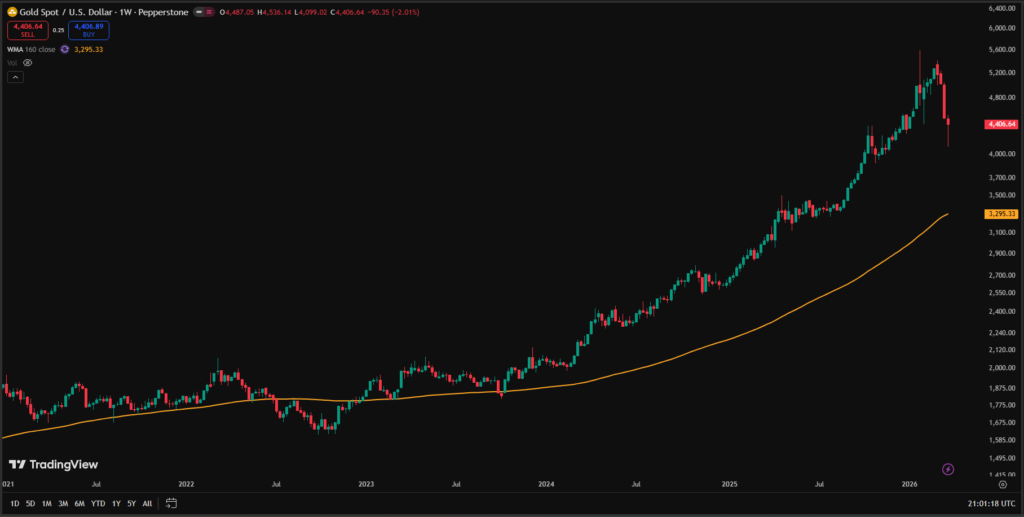
If you look at the 2026 weekly chart provided, the “blow-off top” was followed by a much-needed, healthy correction. The price retraced to find support at levels of actual institutional value. My entry was triggered specifically by this technical pullback. The price fell to the $4,400 zone, testing the 160-period Weighted Moving Average (WMA 160) and consolidating a very strong base.
The chart does not lie. The parabolic move has been “cleansed” from the market, and we are now in a phase of quiet institutional accumulation. Entering here provides me with a significantly more favorable risk/reward ratio. I am not interested in guessing the next 24-hour high; I am building a foundation that can withstand the systemic shocks of the next decade. The current support at $4,400 offers a margin of safety that simply did not exist when everyone was screaming for “$10,000 gold” on CNBC.
6. Diversification vs. Speculation: Gold’s True Vocation
I want to be unequivocally clear with my readers: my gold position is not a “get rich quick” scheme. If you are looking for 100x gains in a week, the leveraged gambling den of shitcoins might be more your speed. The function of gold in my portfolio is pure diversification and the maintenance of absolute purchasing power.
Historically, gold is often hijacked by speculators during moments of panic, but that is a secondary—and often dangerous—function. Its true calling is to serve as financial fire insurance. You don’t buy house insurance hoping the house burns down so you can turn a profit; you buy it so that if a disaster occurs, your life’s work isn’t reduced to ashes.
By allocating a portion of my capital to physical gold and high-trust physical-backed ETFs, I am ensuring that regardless of what happens to the Dollar, the Euro, or the digital banking system, I possess an asset with intrinsic, non-dilutable value. In the long run, gold doesn’t really “go up”; it is the currencies that “go down” against it. Understanding this distinction is the hallmark of a sophisticated investor.
FAQ: Navigating the 2026 Gold Market
Should I allocate 100% of my capital to gold right now?
Absolutely not. Gold should be viewed as a cornerstone of a diversified portfolio. In my personal strategy, an allocation between 5% and 15% is sufficient to provide systemic protection without sacrificing the growth potential found in productive equities or emerging tech.
Is gold a better play than silver for the rest of 2026?
Yes. As I elaborated in my article on the silver trap, gold offers monetary stability and institutional backing that silver—due to its industrial ties—cannot guarantee in this specific climate of geopolitical uncertainty.
How will gold react if the Iran conflict ends tomorrow?
While a peace agreement might trigger short-term volatility and a “relief sell-off” as the war premium fades, the structural issues (debt and deficits) will remain. Gold’s value is predicated on fiscal mismanagement, which existed long before the conflict and will likely persist long after.
Conclusion: The Long-Game Perspective
In summary, my strategic return to gold is a direct response to the deepening unsustainability of the 2026 global financial system. When you combine $1 billion a day in war spending, a global debt pile that defies mathematical logic, and the existential deflationary challenge of AI, gold stands alone as the only “Safe Haven” tested by millennia of human history.
My entry at $4,400 was technical, fundamental, and deeply disciplined. I ignored the noise of the $5,500 peak and waited for the market to come to me. If the current system survives and thrives, gold will have served its role as a diversifier. If the system fails, gold will be the guarantor of my financial sovereignty. In the world of high-stakes investing, the humility to buy insurance before the storm is what separates the winners from the casualties.
For ongoing data on global reserves and demand trends, I highly recommend monitoring the official reports from the World Gold Council, the gold standard for industry data.
Disclaimer: This article represents my personal opinion and my own investment strategy. It does not constitute personalized financial advice. Every investor must conduct their own due diligence and consult with a licensed professional before making significant investment decisions.