
Trump Accounts are tax-advantaged investment vehicles for minors established under the One Big Beautiful Bill Act of 2025. The program provides a $1,000 Treasury-funded seed deposit for children born between 2025 and 2028, with registration via IRS Form 4547. As of January 2026, over 500,000 accounts have been initiated. These funds are restricted to low-cost index funds to foster long-term wealth creation and bridge the national wealth gap through market participation.
I have been analyzing global markets for over two decades, and rarely do I see a policy shift that carries the potential to fundamentally rewrite the financial DNA of a nation. Today, in January 2026, we are standing at the precipice of such a shift. The Trump Accounts are not merely another government handout; they represent a sophisticated pivot from a “welfare state” to an “ownership society.” In this deep-dive analysis, I will break down the technical architecture of these accounts, who qualifies, and why—as an investor—I believe the integration of time and compound interest is the most aggressive wealth-building tool ever handed to the American public.
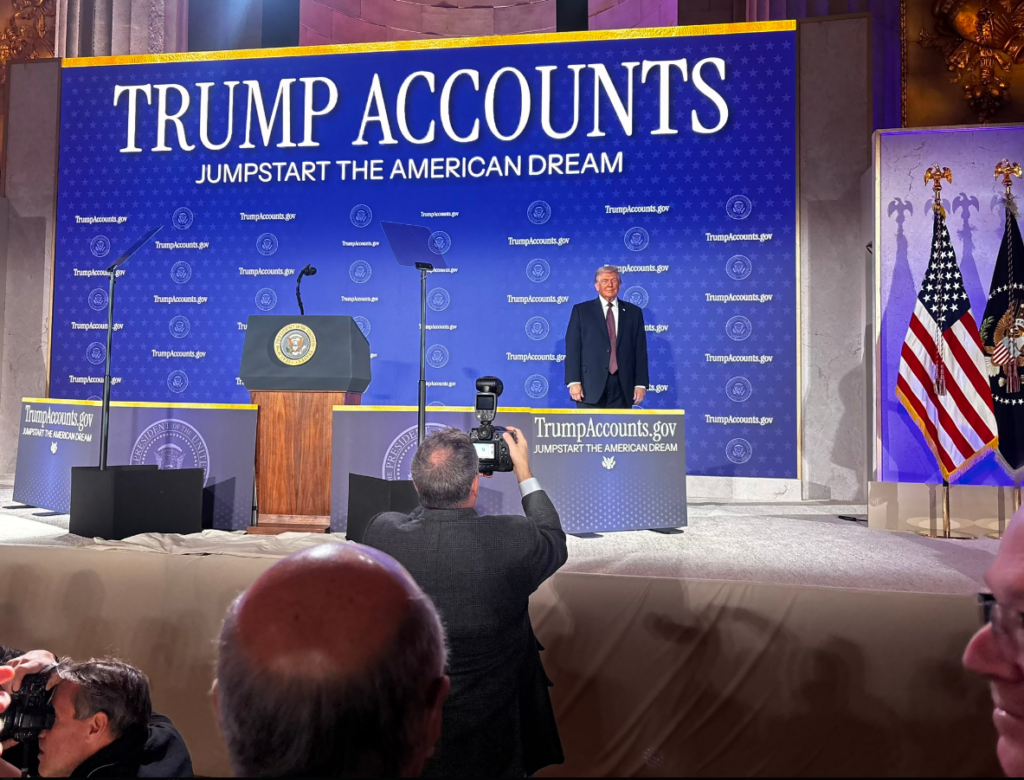
1. Defining the Trump Accounts: The Genesis of the Ownership Society
The Trump Accounts (officially categorized as “American Success Accounts” in some legislative drafts) are custodial investment structures designed to function similarly to a Roth IRA but with specific triggers for birth and long-term capital preservation. The central philosophy, championed by Treasury Secretary Scott Bessent, is to ensure every American child begins their life not just as a citizen, but as a shareholder in the United States economy.
To qualify for the initial $1,000 government seed grant, a child must be born within the “Golden Window” of January 1, 2025, to December 31, 2028. However, the account structure itself is available to any U.S. citizen or legal resident under the age of 18 with a valid Social Security Number (SSN). While older children may not receive the initial taxpayer-funded boost, they still benefit from the unique tax protections and low-cost institutional access that these accounts provide.
In my professional view, this is essentially a “Retail Sovereign Wealth Fund.” Unlike traditional stimulus checks that are often liquidated for immediate consumption, Trump Accounts are legally “locked.” The capital is mandated to work. According to recent reports from Reuters, the program has already garnered massive institutional support, ensuring that the infrastructure is not just a government project, but a public-private partnership of unprecedented scale.
2. Technical Mechanics: How the Program Functions in 2026
The operational rollout of the Trump Accounts has been designed for frictionless adoption. The primary gateway for registration is the IRS Form 4547, which can be filed alongside standard tax returns or through the dedicated trumpaccounts.gov portal.
While the initial seed money is being distributed now, the accounts will enter their full “Contribution Phase” on July 4, 2026. This date was chosen specifically to coincide with the Sestercentennial (250th anniversary) of the United States, signaling a “Financial Independence Day” for the next generation.
The Investment Mandate and “Guardrail” Strategy
What I find most technically impressive about this policy is the strict limitation on asset classes. To prevent the erosion of capital through speculation or high fees, Trump Accounts are restricted to:
- Broad-based Index Funds (ETFs or Mutual Funds) that track the total U.S. stock market or the S&P 500.
- Funds with an expense ratio not exceeding 0.10% (10 basis points).
- A strict prohibition on margin, options, or high-risk speculative vehicles.
By “hard-coding” the investment strategy into passive indexing, the administration is forcing a long-term winning strategy onto the populace. It removes the “behavioral gap”—the tendency for retail investors to buy high and sell low—and replaces it with the cold, hard efficiency of the American corporate engine.
3. Comparative Analysis: Trump Accounts vs. 529 College Savings Plans
As an investor, you must understand where to allocate your next dollar. The following table provides a technical comparison based on current 2026 fiscal regulations:
| Feature | Trump Accounts | 529 Savings Plans |
| Initial Govt. Seed | $1,000 (for 2025-2028 births) | $0 (State-dependent grants only) |
| Annual Contribution Limit | $5,000 | Varies (up to $500k+ lifetime) |
| Qualified Withdrawals | Retirement, 1st Home, Education | Education Only (or Roth rollover) |
| Investment Flexibility | Restricted (Low-cost Index only) | Broad (Stocks, Bonds, Target Date) |
| Management Fees | Capped at 0.10% | Variable (often 0.20% to 0.75%) |
| Tax Status | Tax-Free Growth & Distributions | Tax-Free for Education Only |
[Image: Infographic showing the projected growth of a Trump Account vs a standard savings account over 18 years]
I analyze these numbers and see a clear winner for “base-layer” wealth. While the 529 remains superior for high-net-worth individuals targeting Ivy League tuition, the Trump Account is the superior vehicle for general wealth accumulation due to its lower fee structure and broader withdrawal triggers.
4. Institutional Credibility and the “Bessent” Factor
One cannot discuss this program without mentioning the “wall of private capital” supporting it. Scott Bessent, in a recent address to the Federal Reserve, noted that the goal is to create “a bid under the market that never goes away.” When you have millions of accounts automatically purchasing S&P 500 shares every month, you create a structural floor for equity valuations.
The program has also seen significant private sector “matching.” Titans like Michael Dell have pledged billions to provide supplemental deposits for children in lower-income ZIP codes. This isn’t just charity; it’s a fundamental bet on U.S. productivity. Reports from NBC New York indicate that over 500,000 accounts were opened in the first 30 days alone, signaling that the “Trump Account” brand has achieved a level of trust that previous government savings initiatives lacked.
From a fundamentalist perspective, this creates a virtuous cycle. Increased retail participation in the stock market leads to higher capital availability for U.S. companies, which drives innovation, which in turn increases the value of the index funds held in the Trump Accounts.
5. Investor’s Perspective: Why Time and Compound Interest are Your Only True Allies
Now, let’s talk about the math—the part where I take off my analyst hat and speak to you as a fellow investor. Many critics argue that $1,000 is “insignificant” in the face of modern inflation. They are wrong.
I’ve often cited the story of Ronald Read, the humble janitor who amassed an $8 million fortune. He didn’t have a high salary; he had discipline and time. The Trump Accounts institutionalize the “Ronald Read strategy.” By starting at birth, these accounts capture the most productive years of compounding.
The Power of the “S&P 500 + Time” Combo
If we take the initial $1,000 and assume a historical S&P 500 return of roughly 10%, that money becomes ~$5,500 by age 18 without another cent added. But the real magic happens when families maximize the $5,000 annual contribution. According to my calculations:
- Initial: $1,000
- Annual Addition: $5,000
- Duration: 18 years
- Estimated Total: Over $230,000
I encourage you to play with the numbers yourself using my interest and compound interest calculator. You will see that the difference between starting at age 0 versus starting at age 20 is worth hundreds of thousands, if not millions, of dollars by retirement.
As an investor, I know that volatility is the price of admission for returns. The restricted nature of these accounts prevents parents from “panic selling” during a market dip. It forces the “Diamond Hands” mentality that is required to build true generational wealth. You are betting on the top 500 companies in the world—the innovators, the giants, the cash-flow machines—and you have the most important factor on your side: Time.
Frequently Asked Questions (FAQ)
Who is eligible for the $1,000 “Trump Account” seed money?
Children born between January 1, 2025, and December 31, 2028, who are U.S. citizens or legal residents with a valid SSN, are eligible for the Treasury-funded deposit.
When can I start contributing my own money to the account?
While registration via IRS Form 4547 is open now, the full contribution phase for parents, grandparents, and private matching begins on July 4, 2026.
Can I choose individual stocks like Tesla or Nvidia for this account?
No. To protect the capital from excessive volatility and risk, Trump Accounts are limited to low-cost index funds and ETFs that track broad market indices.
What are the tax implications of a Trump Account?
The accounts are structured for tax-free growth. Like a Roth IRA, contributions are made with after-tax dollars (or government grants), and withdrawals for qualified purposes (retirement, education, first home) are typically tax-exempt.
Conclusion: A New Era of Capital Participation
The Trump Accounts are more than a policy; they are a declaration that the stock market is not a playground for the elite, but a tool for every American. By combining the safety of broad-market indexing with the relentless force of compound interest, the 2026 financial landscape is being reshaped before our eyes.
My professional stance is simple: Do not leave this money on the table. If you have an eligible child, file Form 4547 immediately. If you don’t, apply the same logic to your own portfolio: cut your fees, buy the index, and let time do the heavy lifting. The “janitor’s secret” to wealth is now a national mandate.
Would you like me to run a customized simulation showing how a Trump Account could grow based on your specific monthly contribution goals?
Trump Accounts Official Treasury Briefing – View the latest updates from Secretary Bessent regarding the 500,000+ sign-ups and institutional backing.
Related posts:
 The Civil War at the Federal Reserve: Is Jerome Powell’s Resistance the Last Stand for Economic Stability?
 Trade War 2.0 Greenland: How to Shield Your Portfolio Against New NATO Tariffs and Arctic Volatility
 The Greenland Crisis: How Trump’s New Tariffs Could Wreck Your Tech Portfolio Today
 The End of the Dovish Illusion: Why the January 2026 FOMC Meeting Left Markets in Limbo