In January 2026, JPMorgan Chase reported an adjusted net income of $14.7 billion, beating expectations with an EPS of $5.23. However, the sector faces instability following Donald Trump’s proposal to cap credit card interest rates at 10%. With U.S. public debt hitting $38.4 trillion and market valuations (S&P 500) at historically stretched levels, consumer resilience appears fragile amid an expansionary but uncertain fiscal policy.
Yesterday, as I sat scanning the financial terminals and watched the JPMorgan Chase numbers flash across the screen, I felt an uncomfortable sense of déjà vu. The JPMorgan results for the fourth quarter of 2025, officially released in this opening month of 2026, are technically flawless. However, as I write these lines, I cannot share the blind enthusiasm sweeping through the trading desks in New York. To me, Jamie Dimon’s record numbers are the swan song of a cycle that is ignoring the smoke signals emanating from Donald Trump’s fiscal policy.
I believe we are living in a state of collective denial. The market is celebrating short-term gains driven by aggressive deregulation and populist promises, while ignoring that the “credit card” of the American sovereign debt is reaching its absolute limit. In this article, I will dissect why, despite being an admirer of JPM’s operational execution, my current stance is one of extreme caution and why I have decided that this is the time to take profits rather than chase the top.
1. X-Raying JPMorgan’s Results: Resilience or Exhaustion?
When looking at the raw data, JPMorgan remains the “fortress” we all know. The bank reported an adjusted net income of $14.7 billion (excluding significant items such as the reserve for the Apple card portfolio). What strikes me most—and must be analyzed carefully—is the Net Interest Income (NII). The guidance for 2026 points to an astronomical $103 billion, surpassing the consensus of $100 billion.
The “Fortress” Finance Table (Q4 2025 vs. Q4 2024)
| Financial Metric | Q4 2024 (Actual) | Q4 2025 (Current) | Variation (%) |
| Adjusted Net Income | $13.6B | **$14.7B** | +8.1% |
| Adjusted EPS | $4.81 | **$5.23** | +8.7% |
| Total Revenue | $43.7B | **$46.8B** | +7.1% |
| CET1 Ratio (Capital) | 13.9% | 14.5% | +60bps |
| NII (Annual Guidance) | $92.6B | **$103.0B** | +11.2% |
I see these numbers and my first reaction isn’t euphoria, but a question: how much longer? The bank has benefited immensely from the Fed Pivot we discussed last year, keeping rates high enough to profit on the “spread,” but low enough not to completely crush the borrower. But the consumer resilience, cited exhaustively in yesterday’s earnings call, seems to me to have feet of clay. Provisioning for credit losses has increased, and the $2.2 billion charge related to the Apple Card is a clear warning that consumer credit is starting to crack.
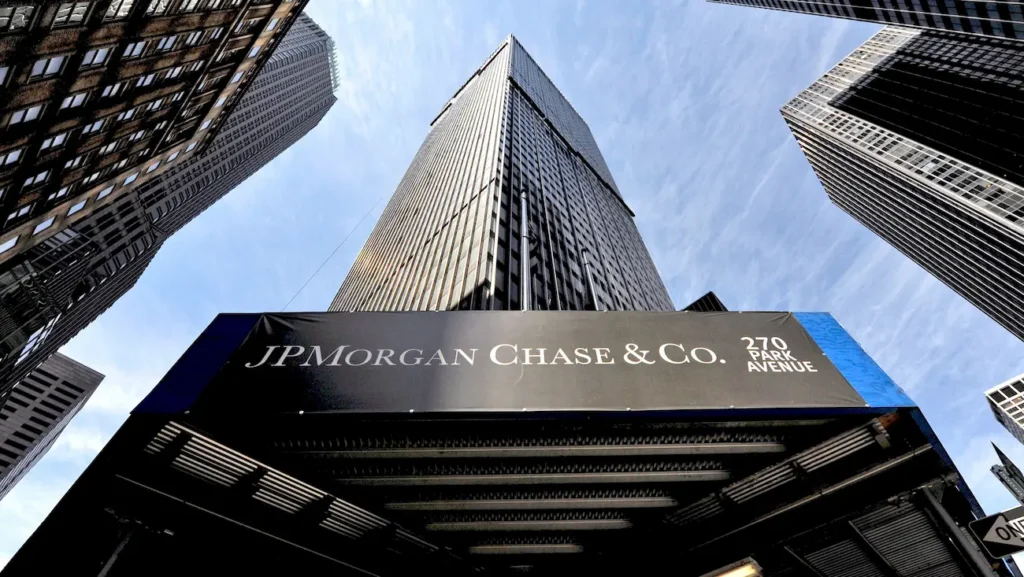
As reported by Bloomberg, market gains and investment banking propped up the bottom line, but retail banking is showing signs of fatigue. I feel the average investor is looking in the rearview mirror, celebrating the rise in JPM stock, while the windshield is covered by the fog of new policies coming out of Washington.
2. Trump’s Populist “Bomb”: The 10% Credit Card Cap
We now enter the murky territory of Donald Trump’s fiscal policy for early 2026. On January 9th, Trump threw a grenade into the financial sector by suggesting a 10% cap on credit card interest rates. For a bank like JPMorgan, which dominates the U.S. credit card market, this isn’t just regulation—it’s a direct attack on the heart of their profitability.
I view this measure as the perfect example of populist fiscal policy that can destabilize the system. Trump wants to deregulate the financial sector (which the market loves), but simultaneously wants to impose price ceilings (which the market hates). It is a contradiction in terms. If this 10% cap is passed by Congress—something that UBS and Goldman Sachs are already openly doubting—access to credit for the middle and lower classes will, in my opinion, simply be cut off. Banks will not take the risk of lending at 10% when the cost of capital and delinquency rates don’t justify the return.
This “card cap” is an attempt to artificially alleviate the cost of living. I believe that if it moves forward, we will see a severe contraction in credit supply, which ironically could accelerate the recession everyone claims has been avoided. The financial sector dropped nearly 4% on Monday following this announcement. Is the market finally waking up to the fact that Trump 2.0 is much less predictable for Wall Street than Trump 1.0?
3. The Sovereign Debt “Credit Card” and the Invisible Limit
Here lies the central point of my caution thesis: U.S. public debt. In January 2026, Treasury data confirms that gross debt has surpassed $38.4 trillion. The cost of servicing this debt is now the second-largest federal expense, exceeding the defense budget. Silver in 2026: A Short-Term Trap.
We are living in blind optimism based on Trump’s “One Big Beautiful Bill Act” (OBBBA), which injected massive fiscal stimulus through tax cuts and AI infrastructure spending. However, I ask: who is going to pay the bill? The deficit for the 2026 fiscal year is projected at $1.7 trillion. The market seems to believe the U.S. can continue to print and spend indefinitely without consequences for long-term bond yields.
I feel we are close to a “Minsky moment” for sovereign debt. When JPMorgan projects $103 billion in NII, they are counting on a “goldilocks” scenario. But if interest rates have to rise again to compensate for the risk premium on American debt, current valuations of 25x or 30x P/E (Price to Earnings) in many sectors will collapse. Valuations are stretched, and I see no margin of safety to absorb any fiscal shock coming from Washington.
4. Technical and Fundamental Analysis: Why I’m Taking Profits
From a fundamental perspective, JPMorgan is trading at a Price/Book (P/B) multiple that has rarely been sustained historically above 2.0x for long periods without a correction. Yes, the ROTCE (Return on Tangible Common Equity) of 18% is phenomenal, but it’s a “peacetime” number.
I analyze the market and see record concentration. The S&P 500 is being pushed by a handful of AI names and banking resilience, but “market breadth” is concerning. My instinct, refined by decades of market cycles, tells me this is the moment to apply the golden rule: sell when the last optimist enters the market.
The Risk of Excessive Deregulation
Trump promised to repeal several Basel III norms, which would free up billions in capital for banks. The market celebrated this as if it were free money. However, I see it as lowering defenses at a time when geopolitical volatility is at its peak. Less capital reserve means more systemic risk. If JPMorgan reduces its reserves to buy back shares (as it is already doing, with $7.9 billion this quarter), what happens if the 10% card cap causes a wave of defaults?
“Confidence is a crystal that cannot be glued; once broken, the financial market discovers that liquidity is an illusion that disappears when we need it most.” — This is my maxim for 2026.
5. FAQ: What You Need to Know Now
Is JPMorgan a good investment in 2026?
While operationally excellent, current valuations offer no margin of safety. I prefer to wait for a correction to P/B levels closer to 1.5x before increasing positions.
How does Trump’s policy affect bank stocks?
Deregulation is positive in the short term, but populist proposals like the 10% interest cap on cards create legal uncertainty and can cannibalize consumer credit revenue.
Can U.S. public debt cause a crash this year?
The risk is not an immediate default, but rather a spike in yields that forces a de-rating of all risk assets. The $39 trillion limit projected for March 2026 will be a critical test.
Conclusion: A Time for Extreme Caution
In conclusion, JPMorgan’s results are the mirror of an economy still burning the fuel of past stimuli. Jamie Dimon remains the world’s best risk manager, but even he cannot stop an uncontrolled fiscal tide. Donald Trump’s fiscal policy, while seductive for short-term bulls, carries the seeds of inflationary instability and populist risk.
I have made my decision: I am reducing my exposure to the financial sector and increasing my position in cash and defensive assets. We are living in blind optimism and ignoring the credit card limit of the world’s largest economy. Do not be fooled by record profits; in the financial market, it’s not about how fast you’re running, but whether there’s a cliff ahead. And in 2026, the cliff seems to be getting closer. It is time to take profits, protect capital, and watch from the sidelines.