
NVIDIA’s Q4 FY26 results confirm its absolute leadership in AI infrastructure, posting record revenue of $68.1 billion (+73% YoY) and net income of $43 billion. Despite a forward P/E of 18 for 2027, which appears to be a historic discount relative to growth, the absence of revenue from China and the potential cyclicality of software mandate caution. The company maintains dominance through its CUDA ecosystem and H200/Blackwell chips, but the risk of Capex saturation justifies my decision to remain sidelined.
As a senior finance editor and market analyst, I have observed that the financial markets have reached a point of information saturation where even stratospheric numbers no longer seem to elicit the “shock and awe” they once did. However, NVIDIA’s latest results demand that we take a scalpel to the anatomy of what is, without question, the greatest cash-generation machine in the modern history of semiconductors. It is fascinating—and almost surreal—to witness a company of this caliber trading at multiples that, in any other cycle, would be considered “value investing,” all while maintaining growth rates that defy economic gravity.
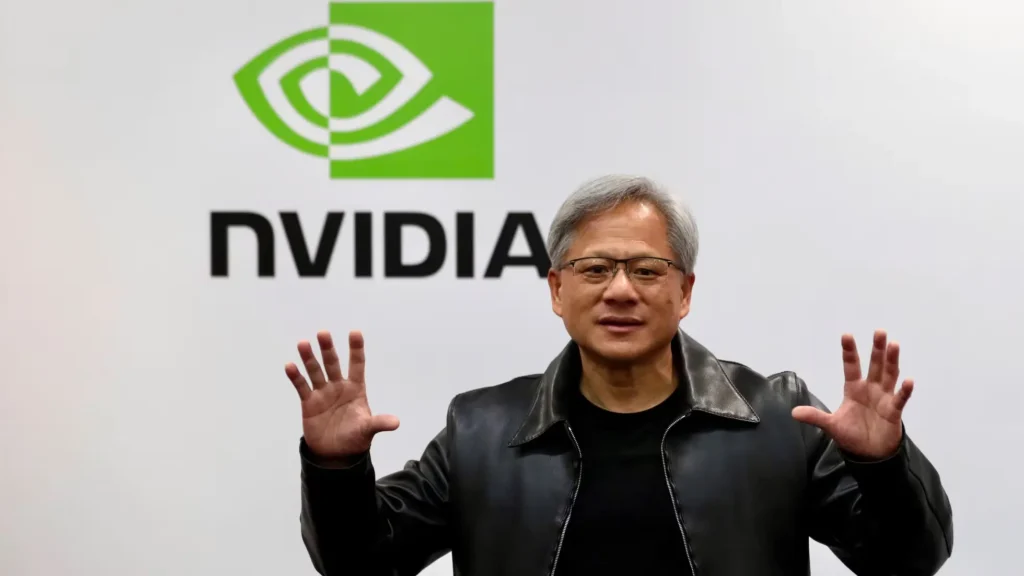
1. The Evolution of a Giant: From 2024 to 2026
To truly understand where NVIDIA stands today in February 2026, we must look in the rearview mirror and observe the vertical incline of its growth curve. In February 2024, the company reported an annual revenue of $60.9 billion, which at the time already felt like the peak of an AI bubble. Fast forward to fiscal year 2025, and that figure surged to $130.5 billion, propelled by the initial production ramp of the Blackwell architecture.
Now, as we close fiscal year 2026, NVIDIA is presenting annual revenue of $215.9 billion, with the Data Center segment now accounting for over 90% of total sales. This evolution is not merely quantitative; it is a structural mutation. NVIDIA has transitioned from being a graphics card manufacturer to becoming the “utility company” of the silicon age. The 82% growth in adjusted earnings per share (EPS) this past quarter is a testament to Jensen Huang’s brutal operational efficiency.
2. The Technological Arsenal: H200, Blackwell, and the CUDA Moat
NVIDIA’s dominance is not built solely on hardware but on the symbiotic integration of silicon and software. The CUDA system remains the “moat” that prevents competitors from gaining a foothold. As an analyst, I view CUDA not just as a programming language, but as a proprietary operating system that holds an intellectual monopoly over accelerated computing.
Regarding hardware, the H200 chip played a vital role in the transition to the Blackwell era. While the market is already focused on the B300 (Blackwell Ultra) and the future Rubin architecture, the H200 was the workhorse that allowed for the inference of Large Language Models (LLMs) with unprecedented efficiency.
- CUDA: The software platform that makes NVIDIA’s GPUs irreplaceable, ensuring that any new AI model is optimized for their hardware first.
- H200: An evolution of the Hopper architecture that brought significant advancements in HBM3e memory, consolidating leadership before the Blackwell “tsunami.”
- Blackwell (B300): The current engine of growth, with systems offering performance gains orders of magnitude above the previous generation.
3. The Chinese Dilemma and Geopolitical Resilience
One of the most sensitive points in my technical analysis concerns China. For years, China was a growth engine, but export restrictions imposed by the U.S. government—and a recent cautious stance from Beijing—have shifted the landscape. In its outlook for the first quarter of fiscal year 2027, NVIDIA was explicit: it assumes zero Data Center compute revenue from China.
The saga of the H200 chip in China is particularly revealing. Despite some initial green lights from the U.S. administration for limited sales to approved customers, the reality on the ground is that shipments remain stagnant. Between third-party verifications and pressure from Beijing for local companies to use domestic chips (such as those from Huawei), NVIDIA is effectively operating with “zero revenue” in its most populous market. This makes the global results even more impressive: the company is breaking records despite losing a major limb of its global market.
4. Valuation and Multiples: The 18 P/E for 2027
Here we enter the territory that divides the optimists from the realists. NVIDIA is currently trading at a forward Price-to-Earnings (P/E) ratio of 18 for the year 2027. For a company growing revenue at over 70% and profits at 80%, this multiple is, frankly, unbelievable. It suggests that the market is pricing in not growth, but the fear of a future abyss.
We are facing a valuation paradox. The “Forward P/E” has dropped as earnings have climbed faster than the stock price. However, this “discount” reflects an existential doubt: how long can Hyperscalers (Microsoft, Google, Meta, Amazon) maintain Capex levels in the hundreds of billions without seeing a proportional return on investment (ROI) in software?
Comparative Table: NVIDIA Financial Evolution (FY2024 – FY2026)
| Metric (in $ Billions) | FY 2024 (Actual) | FY 2025 (Actual) | FY 2026 (Actual) | Q1 FY 2027 (Outlook) |
| Total Revenue | 60.9 | 130.5 | 215.9 | ~78.0 |
| Data Center Revenue | 47.5 | 108.3 | 193.7 | >70.0 (Est.) |
| Net Income (GAAP) | 29.8 | 61.5 | 120.0 | N/A |
| Gross Margin (Non-GAAP) | 73.8% | 76.0% | 75.2% | ~75.0% |
5. The Software Cyclicality Problem and the 2028 “Cliff”
My personal thesis, and the reason why—despite these numbers—I do not hold NVIDIA in my portfolio, rests on the concept of software cyclicality. There is a dangerous lag between infrastructure (what NVIDIA sells) and the final application (what software companies sell).
Currently, we are witnessing an arms race. Companies are buying H200s and Blackwells not necessarily because they are already profiting from them, but because they cannot afford to fall behind. However, software has slower adoption cycles. If software companies fail to monetize AI on a massive scale within the next 18 to 24 months, there will be a brutal correction in Capex. NVIDIA, being a semiconductor business, is inherently cyclical. When the massive installation phase ends and we move into a maintenance or optimization phase, demand for new chips could drop drastically.
This “fear of cyclicality” is what keeps the P/E at such low levels. The market is anticipating that somewhere in 2028 or 2029, NVIDIA could face a real decline in sales. I prefer to observe this transition from “pick-and-shovel seller” to “profit sustainability” from the sidelines.
6. Other Risks on the Horizon
Beyond cyclicality and China, NVIDIA faces the threat of proprietary ASICs. Customers like Google (with its TPUs) and Amazon are developing their own chips to reduce their dependence on Jensen Huang. While CUDA still protects NVIDIA, pricing pressure and the diversification efforts of Hyperscalers are latent risks that cannot be ignored in a serious fundamental analysis.
FAQ: Frequently Asked Questions about NVIDIA in 2026
What was NVIDIA’s net income in the final quarter of 2026?
NVIDIA reported a record net income of $43 billion in the fourth quarter of fiscal year 2026, with an adjusted gross margin of 75.2%.
Why isn’t NVIDIA selling H200 chips to China?
Despite theoretical U.S. authorization, shipments of the H200 to China are stalled due to rigorous verification protocols and Beijing’s reluctance to allow the entry of advanced American technology that could stifle the domestic semiconductor industry.
Is NVIDIA considered “cheap” with a P/E of 18?
Technically, yes. For a company with this growth profile, a forward P/E of 18 for 2027 is very low. However, this multiple reflects the risk that AI demand may hit a cyclical peak and that software monetization may not keep pace with hardware investment.
Conclusion: An Engineering Masterpiece, but a Portfolio Risk
In summary, NVIDIA is, without a shadow of a doubt, the best-managed and best-positioned company of our time. The Q4 FY26 numbers are a masterpiece of financial execution. However, as an investor focused on capital preservation and long-term cycles, the cyclicality of software and the extreme dependence on a handful of Capex-heavy customers make me uncomfortable.
I believe NVIDIA will continue to dominate the AI infrastructure market, but the volatility that will come when the investment cycle normalizes will be merciless. For now, I prefer to admire Jensen Huang’s genius from a distance, keeping my liquidity ready for sectors with lower risks of technological saturation. NVIDIA may look “cheap” based on today’s numbers, but the financial market rarely pays for the past; it pays for what lies beyond the peak of the mountain.
For more in-depth analysis on the tech sector, visit the official NVIDIA Investor Relations portal.
Related posts:
 The Greenland Crisis: How Trump’s New Tariffs Could Wreck Your Tech Portfolio Today
 The Civil War at the Federal Reserve: Is Jerome Powell’s Resistance the Last Stand for Economic Stability?
 Trade War 2.0 Greenland: How to Shield Your Portfolio Against New NATO Tariffs and Arctic Volatility
 2026 AI IPOs: The Triumph of FOMO or the Next Dot-Com Burst?