
As of February 2026, Netflix (NFLX) represents a compelling value play following a 40% technical correction, with the weekly RSI dipping below 30. Trading at a 21x P/E, with projected 21% annual growth and a 26% ROIC, the company is solidifying its dominance via the Warner Bros. acquisition and its scaling ad-tier, which generated $1.5B+ in 2025. Management guides for 31.5% operating margins in 2026.
1. The Giant’s Renaissance: From DVD Disruptor to Global Hegemon
I decided the time was ripe to go long on Netflix after witnessing the maturation of a business model that many skeptics dismissed as “tapped out” just a few years ago. If we look back, Netflix’s trajectory is a masterclass in creative destruction. What began in 1997 as a mail-order DVD service—a direct challenge to Blockbuster’s brick-and-mortar reign—transformed into the engine that defined 21st-century cultural consumption. The 2007 pivot to streaming wasn’t merely a change in medium; it was a shift in the very paradigm of access over ownership. Analyzing the annual reports from 2021 through 2025, I see a company that has evolved from a high-burn “tech startup” into a highly disciplined cash-flow machine.
Netflix’s evolution has allowed it to build a formidable moat based on scale and proprietary data. Unlike legacy studios hamstrung by theatrical windows and fragmented licensing, Netflix verticalized its production, creating a closed-loop ecosystem where real-time user feedback dictates capital allocation. Today, with over 325 million paid members (a milestone hit in Q4 2025), the company’s scale allows it to amortize content costs in a way that competitors like Disney+ or Prime Video simply cannot replicate with the same operating efficiency. This sheer scale gives me the conviction to maintain a heavy position, especially when the broader market ignores the fundamentals in favor of short-term volatility.
The 2026 Revenue Mix: Beyond the Subscription Box
Historically, Netflix’s model was linear: more subs equaled more revenue. However, the latest Form 10-K and the January 2026 shareholder letter reveal a sophisticated strategic diversification. Currently, the revenue breakdown is as follows:
- Paid Subscriptions (Direct-to-Consumer): Accounting for approximately 96.7% of total revenue.
- Advertising (Ad-Tier): While only 3.3% of total revenue (surpassing $1.5 billion in 2025), this segment grew by over 2.5x in the last year alone.
- Auxiliary Revenue: Occasional licensing and the burgeoning gaming/podcast division account for the remainder.
My personal take is that the Street is drastically underestimating ad-tier monetization. According to the 2025 earnings report, the company expects ad revenue to double in 2026. We are witnessing a transformation where Netflix stops competing solely for “household entertainment budgets” and starts capturing “global marketing budgets” previously locked into linear TV.
2. Financial Engineering: Margins, Profits, and the Buyback Engine
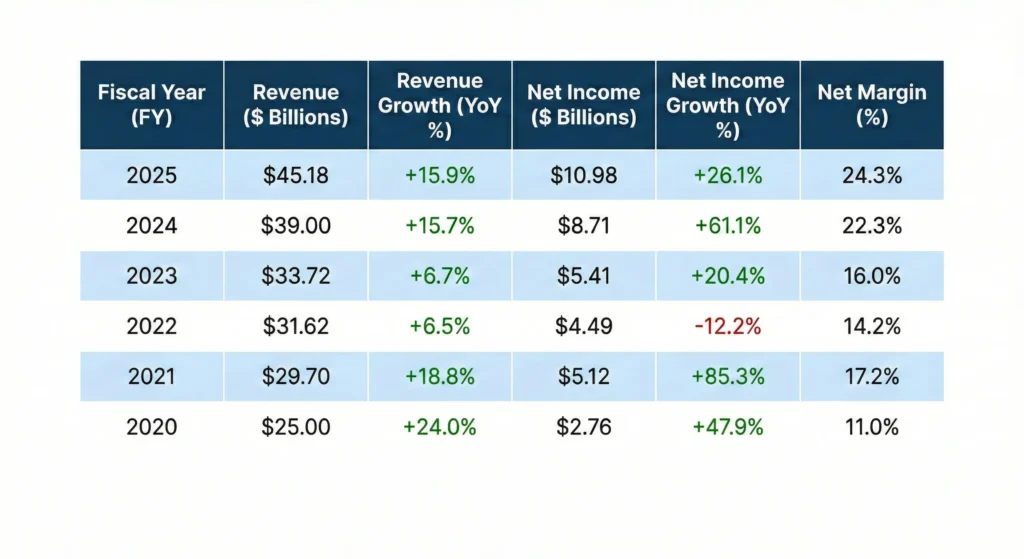
When digging into the raw financial data, the margin expansion is nothing short of breathtaking. In 2021, operating margins hovered around 21%. Fast forward to the close of 2025, and the company delivered a 29.5% operating margin, with a clear roadmap to hitting 31.5% in 2026. This isn’t luck; it’s the result of massive operating leverage—diluting fixed costs over a growing user base while exercising surgical precision in content spending.
| Financial Metric (FY 2025) | Reported Value | YoY Growth | 2026 Forecast |
| Total Revenue | $45.183 B | +16% | $51.200 B (avg) |
| Operating Income | $13.326 B | +30% | $16.100 B |
| Operating Margin | 29.5% | +300 bps | 31.5% |
| EPS (Earnings Per Share) | $2.53 | – | $3.11 (est.) |
| Ad Revenue | >$1.5 B | +150% | $3.0 B |
Source: Netflix Q4 2025 Shareholder Letter and Market Data.
Share buybacks have been the third pillar of my investment thesis. As detailed in the 2024 and 2025 filings, Netflix has utilized its robust free cash flow to aggressively reduce the share float. In a phase where the company no longer needs to burn cash to fuel growth, this capital return policy is a hallmark of financial maturity. It’s this discipline that separates tech companies that merely “survive” from those that “dominate.”
3. The 2026 Catalyst: The Warner Bros. (WB) Acquisition
The most debated point of my thesis, officially addressed in the January 20, 2026, Earnings Call, is the closing process of the Warner Bros. (WB) acquisition. In my view, this is a historic inflection point. Netflix isn’t just buying a studio; it’s acquiring a century-old library—including the DC Universe and Harry Potter—and an unparalleled physical production infrastructure.
How the WB Acquisition Accretes Value:
- Vertical Integration: By bringing production in-house that was previously licensed, Netflix optimizes its long-term margins.
- Churn Reduction: Retention rates skyrocket when users have access to evergreen, “appointment-viewing” franchises with global appeal.
- Ad-Tier Acceleration: High-quality WB premium content creates the most coveted inventory for advertisers seeking “brand-safe” environments.
Naturally, risks exist. Integrating a legacy corporate culture like WB into a nimble tech giant like Netflix could cause operational friction and a temporary spike in debt. However, given Netflix’s sustained 26% ROIC (Return on Invested Capital), I believe the management team, led by Ted Sarandos and Greg Peters, has proven they can allocate capital far more effectively than their peers.
4. Valuation and Fundamentals: The Price of Excellence
Many investors shy away from Netflix, claiming the stock is “always too expensive.” The current numbers tell a different story. Today, Netflix trades at a P/E (Price-to-Earnings) ratio of 21x. For a company projected to grow earnings at an average of 21% annually over the next three to five years, we are looking at a PEG Ratio (Price/Earnings to Growth) of approximately 1. In classic fundamental analysis, a PEG of 1 for a market leader of this caliber is a “screaming buy.”
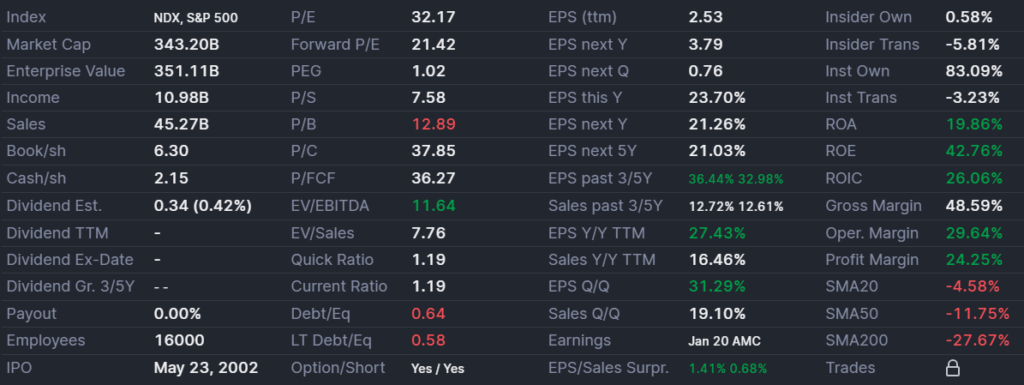
Furthermore, the 26% ROIC is a badge of authority. It indicates that for every dollar the company reinvests, it generates an extraordinary return, well above its cost of capital. To explore my full investment strategy and current portfolio holdings, visit: https://workmarketsfinance.com/portfolio-january-2026/. For official filings and compliance data, investors should consult the SEC EDGAR database.
5. Technical Analysis: The Signal I Was Waiting For
While fundamentals tell me what to buy, technical analysis tells me when. Netflix was indeed in overbought territory following the 2024 rally. However, the market handed us a gift: a 40% drawdown from all-time highs. This correction, often driven by macro fears or institutional rotation, pushed the price into a crucial technical support zone.
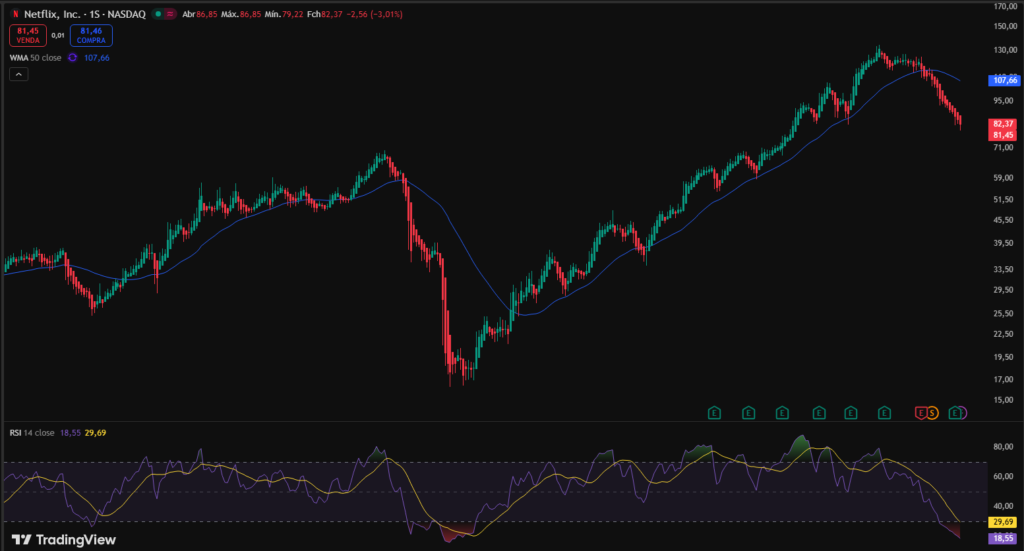
My primary entry trigger was the weekly RSI (Relative Strength Index) dipping below 30. Historically, for “Blue Chip” growth companies with rock-solid fundamentals, a weekly RSI at this level indicates extreme seller exhaustion and a generational buying opportunity. When a company growing at 20%+ per year, with expanding margins and aggressive buybacks, sees its stock price slashed by 40%, my instinct—backed by data—is to accumulate slowly and systematically. I’m not trying to time the “perfect” bottom; I’m building a position where the risk/reward profile is overwhelmingly skewed in my favor.
FAQ: Investing in Netflix in 2026
Is Netflix still considered a growth stock?
Yes. While mature, the expansion into advertising, live events, and the WB acquisition provides a runway for double-digit revenue growth and 20%+ earnings growth.
What is the biggest risk to this thesis?
The main risk is the execution of the WB integration and potential regulatory hurdles regarding market dominance, alongside the constant battle for “share of ear and eye.”
Why buy now instead of waiting for a further drop?
With a 21x P/E and a weekly RSI under 30, much of the “bad news” is already priced in. Waiting for the “perfect bottom” often leads to missing the initial recovery, which tends to be the most aggressive.
Conclusion: An Opportunity Hidden in Fear
In summary, my decision to invest in Netflix in this 2026 climate is based on a rare convergence of factors. We have a sector leader successfully pivoting to a hybrid revenue model (subs + ads) that is about to become an even larger content empire through the WB acquisition.
My stance is clear: the 40% drop is a market anomaly that ignores the company’s operational reality. With operating margins heading toward 31.5% and a 26% ROIC, Netflix isn’t just a streaming platform; it’s the new global utility for entertainment, but with the scalability of a software firm. I am buying, I am accumulating, and I intend to hold as long as the 21% annual growth fundamentals remain intact. The stock market is the only place where customers run away when high-quality goods go on sale. I prefer to do the opposite.
Disclaimer: This article represents my personal opinion and technical/fundamental analysis. It does not constitute direct financial advice. Investing involves risk of capital loss. Always perform your own due diligence before making any investment decisions.
Would you like me to compare Netflix against its peers in the “Streaming Wars” of 2026, or would you prefer a deep dive into an options strategy to hedge this specific entry?
Related posts:
 Constellation Software (CSU): Why I Am Aggressively Doubling Down on This Generational Opportunity Amidst Extreme Market Fear
 Ferrari Stock: Why I’m Buying Ultra-Luxury at a 40% Discount?
 Skin in the Game: Portfolio January 2026 – Why I Doubled Down on Constellation Software (CSU)
 TLT Opportunity 2026: Why I’m Betting Big on US Treasuries and the Dollar