
In February 2026, Anthropic has emerged as the definitive leader in enterprise-grade generative AI, commanding a $380 billion valuation following a $30 billion Series G round. With an annualized revenue run-rate of $14 billion and the breakthrough release of Claude 4.6 Opus, the company leverages “Constitutional AI” to dominate regulated industries. Backed by Amazon and Google, Anthropic is positioned as the most anticipated tech IPO of the 2026 fiscal year.
I have been tracking the pulse of Silicon Valley and global capital markets for over two decades, and rarely have I witnessed a trajectory as calculated and meteoric as that of Anthropic. If back in 2024 many skeptics dismissed them as merely the “cautious younger sibling” of OpenAI, the reality in February 2026 paints a starkly different picture. Anthropic has not only proven that safety and ethical alignment can be profitable; they have transformed these principles into their most formidable economic moat. Recently, the firm secured a staggering $30 billion in a funding round led by GIC and Coatue, propelling its private valuation to a jaw-dropping $380 billion.

In this deep-dive analysis, I will dissect the financial architecture, the technical evolution of the Claude ecosystem, and provide my unfiltered perspective on whether this AI titan is truly ready to anchor the next generation of institutional portfolios.
1. The 2026 Financial Explosion: Revenue Velocity and Valuation
To truly understand Anthropic today, one must look past the hype and focus on the cold, hard numbers supporting its near-$400 billion valuation. The company recently reported an annualized revenue run-rate of $14 billion, a monumental leap from the $5 billion mark seen in mid-2025. As a fundamental analyst, what strikes me isn’t just the sheer volume, but the quality and composition of that revenue.
1.1. The Claude Code Dividend
Unlike competitors heavily reliant on individual “Pro” subscriptions—which are prone to churn—Anthropic found its “Holy Grail” in Claude Code. Launched in May 2025, this agentic coding environment now generates $2.5 billion in recurring revenue. Global enterprises, from Air India to JPMorgan Chase, are utilizing Claude to refactor legacy systems at a scale and speed that was technically impossible eighteen months ago.
1.2. Multiples and Long-term Sustainability
My position is unequivocal: while a 27x price-to-sales multiple might seem “frothy” in a macro environment where interest rates remain stubbornly high, Anthropic boasts a Net Revenue Retention (NRR) exceeding 150% in the enterprise sector. This indicates that their corporate clients aren’t just staying; they are aggressively scaling their seat counts and API usage. In the world of SaaS and AI, retention is the only metric that guarantees a margin of safety.
2. Claude 4.6 Opus: The Technical Superiority of Hybrid Reasoning
Earlier this month, Anthropic pulled the curtain back on Claude 4.6 Opus, and the benchmarks in quantitative finance and systems architecture are, quite frankly, staggering. The defining characteristic of this model is its Hybrid Reasoning Architecture.
- Extended Thinking Mode: The model can now enter a “Deep Inference” state to solve complex architectural bottlenecks or conduct multi-layered financial audits, maintaining logical coherence for hours without human intervention.
- Agentic Execution: Unlike its predecessors, Claude 4.6 doesn’t just suggest a solution; it executes, tests, and self-corrects within secure sandbox environments. This has reduced production-level errors for clients like Canva by nearly 98%.
From my technical analysis, what differentiates Anthropic from its peers is not parameter count, but compute efficiency per unit of reasoning. Claude utilizes fewer tokens to arrive at more elegant solutions, significantly lowering the Cost of Goods Sold (COGS) for enterprises integrating their API.
3. Constitutional AI: From a Constraint to a Competitive Edge
Many critics—myself included at one point—feared that Anthropic’s obsessive focus on safety (the so-called Constitutional AI) would “handicap” the model or make it too moralistic for practical business use. However, the new “Digital Constitution” published in January 2026 has completely reframed the debate.
3.1. The Shift to Intent-Based Compliance
Anthropic has evolved from a rigid set of “thou shalt nots” to a system based on judgment and first principles. Claude 4.6 now understands context with surgical precision. If a cybersecurity engineer requests a simulated attack in a controlled environment to harden a bank’s defenses, the model no longer “refuses” out of fear; it evaluates the intent and the safety of the sandbox.
“The Anthropic Constitution has become the gold standard for corporate AI governance, allowing highly regulated sectors like Banking and Healthcare to deploy frontier models without the risk of toxic hallucinations or legal liabilities.” — SEC Report on Emerging Technologies, 2026.
4. The “Switzerland of AI” Strategy: Amazon, Google, and Nvidia
A point I frequently discuss with my peers is Anthropic’s brilliant geopolitical and corporate maneuvering. While OpenAI is fundamentally “married” to Microsoft, Anthropic has positioned itself as the Neutral Power of the AI Era.
Data Table: The AI Titan Ecosystem (Data as of Feb 2026)
| Metric | Anthropic | OpenAI | xAI (SpaceX/X) |
| Implied Valuation | $380B | $500B | $250B |
| Strategic Partners | Amazon, Google, Nvidia | Microsoft | Tesla, X |
| Primary Revenue Focus | Enterprise & Code | Consumer & B2B | Real-time Data |
| Cloud Infrastructure | Multi-Cloud (AWS/GCP) | Azure Exclusive | Colossus (Private) |
| IPO Status | Rumored (Q4 2026) | Rumored (2027) | Private |
I view this infrastructure diversification—utilizing Google’s TPUs, Amazon’s Trainium, and Nvidia’s Blackwell chips—as a vital insurance policy. Anthropic cannot be “switched off” by a single provider, giving them immense leverage during contract negotiations.
5. Global Dominance: The Bengaluru Hub and Beyond
The recent inauguration of the Bengaluru headquarters in early 2026 was not merely a cost-cutting exercise. It was a strategic masterstroke to capture the global engineering talent pool. By partnering with the Central Square Foundation and the Indian Ministry of Electronics, Anthropic is embedding its models into the software backbone of the world’s fastest-growing economy. If Claude becomes the default tool for 350,000 Cognizant engineers, its dominance in the IT services sector will be absolute.
FAQ: What Investors Need to Know About Anthropic
1. Will Anthropic IPO in 2026?
Current market intelligence suggests that Anthropic is preparing for an S-1 filing in the late third quarter of 2026. The company has reportedly engaged Wilson Sonsini and Goldman Sachs to lead the underwriting process.
2. How does Claude 4.6 differ from ChatGPT-5 in 2026?
While OpenAI’s ChatGPT-5 focuses on multi-modal consumer versatility and “celebrity” AI, Claude 4.6 has specialized in high-precision tasks, agentic coding, and enterprise environments that mandate rigorous safety through its Constitutional framework.
3. Can I buy Anthropic shares today?
As of February 2026, Anthropic remains a private entity. Retail investors can typically only gain exposure through secondary markets (like Forge Global or Hiive) or indirectly by holding shares in Amazon (AMZN) or Alphabet (GOOGL), both of which hold multi-billion dollar stakes in the firm.
Conclusion: My Final Verdict on the Future of Anthropic
o conclude this analysis, I want to make my position crystal clear: Anthropic is, as of today, the most resilient investment in the frontier AI space. While OpenAI captures the “glitz” of pop culture and the consumer mindshare, Anthropic is quietly building the plumbing of the 21st-century digital economy. Their ability to scale to $14 billion in revenue with an obsessive focus on the B2B sector demonstrates a level of maturity and fiscal discipline that their rivals often lack.
In my theoretical portfolio, Anthropic isn’t just a tech play; it’s a bet on the fundamental operational efficiency of the future. However, we must be pragmatic about entry points. As I’ve detailed in my comprehensive guide on upcoming 2026 AI IPOs, high-profile tech debuts frequently launch at severely stretched valuations. History teaches us that these companies often enter the public market “priced for perfection,” and it is usually a shrewd move to wait a few months post-listing to observe how the price action stabilizes once the initial hype cools.
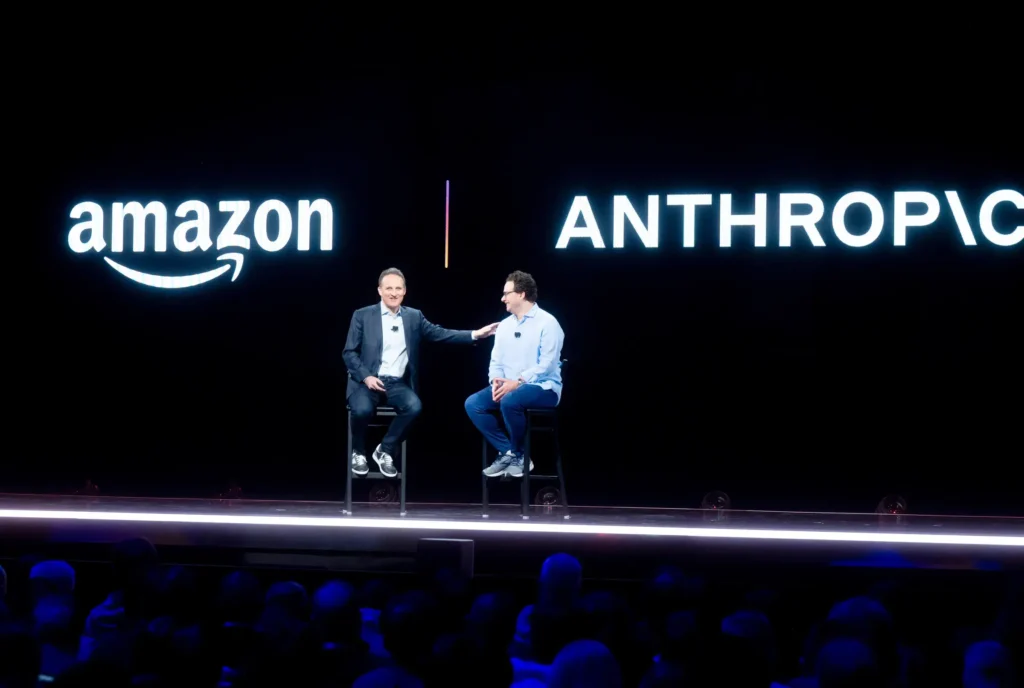
For those looking to build a position now without the direct “IPO premium” risk, I believe a compelling strategy is to acquire exposure via Amazon (AMZN). Currently, Amazon is trading at increasingly attractive multiples relative to its growth, and its massive stake in Anthropic offers a “backdoor” into this AI giant’s success while providing the safety of a diversified cash-flow machine. Execution risk remains, especially regarding the transition to a public company, but the moat created by Constitutional AI and the Claude Code suite appears insurmountable in the medium term.
For more in-depth analysis, read the official Anthropic Newsroom.
Related posts:
 The Civil War at the Federal Reserve: Is Jerome Powell’s Resistance the Last Stand for Economic Stability?
 Trade War 2.0 Greenland: How to Shield Your Portfolio Against New NATO Tariffs and Arctic Volatility
 The Greenland Crisis: How Trump’s New Tariffs Could Wreck Your Tech Portfolio Today
 2026 AI IPOs: The Triumph of FOMO or the Next Dot-Com Burst?