
Investing for children in 2026 requires a strategic shift from static savings to real-asset allocation. With global inflation stabilizing but fiat debasement remaining a risk, the optimal portfolio leverages Low-Cost Index ETFs (80-90%), Bitcoin (5%), and Physical Gold (5%). Utilizing a Strategic RSI-based DCA (Dollar Cost Averaging) approach allows parents to capitalize on market volatility. Historical data suggests that an 18-year horizon with an 8% annualized return can transform modest monthly contributions into a six-figure legacy.
As a senior financial analyst and investor, I often see parents paralyzed by the “paradox of choice” when it comes to their children’s future. In this February 2026 landscape, where the Federal Reserve has navigated a complex “soft landing” and interest rates sit at a structural 3.25%, the cost of inaction has never been higher. Investing for your children is no longer a luxury; it is a mathematical necessity to protect their future purchasing power from the silent erosion of currency devaluation.

In this deep-dive analysis, I will share my personal conviction on why a traditional savings account is a “wealth trap” and how you can build a robust, institutional-grade portfolio for your kids. We aren’t just looking for “pocket money”; we are building a Generational Wealth Engine that leverages the two most powerful forces in finance: time and compound interest.
1. Defining the Horizon: Why 20 Years Changes Everything
Before we discuss tickers or technical indicators, I must insist on a fundamental truth: your child’s greatest asset is not your current capital—it is their time horizon. When you invest for a newborn, you have a 18-to-25-year window. This is a superpower that most institutional hedge funds envy.
In my view, a long-term horizon allows us to ignore the daily “noise” of Wall Street. Whether we face a geopolitical crisis in Eastern Europe or a tech bubble burst, a 20-year window historically absorbs these shocks. According to S&P Global data, the probability of a negative return over a 20-year holding period in the S&P 500 is statistically near zero. Therefore, our stance must be aggressively long-term, focused on equity-heavy allocations rather than the “safety” of bonds that barely beat inflation.
2. Structural Choices: Custodial Accounts vs. Flexible Portfolios
One of the most common questions I receive is: “Should the account be in my name or theirs?” For US-based or international investors, the legal structure dictates your tax efficiency and level of control.
- 529 Plans (Education Specific): These are fantastic if your sole goal is college. They offer tax-free growth and withdrawals for educational expenses. However, I find them somewhat restrictive if your child decides to become an entrepreneur or a digital nomad instead of attending a traditional university.
- UTMA/UGMA (Custodial Accounts): The assets belong to the minor. This is a double-edged sword. It offers great discipline, but at age 18 or 21 (depending on the state), the “kid” gets full control. If they aren’t financially literate by then, this could be a risk.
- The “Parental Control” Brokerage Account: This is my personal preference for maximum flexibility. By keeping the investments in a dedicated sub-account in your name, you maintain 100% control. You decide when they are “ready”—be it at 18, 25, or 30.
3. The Core Portfolio: The 80/10/5/5 Allocation Strategy
I am a firm believer in the 80/10/5/5 Model for 2026. This isn’t your grandfather’s 60/40 portfolio. In a world of digital scarcity and AI-driven productivity, we need a mix of “Old World” stability and “New World” asymmetry.
Comparative Asset Allocation for 2026
| Asset Class | Recommended Ticker (US/Intl) | Target Weight | Role in Portfolio |
| Broad Market Equity | VOO / VT / VUAA | 80% | The primary growth engine. |
| Global Diversification | VXUS / EMIM | 10% | Hedge against US-centric risks. |
| Digital Scarcity (BTC) | IBIT / FBTC | 5% | Asymmetric upside & “Digital Gold”. |
| Hard Assets (Gold) | GLD / IAU | 5% | The ultimate hedge against systemic collapse. |
Why Focus on Low-Cost ETFs?
If you don’t have deep knowledge of individual stock picking—which requires analyzing 10-K filings and discounted cash flow models—stay away from individual stocks. Instead, buy the entire market. For the US market, I recommend VOO (Vanguard S&P 500) due to its ultra-low expense ratio of 0.03%. For those wanting total world exposure, VT (Vanguard Total World Stock) is the “set it and forget it” king.
4. The “Secret” RSI Strategy: How to Maximize Returns
Most advisors tell you to simply “Dollar Cost Average” (DCA). While DCA is great for discipline, I use a more sophisticated approach that I call Strategic Momentum Accumulation. This is the strategy I mentioned in my recent analysis [Link to YouTube Video], and it can significantly boost your “Yield on Cost.”
Instead of just buying on the 1st of every month, I look at the Weekly RSI (Relative Strength Index) of the S&P 500.
- The Base Phase: Invest 50% of your monthly allocation regardless of price. This ensures you are always “in the game.”
- The Accumulation Phase: Keep the other 50% in a high-yield cash account (currently yielding around 4% in 2026).
- The Strike: When the Weekly RSI drops below 50, deploy half of your cash reserves. If the Weekly RSI drops below 30 (rare, but happens during crashes), deploy all remaining cash.
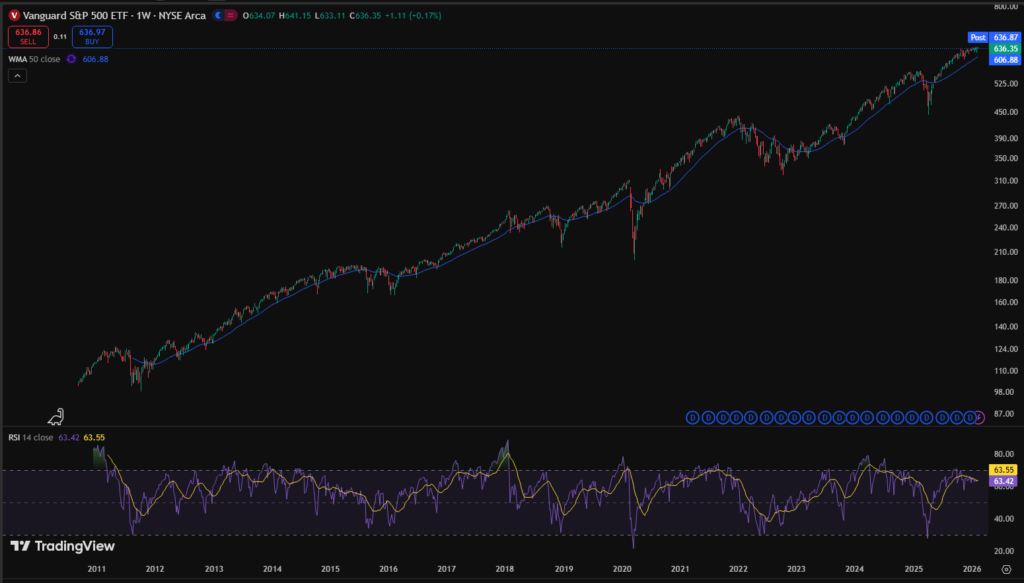
Why do this? Because you are effectively buying more shares when the market is “on sale.” Over 20 years, this slight tactical adjustment can add an extra 1-2% to your annualized return, which, thanks to compounding, can result in tens of thousands of dollars in extra wealth.
5. The Mathematics of Wealth: Compound Interest in Action
Let’s look at the cold, hard numbers. Many parents underestimate what small, consistent contributions can achieve. If you start at birth:
- $100/month at an 8% average annual return results in approximately $45,000 by age 18.
- $500/month under the same conditions results in a staggering $225,000.
I encourage you to use the Compound Interest Calculator on my site to run your own scenarios. Pay close attention to the “hockey stick” curve—the wealth creation in years 15 through 20 is often greater than the first 15 years combined. This is why you must never stop the contributions during a bear market.
6. The Risk Transition: The “Glide Path”
As your child approaches the “utilization phase” (e.g., age 17), you must protect the principal. I advocate for a Gradual De-risking Strategy:
- Ages 0-13: 100% Equities/Aggressive (ETFs + Crypto).
- Ages 14-16: 70% Equities / 30% Fixed Income (Treasuries/Bonds).
- Ages 17-18: 50% Equities / 50% Cash/Short-term T-Bills.
This prevents a sudden 20% market correction in senior year from ruining their college fund.
7. Financial Literacy: The Real Inheritance
I firmly believe that giving a child money without financial education is like giving a fast car to someone who hasn’t learned to drive. Talk about money at the dinner table. * The “Ownership” Concept: Tell them they own a piece of Apple or Disney. When they buy an iPhone, explain that a tiny fraction of that profit goes back to their account.
- The Inflation Lesson: Show them how a $1.00 chocolate bar in 2026 might cost $1.50 in ten years. This teaches them why we must invest in assets that grow faster than the cost of living.
- The Loss of Value: Explain that money in a piggy bank is “dying” slowly. At a 2.5% inflation rate, $10,000 today will only buy $6,000 worth of goods in 20 years. Investing is not about getting rich; it’s about not becoming poor.
FAQ – Frequently Asked Questions
What is the best ETF for my child in 2026?
For most parents, VOO (Vanguard S&P 500) or VTI (Total Stock Market) are the gold standards. They offer exposure to the world’s most profitable companies with almost zero management fees.
Is Bitcoin too risky for a child’s portfolio?
In a 20-year window, the risk of having 0% exposure to the most successful digital asset in history is, in my opinion, higher than the risk of its volatility. Limit it to 5% to capture the upside without risking the entire portfolio.
Can I start with only $50 a month?
Absolutely. Modern brokerages allow for fractional shares. The key is the habit of investing. Starting with $50 at birth is better than starting with $500 when the child is 15.
Conclusion: My Senior Analyst’s Perspective
We are navigating a pivotal shift in financial history; the era of ‘easy money’ is dead, and the era of Strategic Asset Allocation is the new king. My stance is absolute: Investing for children is the most significant gift a parent can provide—a growing legacy far superior to toys or gadgets that lose their value the moment they are unboxed.
By combining a core of US and Global ETFs with a tactical “pinnacle” of Bitcoin and Gold, and using a Technical RSI-DCA strategy, you aren’t just saving; you are engineering a future of freedom. Go to my Compound Interest Calculator, set your goal, and start today. The clock is ticking, and in the world of finance, time waits for no one.
Disclaimer: This article is for informational purposes only and does not constitute personalized financial advice. Always consult with a tax professional regarding custodial accounts.
Related posts:
 Dollar Cost Averaging: The Secret to Financial Freedom
 How Ronald Read and Strategic Stock Picking Can Unlock Your Financial Freedom
 Pension Crisis: Why AI Won’t Save Your Retirement and Why Equity is Your Only Lifeboat
 Trump Accounts: The Ultimate Guide to America’s New Child Savings Program and the Power of Compound Interest