
As of March 2026, the U.S. Dollar (DXY) continues its dominant bullish trajectory, validating long-term technical channel projections and the “magazine cover indicator.” Despite contrarian fears in February, the dollar rebounded from critical 97.000 support levels, fueled by widening yield differentials and the accelerating tokenization of the USD. I maintain high-conviction short positions on EUR, GBP, and AUD, as global liquidity continues to seek the safety and utility of the world’s reserve currency.
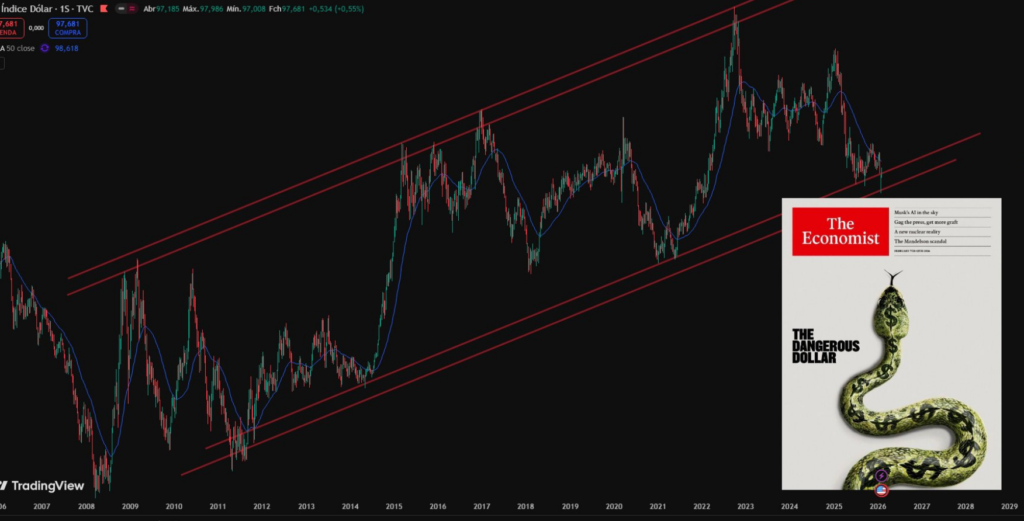
On February 8th, I shared a post on X featuring a cover that many retail traders interpreted as a warning of an impending top, but which I viewed as the ultimate confirmation signal: The Economist’s iconic headline, “The Dangerous Dollar.” At that time, the U.S. Dollar Index (DXY) was wrestling with psychological support levels, and the mainstream narrative was heavily leaning toward a “de-dollarization” climax. However, if you have followed my analysis for any length of time, you know that I treat these high-profile covers as powerful contrarian indicators. Today, on March 25, 2026, the tape confirms my thesis. The dollar has not only recovered; it has demonstrated a technical and fundamental resilience that justifies my continued aggressive short positions on EUR/USD, GBP/USD, and AUD/USD.
1. The Anatomy of a Macro Forecast: What the Charts Reveal Today
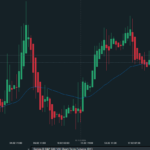
When we look at the two images I’ve provided—the first from my February post and the second reflecting today’s price action—the market’s geometry is undeniable. The U.S. Dollar Index (DXY) has been operating within a near-perfect ascending channel that spans over a decade. In February, when volatility threatened to break the structure to the downside, price action met a massive wall of institutional demand near the 97.000 mark.
I was watching the 160-week Weighted Moving Average (WMA) with hawk-like precision. As you can see in the updated chart, this moving average acted as a formidable dynamic support floor. The fact that the price rejected those lows and is now trading comfortably above 99.637, eyeing the 100-point psychological barrier, proves that “Smart Money” is using every dip to accumulate. This U.S. Dollar trend isn’t a fluke; it is the mathematical result of a widening macro divergence between the Federal Reserve (Fed) and its global peers.
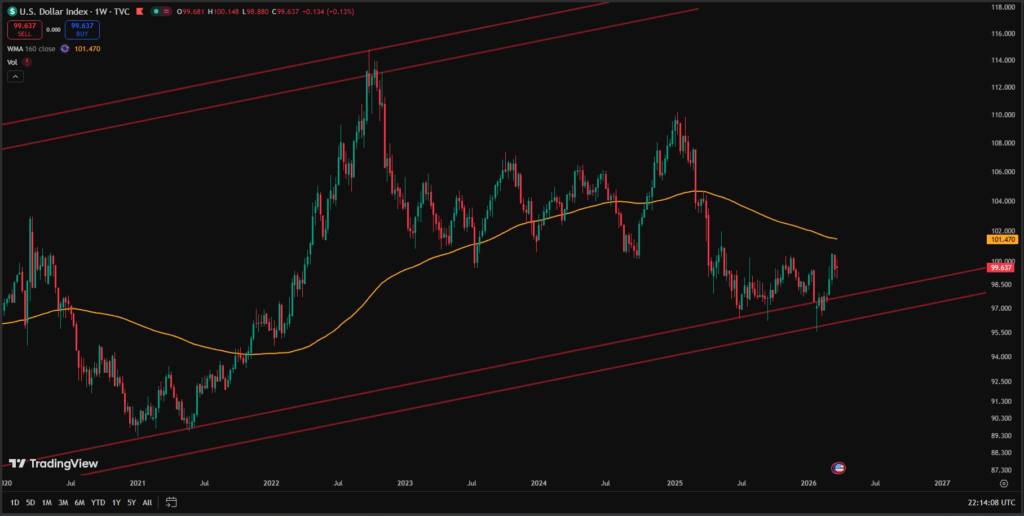
The technical setup suggests that we are not just in a recovery, but in a consolidation phase before a massive breakout. When the DXY spends this much time building a base above a decade-long trendline, the eventual move upward tends to be violent and sustained.
2. The Fundamental Collapse: Why the Euro, Sterling, and Aussie are Fated to Fail
Many of you have asked why I remain so steadfast in my “Short the World” strategy. My conviction isn’t just based on lines on a screen; it’s rooted in the harsh reality of economic stagnation and geopolitical energy dynamics currently strangling the G10 currencies.
2.1. The European Central Bank’s Liquidity Trap (EUR)
The Eurozone is currently caught in a structural vice. While the American economy shows a terrifying level of resilience in the tech and services sectors, Europe remains bogged down by structurally high energy costs and a demographic profile that acts as a lead weight on GDP growth. In my view, the EUR/USD pair is destined to revisit—and likely break—parity. My short exposure here remains the cornerstone of my public portfolio as of February 2026, and I have zero intention of trimming this position.
2.2. British Pound (GBP) and the “Stagflation” Ghost
In the UK, the narrative has shifted from recovery to survival. The Bank of England (BoE) is paralyzed; they cannot hike rates further without imploding a fragile housing market, yet they cannot cut without letting inflation run rampant. This creates a “no-man’s land” for the Sterling. Technically, GBP/USD failed to break through key resistance levels in early Q1, and the sheer strength of the greenback is now crushing British purchasing power.
2.3. The AUD and the China Proxy War
The Australian Dollar is my favorite “risk-proxy.” With the Chinese economy undergoing a painful deleveraging of its property sector and domestic demand remaining anemic, Australia’s commodity exports are under immense pressure. As long as global sentiment favors “safe-haven” assets, the AUD/USD remains a textbook “sell the rips” candidate.
| Asset | Current Position | Core Thesis | Technical Target (2026) |
| DXY (Dollar Index) | Long | Tokenization & Yield Dominance | 104.500 |
| EUR/USD | Short | EU Industrial Decline | 0.9850 |
| GBP/USD | Short | UK Stagflation Trap | 1.1800 |
| AUD/USD | Short | China Slowdown Proxy | 0.6200 |
3. The Digital Anchor: Tokenization of the Dollar in the U.S.
There is a silent revolution happening that mainstream analysts are completely ignoring, but which I analyzed deeply in my recent piece on the tokenization of the dollar in the U.S..
The migration of the U.S. Dollar onto regulated blockchain rails is not weakening the currency; it is cementing its global dominance for the next century. By allowing global financial institutions to settle transactions in dollars instantly, 24/7, the U.S. is ensuring that the dollar remains the “native language” of both decentralized (DeFi) and institutional finance.
I firmly believe that the demand for “On-chain Dollars” is creating a positive supply shock for the underlying asset. As every major Wall Street bank launches its own USD-backed stablecoin or tokenized deposit, the velocity and utility of the dollar increase exponentially. This innovation acts as a liquidity anchor, making any attempt at “de-dollarization” by the BRICS nations seem like a fool’s errand. The world doesn’t want to get away from the dollar; it wants a faster, more efficient version of it—and the U.S. is delivering exactly that.
4. Misreading “The Dangerous Dollar”: A Lesson in Sentiment
When a prestigious publication like The Economist puts the dollar on its cover, portraying it as a venomous snake, they are reflecting the pain that a rising dollar causes to emerging markets and U.S. multinationals.
However, for the sophisticated investor, this is music to our ears. This “danger” is simply a confirmation that the dollar is the only asset left standing when global liquidity dries up. According to recent reports from the Federal Reserve, the demand for dollar swap lines remains historically high, indicating that the world is still “starving” for greenbacks. According to the latest data presented in the Federal Reserve’s Monetary Policy Reports, the demand for dollar swap lines remains historically high, indicating that the global market is still ‘starving’ for greenbacks.
I don’t invest based on what feels comfortable to read over breakfast; I invest based on what markets are forced to do. And right now, the market is being forced to capitulate to American hegemony. The “Dangerous Dollar” isn’t a warning of a crash; it’s a description of a currency that is winning so decisively that it has become a problem for everyone else.
Frequently Asked Questions (FAQ)
Will the U.S. Dollar continue to rise throughout 2026?
Yes. Based on technical analysis of long-term channels and the significant interest rate differential favoring the U.S., the DXY is projected to maintain its upward trajectory, targeting the 104-105 range.
Why is a magazine cover often considered a “buy signal”?
Mainstream media covers usually capture market sentiment at its emotional peak. When a currency is labeled “dangerous” or “doomed” on a cover, it often marks a temporary sentiment extreme, which savvy investors use as a contrarian indicator to enter or hold positions.
How does the tokenization of the dollar impact its value?
Tokenization increases the utility, speed, and global reach of the dollar. By integrating the USD into blockchain technology, the U.S. reduces friction in global trade, ensuring that the dollar remains the primary settlement currency in the new digital economy.
Should I close my EUR/USD short positions now?
In my personal opinion, no. The Euro faces structural challenges—energy costs, demographic decline, and a lagging ECB—that the U.S. simply does not share. The bearish trend for EUR/USD remains intact as long as it trades below its 200-day moving average.
Conclusion: The Hegemon’s Resilience
In summary, the scenario I outlined in February—back when the dollar was viewed with skepticism—has proven to be the foundation of one of the most profitable trades of the year. The U.S. Dollar trend is made of iron. This isn’t just about technical charts; it’s about a global financial architecture that, through tokenization and restrictive monetary policy, leaves no room for credible alternatives.
I will remain faithful to my strategy: buying the dollar on every dip and shorting the Euro, Pound, and Aussie on every relief rally. The market rewards those who have the courage to ignore the media noise and follow the actual flow of capital. The dollar is, and will remain, the undisputed king of the financial board in 2026.
Disclaimer: This article reflects my personal opinion and market analysis only. It does not constitute financial advice. Investing in foreign exchange (Forex) markets involves a high risk of capital loss.
Related posts:
 Why I Am Long VIX in 2026: Buying the Insurance Policy No One Wants
 Trading Portfolio January 2026: +11.8% Growth and My High-Conviction Bet on the Dollar Paradox
 The Great Crypto Reset: Why the Bitcoin Crash Was Inevitable and Where I’m Placing My Next Buy Orders
 February 2026: Why I’m Shorting “Fear” While the Market Panics (VIX Trade)