
Trading for a living in 2026 demands more than technical proficiency; it requires a robust capital structure and income diversification. SEC and FINRA data confirm that approximately 90% of retail traders lose capital over a 12-month horizon. Long-term viability depends on managing severe drawdowns and maintaining passive income streams to mitigate psychological pressure, ensuring that survival does not depend solely on daily market performance and equity curve volatility.
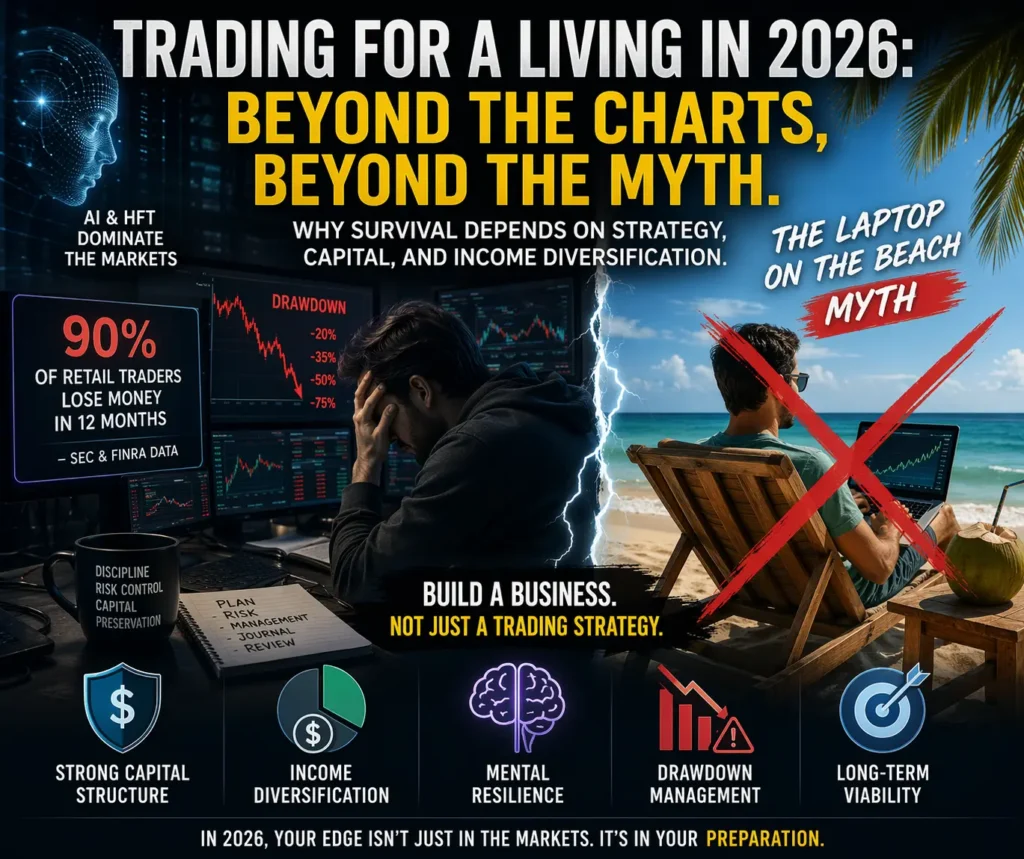
Over the last decade, I have seen thousands of enthusiasts enter the market lured by the promise of geographic and financial freedom, but the reality of trading for a living is a path paved with challenges that most deeply underestimate. In 2026, with the rise of high-frequency algorithms (HFT) and the total integration of Artificial Intelligence into global markets, the margin for error has become practically non-existent. In this article, I am going to deconstruct the “laptop on the beach” myth and explain, based on my experience and fundamental analysis, why exclusive reliance on the charts can be the fastest way to ruin both your mental health and your net worth.
1. The Statistical and Mathematical Reality of the 2026 Market
To begin this analysis, we need to look at the numbers head-on. I don’t believe in “shortcuts,” and the market certainly doesn’t either. Recent reports from authorities like the Financial Conduct Authority (FCA) and aggregated data from global prime brokerages show that, despite the democratization of access, the failure rate remains stagnant: the vast majority of operators do not survive their first year.
Trading for a living means you aren’t just trying to earn a “bonus”; you are managing a high-risk business where your inventory (capital) is extremely volatile. When we analyze average profitability, even elite hedge fund managers at firms like Bridgewater or institutional desks at Goldman Sachs rarely achieve consistent returns above 20-30% annually without exposure to catastrophic systemic risks. If your plan is to turn $5,000 into a monthly salary, the math tells me you are operating in a gambling zone, not an investment zone.
The Impact of Algorithmic Volatility
Today, in 2026, we face a scenario where markets are driven by instantaneous sentiment processed by LLM-integrated trading bots. This means stop-hunt movements are more precise than ever. I observe many traders trying to apply 2018 methods to a market that no longer responds to simple support and resistance patterns. Technical sophistication is mandatory, but risk management is what truly determines who can succeed at trading for a living over the long haul.
2. Hidden Difficulties: The Psychological Weight of “Needing to Win”
Here lies the heart of the problem and the reason why I maintain such a firm stance on this topic. When your rent, your groceries, and your family’s bills depend on a candlestick closing above a certain zone, your brain enters “fight or flight” mode.
I state this with total conviction: trading for a living becomes psychological torture if there is no external financial cushion. The cognitive bias of loss aversion is amplified tenfold when the money at stake is your grocery money. The moment you enter a trade under pressure, your ability to follow your trading plan—your mechanical setup—disappears. You begin to hesitate on perfect entries and “hope the price comes back” on losing trades, which is the first step toward account liquidation.
The Capital Death Spiral
Imagine you have a negative month. In professional trading, this is perfectly normal and expected. However, if your goal is trading for a living, at the end of that negative month, you will still have to withdraw money from your account to pay your living expenses.
“Withdrawing capital during a drawdown period is the greatest enemy of compound interest.”
If your balance dropped 5% due to market performance and you withdraw another 5% to live, you start the next month at -10%. Now, to get back to your starting point, you no longer need to gain 10%; you need approximately 11.2%. If this repeats for three or four months, the percentage required to recover becomes mathematically impossible to achieve without drastically increasing risk (leverage), which invariably leads to ruin.
3. Comparative Data: Income Structure for Professional Traders
Below, I have prepared a comparison between the “Exclusive Trader” model and the “Hybrid Trader” model—the latter being the one I staunchly advocate for anyone seeking true longevity.
| Feature | Exclusive Trader (100% Trading) | Hybrid Trader (Trading + Secondary Income) |
| Psychological Pressure | Extreme (Performance Dependent) | Moderate/Low (Bills paid elsewhere) |
| Drawdown Management | Critical (Forced withdrawals) | Sustainable (Capital stays in the market) |
| Risk of Ruin | High (Negative snowball effect) | Very Low (Financial resilience) |
| Operational Flexibility | Low (Need to trade every day) | High (Can wait for A+ setups) |
| Mental Health | Often affected by market cycles | Stable and balanced |
4. The Crucial Importance of Multiple Income Streams
We have reached the point where my opinion diverges from most internet “gurus.” I argue that to trading for a living healthily and professionally, you should not live only off trading. It sounds paradoxical, but it is the absolute truth of the financial markets.
I firmly believe that every trader should have at least one or two secondary income streams. This could be a stable job (even part-time), real estate investments generating rent, a YouTube channel, or specialized consulting.
Why this insistence?
- Operating Capital Protection: If you have a $2,000 profit in trading and your expenses are covered by your salary, that $2,000 can be reinvested. Your capital grows exponentially.
- The Power of “Not Trading”: The best trader is the one who knows when to stay out. If you need money to pay the electricity bill tomorrow, you will force trades in a choppy, range-bound market. If your income is guaranteed, you can afford to wait a whole week for the perfect setup.
- Resilience in Bear Markets: Not every year is a bull market. The Fed or the BCE can shift monetary policies that dry up market liquidity for months. Without a secondary source, you will be crushed by macroeconomic circumstances.
You can check my Investment Portfolio to understand how I diversify my own capital so as not to depend on a single variable. This systemic vision is what differentiates amateurs from the professionals who actually manage to trading for a living.
5. Trading Psychology: When Method Isn’t Everything
Even if you have a 100% mechanical method, or even a state-of-the-art automated algorithm, the human factor remains the weakest link. In 2026, technology helps us, but it does not replace discipline.
When we face a losing streak—a drawdown—our minds start playing tricks on us. We begin to doubt the strategy that worked for two years. If you are trying to trading for a living without other income sources, that doubt turns into panic. Panic leads you to change parameters, turn off the bot at the wrong time, or “revenge trade” to win back what the market took from you.
The market owes you nothing. The market is a machine for transferring money from the impatient to the patient. Patience is only possible when your physical survival is not at stake in every single trade.
Technical Analysis vs. Biological Necessity
Technically, a sequence of six negative months is statistically probable in any trend-following strategy. How do you survive six months without income if you are attempting trading for a living exclusively? The answer is simple: most don’t survive. They return to the job market with destroyed capital and a shattered psyche. I don’t want that to happen to you.
6. Frequently Asked Questions (FAQ)
Is it possible to trade for a living exclusively in 2026?
Yes, it is mathematically possible, but statistically improbable for the majority. It requires high initial capital (usually above $150,000 to $200,000 for US cost of living) and iron discipline to manage losing periods without affecting your lifestyle.
What is the biggest mistake people make when trying to trade for a living?
Under-capitalization. Attempting to generate consistent monthly income from a small account forces the trader to use excessive leverage, which inevitably leads to a total loss of capital.
Does having another profession hurt my trading performance?
On the contrary. Having another income stream removes the emotional pressure from your trades. A “serious hobbyist trader” often achieves better results than someone desperate for profits to pay bills.
Conclusion: My Verdict on Trading for a Living
To close this analysis, I want to be very direct with you. The romanticized idea of trading for a living as an exclusive activity is, for 99% of people, a dangerous trap. I have seen firsthand how the market grinds down those who don’t have a safety net.
My advice, and my firm position as an analyst, is that you should view trading as a wealth acceleration tool, not your sole source of survival. Build your empire on multiple foundations: a job you enjoy, real estate, dividend-yielding assets, and, of course, trading to exponentiate those gains.
If you don’t have another “lifesaving net,” your psychology will be compromised at the first sign of negative volatility. And in trading, your psychology is your greatest asset. Don’t destroy it for an illusion of freedom that actually makes you a slave to the charts 24 hours a day. If you want to succeed in the 2026 markets, be smart: diversify your income so you can trade with the peace of mind of someone who doesn’t need to win today to eat tomorrow. That is true financial freedom.
To deepen your knowledge on market risks and performance reporting, I recommend carefully reading the Investopedia Guide on Risk Management, a global reference in financial education.
Risk Disclaimer: Trading financial assets involves a high risk of loss of capital. The content of this article is for informational purposes only and expresses the personal opinion of the author; it does not constitute financial advice or investment recommendations. Never invest money you cannot afford to lose.
Related posts:
 Silver in 2026: Is This Price Explosion Just the Beginning or a Short-Term Trap?
 Bitcoin DCA Strategy with Heikin Ashi: My Blueprint to Defeat Fiat Currency Devaluation
 The Death of the Stop Loss? My Forex Trading Strategy Based on Cyclicality and Proportional Volume
 Palantir (PLTR) 2026: Buying the Hype or Waiting for the Correction?