
As of March 2026, the US Dollar has reaffirmed its global hegemony, hitting price levels not seen since May 2025. Contrary to “de-dollarization” narratives, the DXY index exhibits superior technical resilience, backed by a global flight to safety and the unparalleled depth of US capital markets. Current data suggests a continued bullish trajectory, driven by the dominance of American tech giants and a global “de-fiatization” trend, where the dollar remains the most stable fiat reserve despite systemic inflation.
I have been observing the financial markets for decades, and if there is one constant I have learned to respect, it is the US Dollar’s uncanny ability to humiliate those who bet on its premature demise. Today, in mid-March 2026, we find ourselves at a technical and fundamental crossroads that demands a cold analysis, stripped of ideological bias. While many investors lost their way chasing narratives about the BRICS and “new reserve currencies,” I maintained my stance: the dollar would not only survive but return to dominate global investment portfolios.
In this article, I will explain why my outlook remains firmly bullish on the “greenback,” analyzing the current DXY chart and debunking the glaring errors made by armchair analysts over the past year.
1. The 2026 Landscape: Reality vs. The Narrative
Many of you will remember February 2026. It was a peculiar period. Newsstands and the covers of the world’s most prestigious financial magazines were competing to see who could print the most catastrophic headline: “The End of the Dollar Era,” “The Fall of the Monetary Empire,” or “The Yuan: The New King.” At that time, the US Dollar was facing considerable selling pressure, and pessimism was the common currency in investment forums.
However, what we are witnessing now is the dollar closing at highs that haven’t been visited since that very period of collective hysteria. I have always argued that de-dollarization, in the way it is sold by geopolitical marketing, is a dangerous myth for the average investor. As economist Daniel Lacalle correctly points out, what we are experiencing is not de-dollarization, but de-fiatization. In other words, a generalized loss of confidence in all currencies issued by central banks, not just the dollar.
Yet, in the hierarchy of the fiat system, the dollar remains the “MVP.” When geopolitical tensions escalate—as we have seen recently—and inflationary risks bite back, capital does not flee to the Brazilian Real or the Russian Ruble; capital races, desperate for liquidity and safety, toward the US Treasury.
2. Technical Analysis: The Ascending Channel and the Power of the WMA 160
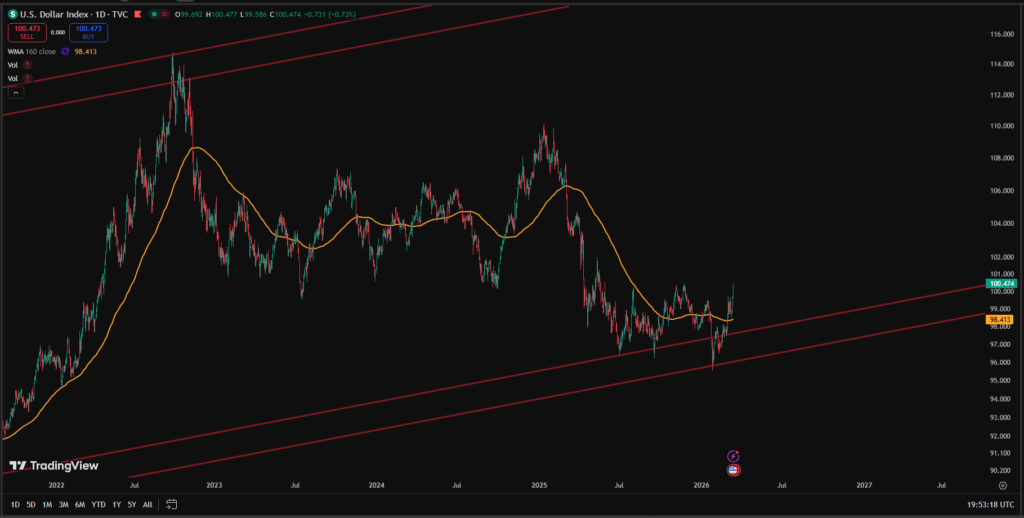
Looking at the chart I’ve brought you today (DXY, 1D), the price structure is crystal clear to any analyst who values technical rigor. The US Dollar is trading within a long-term ascending channel that has guided the bulls since the 2024 corrections.
The Support Bounce and WMA Confirmation
The most relevant point I want to highlight is the price’s interaction with the 160-period WMA (the orange line on the chart). Notice how, after a period of consolidation and a test of the channel’s base, the price not only held the dynamic support but surged with volume, breaking above the WMA. Currently, the DXY sits at 100.474, showing impressive buying strength.
- Resistance Breakout: The dollar closed above critical resistance levels that had acted as a ceiling since the last quarter.
- Moving Averages: The slope of the WMA 160 is beginning to curve upward, which historically precedes prolonged trend movements.
- Projection: In my view, as long as the price remains above 99.000 (the channel base), the path of least resistance is up, with technical targets set at 104.000 and, subsequently, a retest of the 110.000 highs.
This chart isn’t just a collection of lines; it is the visual representation of the global demand for dollars. As long as the world remains uncertain, the ascending channel will be our best friend.
3. Why Investing in the Future Requires Holding Dollars
I am often asked: “But why insist on the dollar if US debt is at record levels?” My answer is always the same: Where are the world’s leading companies located?
If we want to invest in cutting-edge Artificial Intelligence, private space exploration, revolutionary biotechnology, or the semiconductors that power the planet, we must look to the United States. Companies like Nvidia, Microsoft, Apple, and the new energy giants of 2026 do not trade in “baskets” of BRICS currencies. They trade in dollars.
To invest in the future, it is imperative to have exposure to the currency where innovation is funded. I don’t see the dollar just as a currency; I see it as the entry ticket to the most productive technological ecosystem in human history. Those who waited for the “end of the dollar” in 2025 missed out on the rally of the world’s largest tech companies, which continued to invoice and distribute dividends in the sovereign currency.
Furthermore, we must consider the evolution of the financial system. The dollar tokenization is a reality that is further solidifying this dominance. By transforming the dollar into programmable digital assets, the US is facilitating its use in markets where it was previously difficult to transact, increasing its velocity and global demand.
4. Asset Comparison: Dollar vs. The Competition (2026 Data)
To help you visualize the magnitude of the dollar’s resilience, I have prepared this comparative table with data based on the latest reports from the IMF (International Monetary Fund):
| Asset / Currency | 12-Month Performance (YTD 2026) | Global Payment Usage (SWIFT/ISO) | Reserve Status (%) |
| US Dollar (USD) | +7.2% | 48.5% | 58.2% |
| Euro (EUR) | -2.1% | 22.4% | 19.1% |
| Yuan (CNY) | +0.5% | 4.8% | 2.5% |
| Gold (XAU) | +12.4% | N/A (Reserve Asset) | 15.0% (Equiv.) |
| BRICS Basket (Est.) | -4.8% | < 1.0% | < 1.0% |
The numbers don’t lie. Despite gold’s excellent performance—acting as the ultimate hedge against inflation—the US Dollar continues to crush other fiat currencies in terms of utility and exchange value. The Yuan, despite all the propaganda, remains marginal in real global trade due to a lack of legal certainty and the free flow of capital in China.
5. Authority Citations and the Fed’s Role
Jerome Powell and the Federal Reserve have been targets of fierce criticism, but the truth is that the “higher for longer” interest rate policy that characterized 2024 and 2025 was the fuel needed for this rebirth. According to the latest report from the ECB (European Central Bank), interest rate differentials and American economic productivity continue to attract capital from the Eurozone, which suffers from demographic aging and industrial stagnation.
Senior analysts at Goldman Sachs and official reports from the BIS (Bank for International Settlements) confirm that dollar liquidity is unrivaled. In a market that moves trillions daily, the depth of US Treasuries offers an emergency exit that no other market can replicate. As I often say: in the middle of a fire, everyone wants the widest exit door. And that door is labeled USD.
6. The Magazine Cover Error: The Contrarian Indicator
There is a maxim in the market: when the theme “The End of the Dollar” hits the cover of a general interest magazine, it’s a sign that the downward move is over. That is exactly what happened in 2026. The sentiment was so extreme, the pessimism so palpable, that the market was “cleared” of sellers.
I saw a golden opportunity there. While the masses were reading about the imminent collapse, “smart money” was accumulating dollars at historical supports. What we see on the chart today is the result of that accumulation. The dollar closed at highs of nearly a year because the market realized that the alternatives are, at best, experimental and, at worst, authoritarian and illiquid.
FAQ – Frequently Asked Questions about the Dollar in 2026
Will the dollar continue to rise in 2026?
Yes, in my view, the trend is bullish. Technical fundamentals (WMA 160 breakout) and macroeconomic factors (capital flow to US AI and tech firms) support a continued valuation of the DXY toward levels above 104.000.
Is de-dollarization a real threat?
Not in the short or medium term. As SWIFT and IMF data show, dollar usage in payments and reserves remains dominant. What exists is “de-fiatization,” where gold gains ground, but the dollar remains the preferred fiat currency.
Why did the dollar rise despite predictions of a crash?
Crash predictions were based on political narratives rather than economic data. The market rewarded the economy with the highest growth, legal certainty, and technological innovation, which continues to be the United States.
Conclusion: My Final Position
To conclude, I want to reinforce my conviction: ignore the noise and focus on the facts. The DXY chart we analyzed shows an asset in full technical health, respecting bull channels and fundamental moving averages. The US Dollar is, and will remain, the anchor of the global financial system as long as innovation and capital seek freedom and liquidity.
If you want to invest for the future, you cannot afford not to have dollars in your portfolio. That is where the companies that will shape the next decade are located. Those who sold in February 2026, influenced by sensationalist magazine covers, are today buying back at much higher prices. I prefer to be on the side of the trend and history. And history tells us that the dollar should never be underestimated.
Disclaimer: This article reflects my personal opinion and technical analysis based on data available as of March 2026. Investing in financial markets involves risks. Do not make investment decisions based solely on this content; always consult a certified financial advisor.
Related posts:
 The Alien Financial Crisis: The Bank of England’s Warning and the 2026 Gold and Silver Meltdown
 The Invisible Revolution: Why Dollar Tokenization is the U.S. Ultimate Weapon for Market Dominance in 2026
 The Civil War at the Federal Reserve: Is Jerome Powell’s Resistance the Last Stand for Economic Stability?
 Trading Portfolio January 2026: +11.8% Growth and My High-Conviction Bet on the Dollar Paradox