
In February 2026, financial markets are undergoing an irrational capitulation driven by AI-induced fear. While Big Tech (Microsoft, Amazon) is being penalized for a projected $650 billion Capex, software and service giants (Adobe, Visa, Booking) are plummeting on fears of technical obsolescence. However, Goldman Sachs data suggests that operational efficiency and new revenue streams from AI agents will yield unprecedented ROI starting in 2027, signaling a historic entry point for long-term investors.
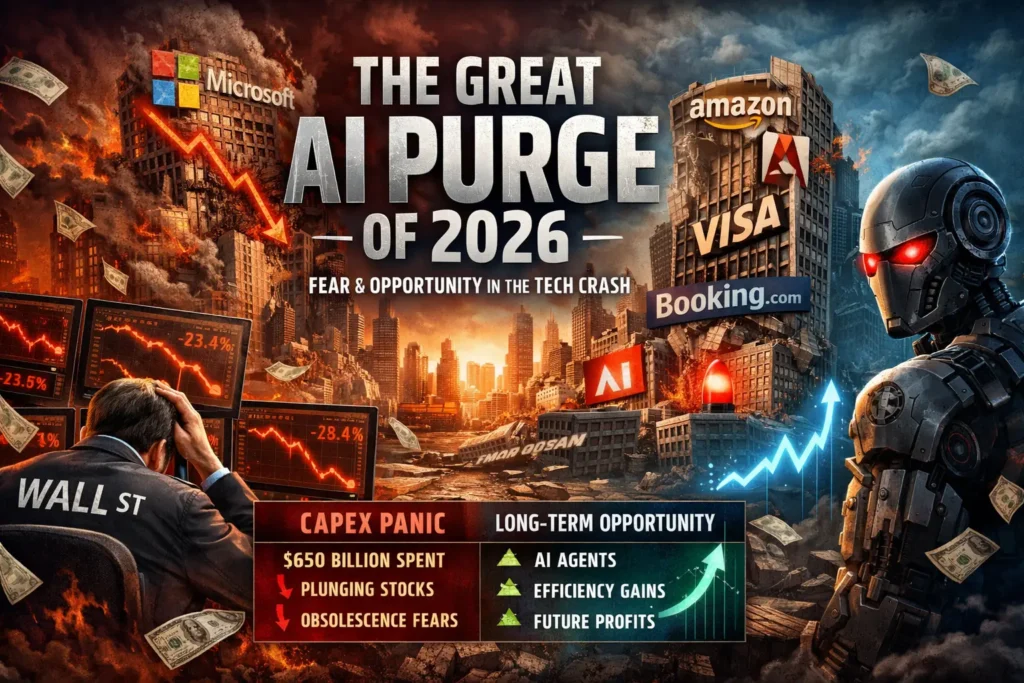
We are currently witnessing a moment of collective schizophrenia in the financial markets. If in 2023 and 2024 the word AI was the fuel propelling every stock into the stratosphere, today, in 2026, it has become the “kiss of death” for the impatient. I look at the Bloomberg terminals and see a sea of red—but this isn’t the red of bankruptcy; it is the red of transitional panic. The market, in its infinite short-term myopia, has decided that massive investment in artificial intelligence is a capital black hole and that all previous business models will simply evaporate by year-end.
1. The Capex Wall: Punishing the Giants
The so-called “Hyperscalers”—Microsoft, Alphabet, and Amazon—are being slaughtered. Why? Because they are actually delivering on their promises. According to recent reports from Bridgewater Associates, these companies are expected to invest approximately $650 billion in capital expenditure (Capex) in 2026 alone. To the average Wall Street analyst living quarter-to-quarter, this figure is terrifying. They view the suspension of share buyback programs and the erosion of free cash flow (FCF) margins as a sign of desperation.
1.1. The Anthropic Investment and Amazon’s Strategy
I view this from a diametrically opposite perspective. When we look at Amazon’s investment in Anthropic, we realize this isn’t just “burning cash.” We are talking about building the public utility infrastructure of the 21st century. Amazon isn’t just buying a stake in a language model company; it is ensuring that AWS remains the operating system of global intelligence.
The market penalizes Microsoft because it committed $250 billion in computing capacity to OpenAI through 2032. But ask the fundamental question: Who will dominate enterprise software when every employee has an autonomous agent working for them? The answer is whoever owns the infrastructure. Today’s Capex fear is, in my opinion, the greatest asset mispricing since the dot-com crash, with the crucial difference that these companies now have real revenue and astronomical profits to back the bet.
2. The “SaaS-pocalypse”: Adobe, Intuit, and the Fear of Vibe Coding
Another sector being decimated is Software as a Service (SaaS). “Golden” names like Adobe (ADBE), Intuit (INTU), and even the acquisition powerhouse Constellation Software (CSU) are seeing double-digit drawdowns. The narrative is simple but fallacious: “If AI can generate code and design instantaneously, why pay expensive subscriptions for traditional tools?”
2.1. The Myth of Instant Obsolescence
The rise of so-called “Vibe Coding”—where anyone can create applications using natural language—has spooked SaaS investors. They believe the competitive moat of these companies has vanished. However, what the market ignores is “data gravity.”
- Adobe isn’t just Photoshop; it is the collaborative workflow for millions of enterprises.
- Intuit isn’t just tax software; it is the custodian of legal and financial compliance.
I firmly believe these companies are being unfairly punished. They won’t be replaced; they will integrate these capabilities to slash their own development costs. Imagine the margins of Constellation Software when the cost of maintaining its vast portfolio of vertical software drops by 70% due to AI automation. We are talking about a margin expansion that the market has yet to price in.
3. Disruption in Payments and Travel: Visa vs. AI Agents
Perhaps the most bizarre panic involves Visa (V), Mastercard (MA), Booking.com (BKNG), and Expedia (EXPE). The bear thesis posits that in a world of AI agents, we won’t need booking interfaces or traditional payment rails. The agent will handle everything.
3.1. The Case for Booking and Expedia
The drops in Booking and Expedia are particularly fascinating. The market claims AI will destroy platform creators. However, Seeking Alpha reports from February 2026 show that Expedia is already expanding margins by 125 basis points precisely because AI is optimizing its marketing and customer support.
“The market is selling everything with a human interface, forgetting that AI needs inventory and trust to transact.”
People will not stop traveling, and AI agents will need to access massive databases and payment guarantees that only Visa and Booking possess. My opinion is clear: the market is confusing a change in interface with business destruction.
4. Comparative Analysis: Capex vs. Revenue Potential (2026-2027 Projections)
To support my position that these are unique entry points, I have prepared this comparative table based on aggregated data from Goldman Sachs and Q4 2025 earnings reports.
| Company | Projected 2026 Capex ($B) | YTD Drawdown | FWD P/E Ratio | AI Competitive Advantage |
| Microsoft | $85 | -31% | 22x | OpenAI & Azure Integration |
| Amazon | $110 | -24% | 24x | Anthropic & Cloud Dominance |
| Adobe | $3.5 | -64% | 11x | Firefly & Firefly Video |
| Visa | $2.1 | -19% | 24x | Tokenization & B2B Security |
| Booking.com | $1.8 | -35% | 15x | Proprietary Travel Agents |
Source: Consolidated data from independent analysts and 2026 financial reports.
As we can observe, valuation multiples (P/E Ratios) are approaching historic lows for companies that are still growing at double digits. Seeing Visa trade at 24x earnings or Booking at 15x is, in my view, a gift the market is giving us due to irrational AI dread.
5. My Opinion: The Great Efficiency Paradox
Here lies my central thesis: the market is selling the very technology that will save these companies. In my analysis, artificial intelligence will not destroy users or creators; it will act as a margin multiplier.
The companies investing heavily in Capex today are building moats that no “garage” startup with an open-source model can leap over. And the service companies (like travel and payments) that the market claims are obsolete are actually the ones that will benefit most from operational cost reduction.
I am buying this dip. I am positioning myself in companies with rock-solid balance sheets that can weather this investment “digestion” period. When the market wakes up in 2027 and realizes that Capex has transformed into recurring profits and that obsolescence was merely software evolution, today’s prices will look like a statistical anomaly.
Frequently Asked Questions (FAQ)
Will AI replace software from companies like Adobe and Intuit?
No. It will transform how we interact with them. The value of these companies lies in trust, data, and process integration—something a simple generative AI cannot replicate without the supporting infrastructure of these giants.
Why is Big Tech’s Capex viewed as a risk?
Because investors fear that the return on investment (ROI) will take too long to materialize, affecting dividends and share buybacks in the short term. It is a purely short-term financial view that ignores strategic advantage.
Are credit card companies (Visa/Mastercard) at real risk?
Disintermediation risk exists, but the security infrastructure and global acceptance network of Visa and Mastercard are extremely difficult to replace. They are actually using AI to drastically reduce fraud losses, which increases their profitability.
Conclusion: The Hour of Human Authority vs. Fear Algorithms
I conclude this analysis with a firm conviction: the fear surrounding AI in 2026 is the noise that separates value investors from momentum speculators. We are seeing a generalized sell-off where high-quality assets are being tossed overboard simply because they are “linked to tech.”
History teaches us that moments of high technological uncertainty, when accompanied by sector-wide drops in profitable companies, are the foundations of the next bull markets. Do not be fooled by the narrative of total obsolescence. AI will not destroy the business world; it will merely transfer value to those who have the scale and the audacity to invest when everyone else is running away. Stay focused on fundamentals, ignore the Capex panic, and see this purge as the opportunity of a lifetime.
Disclaimer: This analysis reflects my personal opinion and does not constitute direct financial advice. Investments in financial markets involve risks. In 2026, AI volatility remains high; always consult your wealth manager.
For a deeper look into the capital dynamics of artificial intelligence, I recommend reading the Goldman Sachs 2026 Market Outlook Report, which details the transition from infrastructure investment to platform value.
Related posts:
 Why Constellation Software is My Only Choice: The Death of Horizontal Software and the Resilience of VMS
 Silver in 2026: Is This Price Explosion Just the Beginning or a Short-Term Trap?
 The Death of the Stop Loss? My Forex Trading Strategy Based on Cyclicality and Proportional Volume
 Skin in the Game: Portfolio January 2026 – Why I Doubled Down on Constellation Software (CSU)