
Sprouts Farmers Market (SFM) is a dominant player in the health-focused grocery niche. With $8.8 billion in revenue in 2025 and 7.3% comparable store sales growth, the company operates with solid margins and aggressive share buybacks. Currently, following a 64% technical correction from its 2025 highs, SFM trades at a forward P/E of 11x, presenting an ideal entry point supported by a positive weekly Heikin Ashi candle.
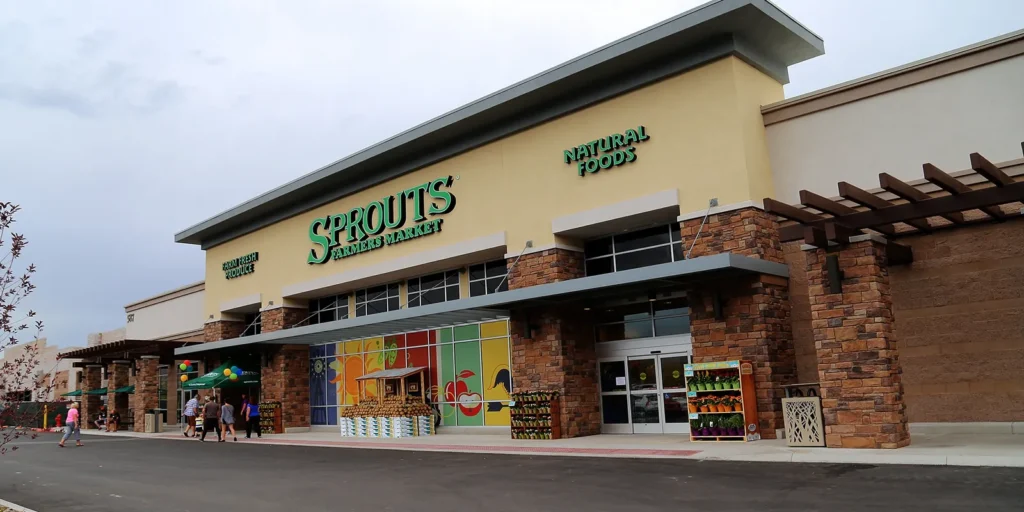
I have always argued that the best businesses aren’t necessarily those creating the next artificial intelligence technology, but rather those that solve fundamental human needs efficiently and with a clear edge. Recently, I initiated a strategic position in Sprouts Farmers Market (SFM). In this article, I will detail my investment thesis, which combines rigorous fundamental analysis with a technical trigger that I consider unmissable in the current 2026 landscape.
1. The History of Sprouts Farmers Market: The Birth of a Niche Giant
To understand why Sprouts Farmers Market is so resilient, we must look at its roots. Founded in 2002 in Chandler, Arizona, the company wasn’t born to be just “another supermarket.” It was conceived to fill the void left by large conventional retailers who often neglected the freshness and accessibility of natural and organic products.
SFM positioned itself in the market with a “farmers market” model within four walls. The store layout is intentionally open, with the fresh produce (fruits and vegetables) department at the center of the store, rather than at the edges as in traditional supermarkets. This design isn’t just aesthetic; it’s a statement of intent. Sprouts trades in health and wellness, focusing on a consumer who doesn’t just want to buy calories, but nutrients.
Over the last two decades, the company has expanded aggressively while remaining true to its niche. It targets “health enthusiasts” and “innovation seekers”—customers looking for specific diets like keto, vegan, gluten-free, or paleo. This focus on a specific target audience allows SFM to command slightly higher margins than a Walmart while maintaining more competitive prices than Whole Foods (owned by Amazon).
2. Financial Radiography: The Numbers Sustaining the Thesis
You don’t just invest in stories; you invest in cash flows and sustainable growth. Analyzing the annual reports and the most recent Q4 and Full Year 2025 balance sheet, it’s clear that SFM management knows exactly how to extract value from every square foot of store space.
In 2025, Sprouts Farmers Market delivered numbers that would make any value investor enthusiastic. Total sales reached $8.8 billion, representing a 14% increase over the previous year. What impresses me most, however, is the comparable store sales growth of 7.3%. In a sector where 2% to 3% is the norm, SFM is operating on another level of efficiency.
Below, I have prepared a detailed table with key financial indicators to help you visualize the company’s trajectory:
Results and Projections Table: Sprouts Farmers Market (SFM)
| Indicator | FY 2024 Result | FY 2025 Result | 2026/2027 Forecast |
| Net Sales | $7.7 Billion | $8.8 Billion | $9.6 Billion+ |
| Comp. Sales Growth | 7.6% | 7.3% | 4% – 6% (est.) |
| Diluted EPS (Earnings Per Share) | $3.75 | $5.31 | $5.75 – $6.10 |
| Operating Margin | ~6.5% | ~7.2% | Stability at 7% |
| New Stores Opened | 33 | 37 | 40+ per year |
| Total Stores | 440 | 477 | Goal of 500+ in 2026 |
| Dividends | Zero | Zero | Focus on Reinvestment |
| Share Buybacks | Active | Active ($200M+) | Continuity |
Important Note: SFM does not pay dividends, and I prefer it that way. Why? Because the company can reinvest its capital at extremely attractive rates of return (ROIC) by opening new, smaller-format stores. These new stores are cheaper to build, have lower operational costs, and reach break-even much faster.
3. Sector Analysis and Competition: Where SFM Differentiates Itself
The grocery retail market is fierce. Giants like Costco, Kroger, and Albertsons fight for every cent of margin. However, SFM plays a different game. While Kroger tries to be everything to everyone, Sprouts focuses on the “perimeter of the store.”
About 70% of SFM’s sales come from attribute-driven products (organic, non-GMO, plant-based, etc.). This specialization creates an intellectual barrier to entry. The SFM buyer isn’t the same person going to Walmart to buy bulk toilet paper; it’s the consumer willing to pay a little more for a perfectly ripe organic avocado or a specific supplement they can’t find elsewhere.
The macroeconomic trend of prioritizing health is an unstoppable tailwind. In 2026, people are more conscious than ever of the link between nutrition and longevity. Entities like the FDA and reports from public health analysts have reinforced the need for less processed diets, and SFM is the natural destination for this transition.
4. Valuation: The Opportunity Generated by the “Great Correction”
This is the juiciest part of my thesis. In 2025, SFM became a Wall Street darling, and the stock price rose parabolically, hitting multiples I considered unsustainable. However, the market, in its infinite wisdom (or madness), applied a severe correction.
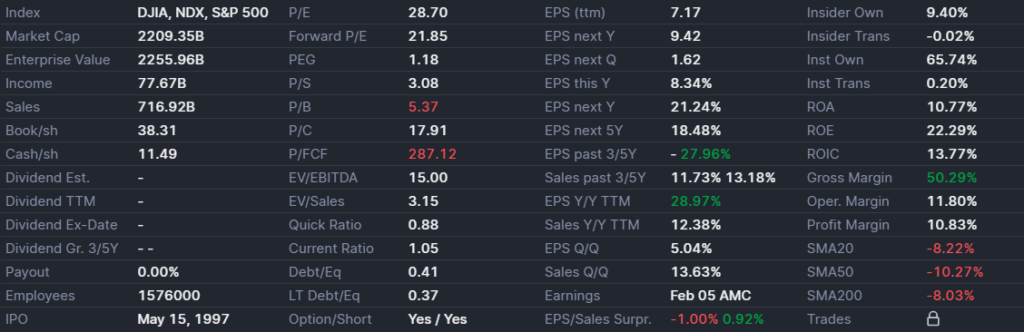
The stock has corrected more than 64% from its 2025 highs.
This drop wasn’t driven by deteriorating fundamentals—as we’ve seen, profits and sales continue to grow—but rather by a valuation adjustment and portfolio rotation. Currently, SFM trades at a forward P/E (Price-to-Earnings) of 11x.
If we consider that expected earnings growth for the next 5 years is around 8% per year (a conservative estimate given recent history), we are looking at a PEG Ratio very close to 1. In the world of finance, buying a company with this level of dominance, no problematic net debt, and growing double-digits in EPS at an 11x multiple is what we call a “no-brainer.”
5. Technical Analysis: The Trigger in the Heikin Ashi Candle
As an investor, I don’t just use fundamentals to decide what to buy; I use technical analysis to decide when to buy. On the weekly chart, SFM has finally given the signal I was waiting for.
After months of a painful downward trend, the weekly chart printed a green Heikin Ashi candle. For those unfamiliar, Heikin Ashi candles smooth out price action, eliminating “noise” and focusing on the trend direction. A green Heikin Ashi candle after a prolonged 64% correction is, for me, an accumulation trigger.
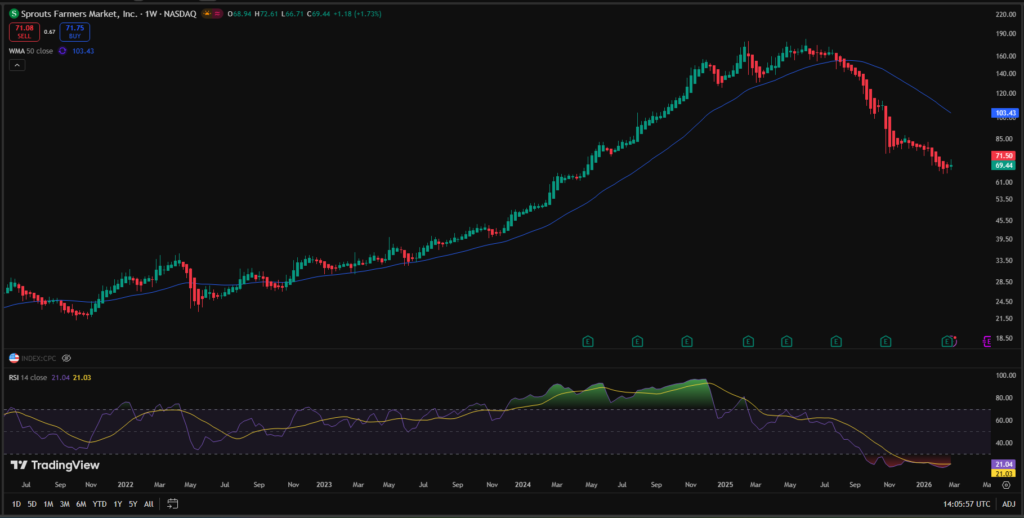
This signal suggests that the bottom has been established and that selling pressure has exhausted itself. I’m not trying to time the exact bottom to the cent, but rather initiating a position in a value zone where the probability of long-term return massively outweighs the downside risk.
6. Portfolio Strategy: Diversifying Beyond Tech
Many investors make the mistake of having portfolios composed entirely of Big Tech. While I love technology, a balanced portfolio needs exposure to different sectors. SFM enters my portfolio as a Defensive Consumption position with a Growth Profile.
It offers a natural hedge against inflation (as it can pass costs to its loyal consumer base) and doesn’t depend on semiconductor cycles or software adoption rates. It’s the perfect pair for other positions I hold, such as General Mills (GIS). If you want to understand how I approach other companies in the food sector, you can read my analysis on why General Mills stock plunged recently.
While GIS is a “cash cow” for dividends, SFM is my aggressive growth bet within food retail. Both share the characteristic of being at very attractive prices after market corrections.
Frequently Asked Questions (FAQ)
1. Why doesn’t Sprouts Farmers Market pay dividends?
Management prefers to use free cash flow to buy back shares, which increases shareholders’ stake in the profit, and to fund the opening of new stores (about 40 per year), generating a return on invested capital higher than what a small dividend payment would offer.
2. Is competition with Amazon (Whole Foods) a risk?
While it is a risk, SFM differentiates itself through its smaller store format (approx. 25,000 sq. ft.), which is more efficient and easier to navigate than the large Whole Foods stores. Additionally, SFM has a private label penetration (Sprouts Brand) that already reaches 20% of sales, creating loyalty.
3. What is the Heikin Ashi trigger you mentioned?
Heikin Ashi candles are a technical visualization method that averages prices. A green candle with no lower shadow on a weekly chart indicates a strong upward trend forming. In SFM’s case, the color change from red to green after a 64% drop signals a trend reversal.
Conclusion: Why I’m “All-In” for the Long Term
My decision to initiate a position in Sprouts Farmers Market (SFM) is based on a rare balance between value and growth. We are talking about a company that dominates an expanding niche, with management executing flawlessly, which—due to a temporary market misjudgment—is being sold at “bargain prices.”
A P/E of 11x for a company growing EPS at double digits with a clear plan to reach 1,000 stores in the coming years is an opportunity that doesn’t come around often. The 64% correction cleared out the excess optimism, and the Heikin Ashi technical signal gave me the comfort needed to hit the buy button.
For more official details and investor reports, I highly recommend consulting the Sprouts Investor Relations site directly.
I firmly believe that five years from now, we will look back at 2026 prices as one of the best entry points of the decade for food retail.
Disclaimer: This article represents my personal opinion and my real investment positions. It does not constitute personalized financial advice. Investing in capital markets involves risks of capital loss. You should always perform your own due diligence or consult a certified financial advisor before making any investment decision.
Related posts:
 The 2026 Portfolio State of Play: Why My “Resilient Growth” Strategy Is Ignoring the Market Noise
 Ferrari Stock: Why I’m Buying Ultra-Luxury at a 40% Discount?
 Skin in the Game: Portfolio January 2026 – Why I Doubled Down on Constellation Software (CSU)
 S&P Global’s 10% Dip: Generative AI Threat or a Generational Buying Opportunity?