
In February 2026, investing in Amazon has become a core value play following a 25% drawdown from its all-time highs. With a forward P/E of 22x and an expected five-year EPS CAGR of 18.5%, the company is doubling down on massive AI expansion via AWS and logistics infrastructure. Despite a record $200 billion Capex guidance for 2026, robust ROIC and the surging valuation of Anthropic ($380B) underpin my “buy” conviction.
As a seasoned investor who has navigated financial markets for years, I have learned that the most lucrative opportunities rarely come gift-wrapped in calm headlines. Today, I am writing this article to detail my investment thesis for what I consider to be the digital infrastructure of the modern world. I have recently initiated a position in Amazon (AMZN), and throughout this piece, I will explain exactly why I made this decision in the current 2026 macro environment, looking past the short-term noise to focus on what truly matters: long-term value creation.
1. Defining Amazon: From a Seattle Garage to Global Hegemony
To understand why I decided to invest in Amazon, one must first understand its DNA. Amazon.com, Inc. is not merely a retail company; it is an integrated ecosystem of services that has redefined how consumption and technology operate. Founded in 1994 by Jeff Bezos in a garage in Bellevue, Washington, the company began with a simple yet audacious vision: to be “Earth’s biggest bookstore.”
What many overlook is that Amazon’s history is a masterclass in aggressive reinvestment. In its early years, the company was heavily criticized for its lack of profitability, with Wall Street analysts famously labeling it “Amazon.toast.” Bezos, however, remained steadfast in his mantra: “It’s always Day 1.” This philosophy dictates that the company must always act with the agility of a startup, focusing obsessively on the customer and innovation while avoiding the stagnation that plagues large corporations.

Over the decades, Amazon evolved from selling books to selling everything, launching Amazon Prime in 2005, which became the most successful customer loyalty “anchor” in history. Later, the company realized that the internal infrastructure it built to support its e-commerce could be sold to other businesses—thus giving birth to AWS (Amazon Web Services), the profit engine that today funds the company’s most ambitious ventures.
2. The Business Ecosystem: Where the Real Capital is Generated
Amazon currently operates across three primary segments, and understanding the interplay between them is critical to my thesis. We are not just buying an online store; we are buying a leader in Cloud Computing, Generative AI, and Advanced Logistics.
North America (Retail and Services)
This is the traditional heart of the company, consisting of online and physical stores (like Whole Foods) in the US, Canada, and Mexico. It accounts for approximately 59% of total revenue. In 2026, the focus here has been the regionalization of the fulfillment network. Instead of large national hubs, Amazon now operates through regional centers that allow for same-day delivery on over 100 million items.
- Annual Growth: ~10-12%.
- Profitability: While margins are historically thin, the introduction of advanced robotics and AI in logistics is beginning to expand operating margins to unprecedented levels.
International
This segment covers retail operations outside North America. Historically, it has been a “money pit” due to the high costs of entering markets like India, Brazil, and Europe. However, in 2025/2026, we have witnessed a pivot to profitability across several of these key regions.
- Annual Growth: ~15-17% (on a constant currency basis).
- Earnings Contribution: Still a small slice of the pie, but it offers the highest margin expansion potential as the infrastructure matures.
AWS (Amazon Web Services)
This is my primary reason for being bullish. AWS holds roughly 32% of the global cloud infrastructure market. It is the segment that generates the lion’s share of the company’s operating income (often over 60% of the total). In 2026, AWS has shifted from “server hosting” to becoming the foundational Generative AI layer for enterprises.
- Annual Growth: Accelerated to 24% in the final quarter of 2025.
- Operating Margin: Remains robust, hovering above 30%.
3. Financial Radiography: The Numbers Behind the Thesis
For a fundamental analyst, the data from the 2023 and 2024 annual reports, combined with the preliminary 2025 results, tells a story of unprecedented scale. Below, I have compiled a comparative table to visualize the evolution of the company’s metrics:
Table: Amazon Financial Performance (2023 – 2025)
| Metric (in Billions $) | 2023 (Actual) | 2024 (Actual) | 2025 (Est./Prelim.) | Annual Growth (%) |
| Total Revenue | $574.8 | $638.0 | $716.9 | ~12.5% |
| Operating Income | $36.9 | $68.6 | $97.5 | ~42% |
| Operating Margin | 6.4% | 10.8% | 13.6% | +280 bps |
| Net Income | $30.4 | $59.2 | $77.7 | ~31% |
| Capex (Investment) | $48.4 | $83.0 | $128.3 | ~54% |
| Operating Cash Flow | $94.9 | $120.0 | $139.5 | ~16% |
Analyst Note: Look closely at the Capex surge. Amazon is investing billions in proprietary chips (Trainium and Inferentia) and data centers to reduce reliance on Nvidia. This investment “crushes” Free Cash Flow (FCF) in the short term, which spooked impatient investors, but this is exactly where the opportunity lies.
4. Return on Invested Capital (ROIC) and Capital Efficiency
A central pillar of my analysis is ROIC (Return on Invested Capital). At the end of 2025, Amazon’s ROIC stood at approximately 13%. While this may seem lower than some “asset-light” software companies, context is key: Amazon is a capital-intensive juggernaut.
The fact that they can maintain a double-digit ROIC while deploying $200 billion (estimated for 2026) into infrastructure is a testament to Andy Jassy’s masterful capital management. My personal view is clear: I would much rather own a company that invests $200B at a 13% return than one that has no growth runway and simply uses cash for “financial engineering” through share buybacks.
Regarding share buybacks, Amazon has remained conservative. Historically, it prioritizes organic reinvestment. However, with operating cash flow nearing $140 billion, I would not be surprised to see a more aggressive buyback program if the stock price remains depressed by the recent technical correction.
5. Current Valuation: Opportunity or Value Trap?
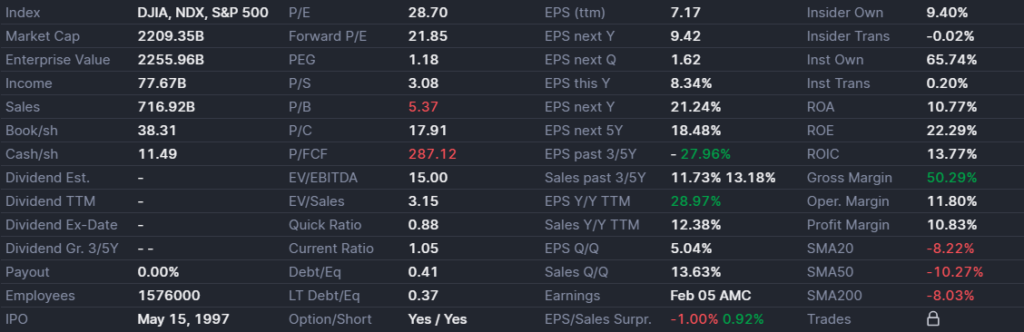
Currently, Amazon is trading at a forward P/E (Price to Earnings Ratio) of approximately 22x based on 2027 projected earnings. By Amazon’s historical standards, which often saw it trading north of 50x or 80x, we are witnessing one of the most attractive valuation levels of the last decade.
Why is the market “cheap”?
The consensus forecast predicts an average annual earnings growth of 18.5% over the next five years. If we apply the PEG (Price/Earnings to Growth) ratio, we are looking at a multiple close to 1.2, which is extremely attractive for a dominant market leader. The market is penalizing the stock due to fears that the 2026 Capex guidance ($200B) will erode margins. I fundamentally disagree with this pessimistic outlook.
This massive investment is what will ensure AWS remains the platform of choice for AI development. Furthermore, Amazon holds highly valuable strategic stakes. The most notable is Anthropic, the creator of Claude AI. With Anthropic valued at $380 billion in its latest February 2026 funding round, Amazon’s stake (from its initial $8B investment) is now worth tens of billions—a value not yet fully reflected on the balance sheet.
You can read more about the strategic importance of this move in my detailed article on investing in Anthropic in 2026.
6. Technical Analysis: The 25% Drawdown and My Entry Point
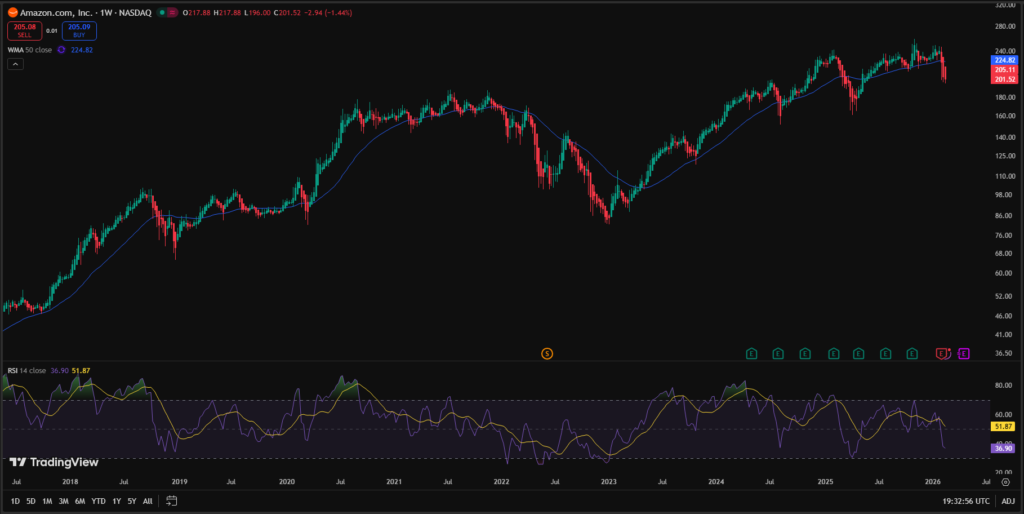
From a technical perspective, there is “blood in the streets,” which I find compelling. Since reaching all-time highs (ATH) in late 2025, Amazon has suffered a 25% correction. This decline was fueled by a mix of institutional profit-taking and macroeconomic jitters regarding global consumer spending.
My Entry Strategy
- The Weekly Chart: The weekly RSI (Relative Strength Index) has not yet hit the “extreme oversold” territory (below 30) that I usually wait for before taking a massive position. However, we are already at significant historical support levels.
- Positioning: I have already started scaling in with small positions. I am not trying to time the exact bottom. Instead, I am accumulating shares at this discount. If the stock drops another 5% or 10% and the RSI finally enters the “golden zone,” I will back up the truck with absolute conviction.
In my view, the risk of being sidelined at this valuation is far greater than the risk of temporary volatility over the next few percentage points.
FAQ: Frequently Asked Questions About Investing in Amazon
1. Is it worth buying Amazon now despite the high Capex?
Yes. The market is hyper-focused on immediate cash outflows but ignores the fact that these AI and AWS infrastructure investments will generate exponential cash flows in 2027 and 2028. It is a classic case of short-termism vs. long-term vision.
2. What is the biggest risk to this investment thesis?
The main risks are regulatory (Antitrust) and the potential for a deep global recession that could dampen retail spending. However, the diversification provided by AWS offers a hedge that traditional retailers lack.
3. Does Amazon pay a dividend?
No. As of 2026, Amazon remains fully committed to reinvesting capital for expansion and maintaining its technological lead. Shareholder returns are delivered through share price appreciation.
Conclusion: My Final Verdict
Investing in Amazon in 2026 requires the stomach to endure volatility caused by the company’s gargantuan investment cycle. But looking at the fundamentals—AWS growing at 24%, expanding retail operating margins, and a 22x P/E for 18.5% growth—the conclusion is inevitable: Amazon is on sale.
I don’t invest based on what the chart will do tomorrow, but on what the company will be worth five years from now. With the vertical integration of AI chips and a winning bet on Anthropic, Amazon is building an economic moat that few companies on earth can even dream of. My position is open, and I am ready to capitalize on any further dips.
To stay updated with official reports and IR data, I always recommend checking the Amazon Investor Relations official page.
Disclaimer: This article reflects my personal opinion and individual investment thesis. It does not constitute personalized financial advice. Investing in stocks involves the risk of capital loss. Perform your own due diligence before making any investment decisions.
Related posts:
 Ferrari Stock: Why I’m Buying Ultra-Luxury at a 40% Discount?
 Skin in the Game: Portfolio January 2026 – Why I Doubled Down on Constellation Software (CSU)
 TLT Opportunity 2026: Why I’m Betting Big on US Treasuries and the Dollar
 S&P Global’s 10% Dip: Generative AI Threat or a Generational Buying Opportunity?