
On February 3, 2026, Novo Nordisk ($NVO) shares plunged 14% following the release of its 2025 annual results. Despite robust sales of DKK 309.1B (+10% CER), Wall Street was spooked by a 2026 guidance projecting a 5% to 13% decline in adjusted operating profit. This contraction is driven by U.S. pricing pressures and a $4.2B 340B rebate reversal. However, with a P/E ratio of 14 and the record-breaking launch of the Wegovy Pill, the fundamentals remain intact for long-term investors.
The “darling” of the pharmaceutical sector and the undisputed leader in the GLP-1 revolution has just taken a brutal hit. This morning, as I opened my Bloomberg terminal, I was met with a sight that keeps growth investors awake at night: Novo Nordisk ($NVO) bleeding over 14% in a single session. The catalyst? A 2025 earnings report that, while operationally massive, carried a 2026 guidance that sent institutional algorithms into a selling frenzy. As someone who has held Novo Nordisk ($NVO) in my personal portfolio for years, the question immediately became: Are we witnessing the popping of a biotech bubble, or is this merely the noise of a short-sighted market failing to grasp long-term fundamentals?
In this deep dive, I will dissect the numbers, explain why the “headline” guidance is deceptive, and share my strategic outlook on why I am treating this sell-off not with fear, but as a high-conviction entry point. The GLP-1 landscape is shifting from scarcity to mass-market scale, and understanding the delta between “adjusted” and “unadjusted” profits is the key to outperforming the market in 2026.
1. Dissecting the 2025 Financials: Growth Under the Weight of Expansion
To understand today’s panic, we must first look at what actually happened in 2025. Novo Nordisk ($NVO) reported total net sales of DKK 309.1 billion, a solid 10% increase at constant exchange rates (CER). If we isolate the Obesity Care segment—the home of the blockbuster Wegovy—growth was a staggering 31%. These are not the numbers of a dying company; they are the numbers of a titan that continues to capture market share in a world where metabolic health has become the primary healthcare challenge of the 21st century.
However, the operating profit of DKK 127.7 billion showed a slight 1% decline in Danish kroner. Why? Upon digging into the filings, the answer is clear: the company incurred approximately DKK 8 billion in “transformation costs” related to scaling production and integrating the Catalent acquisition. This is a critical point for my thesis: management is intentionally sacrificing short-term margins to solve their historical “supply-chain bottleneck.” I would much rather own a company that spends aggressively today to ensure it can deliver millions of doses tomorrow, rather than one that masks production failures with artificial margin expansion.
2. The 2026 Guidance: Decoding the Market’s Overreaction
The true “villain” of today’s price action was the 2026 outlook. Novo Nordisk ($NVO) projected adjusted sales and operating profit growth between -5% and -13%. For a market conditioned to double-digit growth, the word “negative” acted like a match in a gas station. But, as I often preach, the devil is in the accounting adjustments and the regulatory shifts in the United States.
The 340B Reversal and “Adjusted” Metrics
Starting in 2026, Novo Nordisk began reporting “adjusted” metrics to exclude the impact of a massive $4.2 billion reversal of provisions related to the 340B Drug Pricing Program in the U.S. This was a one-time accounting event. If we ignore these non-cash adjustments and look at the actual cash generation, the unadjusted operating profit is actually expected to grow by 11%.
The market is currently reacting to the “adjusted” lower figure, completely ignoring the fact that the actual cash flow remains remarkably healthy. In my view, this is a classic “accounting trap” where the headline figure triggers automated sell orders, creating a disconnect from the company’s real economic power.
U.S. Pricing Pressures and the Medicare Factor
We cannot ignore that 2026 is the year the Inflation Reduction Act (IRA) price negotiations truly begin to bite. The company admitted to “pricing headwinds” in the U.S. as Medicare and private PBMs (Pharmacy Benefit Managers) demand steeper rebates. However, as an investor, this was already priced into any rational model. The business model is transitioning from “high-price, low-volume” to “moderate-price, massive-volume.” This is where the next pillar of my thesis comes in.
3. The “Game Changer”: The Explosive Success of the Wegovy Pill
While analysts focus on patent cliffs and PBM rebates, I am hyper-focused on the adoption curve of the Wegovy Pill. Launched on January 5, 2026, the oral version of semaglutide is proving to be a success that has eclipsed even my most bullish projections.
Recent data indicates that the Wegovy Pill has already surpassed 50,000 weekly prescriptions. To put this into perspective, this launch trajectory is faster than the original Wegovy injectable and even outpaces Eli Lilly’s Zepbound launch in its early days. The convenience of a daily pill versus a weekly injection is the key to unlocking the “mass-market” phase of obesity treatment. I believe Novo Nordisk ($NVO) is building a massive competitive moat through convenience, which will allow them to retain market leadership even as new players enter the space.
Comparative Analysis: GLP-1 Market Leaders (Data as of Feb 2026)
| Metric | Novo Nordisk ($NVO) | Eli Lilly ($LLY) | Big Pharma Average |
| Forward P/E Ratio | 14.1 | 28.5 | 18.2 |
| Operating Margin | 41.3% | 34.2% | 22.0% |
| Obesity Growth (2025) | +31% (CER) | +42% (CER) | N/A |
| Dividend Yield | 1.8% | 0.9% | 2.1% |
| Price/Cash Flow | 12.4 | 22.1 | 15.8 |
4. Valuation: A Growth Powerhouse at a Value Price?
Today’s crash has pushed Novo Nordisk ($NVO)‘s P/E (Price-to-Earnings) ratio down to approximately 14. Let me emphasize this: we are looking at a company that controls roughly 30% of the global diabetes market, maintains operating margins north of 40%, and operates in a market that Morgan Stanley and Goldman Sachs estimate will reach $150 billion by 2035.
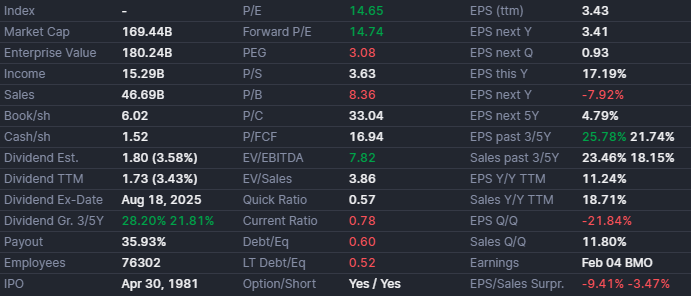
It is exceedingly rare to find this level of profitability and market dominance at such a low multiple. To me, this is the classic “Mr. Market” scenario described by Benjamin Graham: the market is in a state of deep depression and is offering its crown jewels at a 14% discount. I do not see Novo Nordisk ($NVO) as a “value trap”; I see it as a high-growth company undergoing a necessary—and expensive—logistical and accounting transition.
5. My Personal Strategy and Risk Assessment
As stated, I am holding Novo Nordisk ($NVO) in my portfolio. This dip does not change my fundamental thesis; in fact, it strengthens it. The “miss” in the 2025 report wasn’t due to a failure of the drug’s efficacy or a loss of clinical relevance, but rather the cost of scaling. The integration of Catalent is a masterstroke that will eventually give Novo total control over its supply chain, a feat that competitors like Eli Lilly are still racing to match.
My clear strategy moving forward:
- HODL: I am not selling a single share. Panic is the ultimate enemy of long-term alpha.
- Buy the Dip: I have set tiered limit orders. If the stock tests lower support levels in the coming week, I will increase my position by an additional 20%.
- Monitor the Pipeline: I am closely watching the CagriSema Phase 3 data. If results continue to show weight loss exceeding 25% with a manageable safety profile, the stock will return to valuation levels far above current prices.
It is essential to read my previous analysis on whether Novo Nordisk ($NVO) is still a buy to understand the historical context of this price action. The metabolic disease market is vast and, unfortunately, expanding. As long as global obesity rates rise, the demand for Novo’s products will remain price-inelastic.
FAQ – Frequently Asked Questions on the $NVO Sell-off
1. Why did Novo Nordisk stock drop 14% today?
The primary driver was the conservative 2026 guidance forecasting an adjusted operating profit decline of 5-13%. Investors reacted to U.S. pricing pressures and the heavy capital expenditures required for production expansion.
2. Is the Wegovy Pill a threat to the injectable version?
It is a complementary product. While it might cannibalize some injectable sales, it opens up a massive new patient segment that prefers oral medication, significantly expanding the total addressable market (TAM).
3. How will the IRA price negotiations affect $NVO?
While Medicare price negotiations will lower the “list price” for certain drugs, the high volume of prescriptions and the expansion into new indications (like cardiovascular health and NASH) are expected to offset the per-unit margin compression.
4. Should I buy $NVO now or wait for it to drop further?
At a P/E of 14, the margin of safety is high. While short-term volatility may persist due to technical selling, the fundamental valuation is the most attractive it has been in years for a long-term (3-5 year) horizon.
Conclusion: Patience Over Panic
In conclusion, my stance is one of firm, calculated optimism. Novo Nordisk ($NVO) did not stop being a cash-generating machine overnight. What we witnessed today was the realignment of expectations from short-term speculators who fail to understand the cyclical nature of CAPEX investments in Tier-1 pharma.
I believe 2026 will be remembered as the “Year of Transition”—the moment when Novo cleared its balance sheet, solved its manufacturing woes, and cemented its dominance via the oral delivery of its blockbuster molecule. For those of us who focus on fundamental analysis and long-term value creation, the “blood” in the streets of Wall Street today has a very specific scent: the scent of a generational opportunity.
For more official details and to access the full annual report, I highly recommend visiting the Novo Nordisk Investor Relations page.
Disclaimer: This article reflects my personal opinion and investment strategy. It does not constitute financial advice. Investing in the stock market involves risk; always perform your own due diligence before making any investment decisions.
Would you like me to analyze the specific clinical pipeline (CagriSema) to see how Novo Nordisk plans to defend its throne through 2030?
Related posts:
 My 2026 Bet on General Mills (GIS): Why Defensive Stocks Are My Sanctuary in an Overheated Market
 Is Novo Nordisk (NVO) Still a Buy in 2026? My Deep Dive into the Giant Curing Obesity
 Skin in the Game: Portfolio January 2026 – Why I Doubled Down on Constellation Software (CSU)
 Constellation Software (CSU): Why I Am Aggressively Doubling Down on This Generational Opportunity Amidst Extreme Market Fear