
On January 30, 2026, the silver crash reached historic proportions, with an intraday collapse exceeding 35%, retreating from highs of $118 to $76. The movement was catalyzed by Kevin Warsh’s nomination to the Fed and a vertical surge in the U.S. Dollar. This technical breakdown pierced the 50-day WMA, triggering massive margin calls that are forcing the liquidation of profitable positions in indices like the S&P 500, threatening a global sell-off.
I warned you. If you have been following my analysis here on the site, you know that my optimism regarding precious metals was never blind. Today, January 30, 2026, we woke up to a scenario that many considered impossible, but one that market mathematics always had on the horizon: an absolutely brutal silver price drop, losing more than a third of its value in just a few hours of trading. Watching the TradingView screen paint a red candle that swallows months of gains is a shock for beginners, but for me, it is the culmination of an euphoria that surpassed the limits of technical sanity. Silver, which recently tested $118, is now struggling to hold onto $76, and what this means for your portfolio goes far beyond the physical metal itself.
1. The Chaos Trigger: The “Warsh Factor” and the Resurrection of the Dollar
The market lives on expectations, and today, the expectation of a complacent monetary policy died. The confirmation that the U.S. government plans to nominate Kevin Warsh (Who is Kevin Warsh? The New Fed Chair), a well-known inflation “hawk”, to the leadership of the Federal Reserve, sent an electric shock through the U.S. Dollar Index (DXY). I have always argued that silver was the best hedge against fiat devaluation, but when the market begins to price in higher rates for longer and an aggressive reduction of the Fed’s balance sheet, liquidity flees from risk assets and commodities as if there were a fire in the building.
This silver crash is not just a technical move; it is a fundamental reassessment of the macroeconomic landscape for 2026. We were accustomed to a weak dollar and out-of-control public debt fueling the rally. However, today’s announcement forced a violent reversal. Silver, being a high-beta asset, reacted in the most extreme way possible. I see this movement as a necessary, albeit painful, “cleansing” of all the leveraged positions that have accumulated over recent months.
2. Anatomy of a Flash Crash: The Breakdown of the 50-day WMA
If we look at the daily chart of silver (XAG/USD), the carnage is evident. The price had been brilliantly sustained by the 50-day Weighted Moving Average (WMA 50), which sat near $82.95. When the price pierced that support with the force of a runaway truck, high-frequency algorithms entered a frenzied selling mode. I believe the technical panic was fueled by the cascading execution of stop-loss orders.
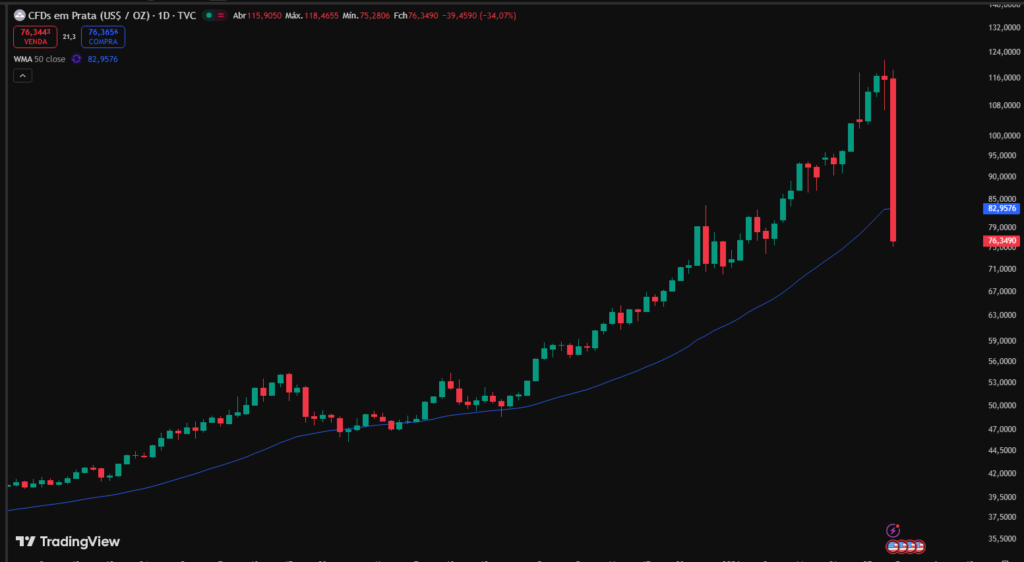
Silver plummeted from an intraday high of $118.50 to close around $76.60. We are talking about a variation that destroys margin accounts in seconds. The fact that we closed below the WMA 50 is a red alert signal for any technical analyst. Historically, when silver suffers a correction of this magnitude, it does not recover in a straight line. We need to see a consolidation base, and my fear is that $70 will be the next psychological test before any attempt at a bounce.
3. The Hidden Danger: Margin Calls and Forced Equity Liquidation
Here we enter the most critical point of my analysis today. This 35% drop in silver has created a liquidity black hole. Thousands of traders and hedge funds were positioned in silver with leverage of 10x, 20x, or more. With a drop of this magnitude, these investors are receiving the dreaded margin calls.
When the broker calls—or the system automatically liquidates—the investor has two choices: deposit more capital or have their positions closed. Often, to cover silver losses, these large players are forced to sell their profitable positions in tech stocks and indices like the S&P 500 and the Nasdaq. This is where the contagion becomes systemic. We are already seeing the S&P 500 buckle under pressure, not because companies have lost value, but because silver “broke” the financial market. I am convinced that this movement could trigger a general sell-off in the coming sessions, as the need for immediate liquidity outweighs any long-term investment thesis.
| Asset | Peak Price (Jan 2026) | Current Price (Jan 30, 2026) | Daily Change | Technical Status |
| Silver (XAG/USD) | $118.50 | $76.60 | -35.45% | Below 50 WMA |
| Gold (XAU/USD) | $5,594 | $4,880 | -9.20% | Support at $5,000 |
| S&P 500 | 6,950 pts | 6,920 pts | -0.96% | Contagion Risk |
| Dollar Index (DXY) | 96.50 | 97.10 | +0.88% | Bullish Breakout |
4. Revisiting the Thesis: Silver at $100 and Gold at $5000
Many of you remember my previous article where I projected Silver at $100 and Gold at $5000. I would like to highlight that this target was not only met but exceeded. Hitting targets is the easy part; the hard part is managing success and knowing when the string is about to snap. In that article, I mentioned that physical scarcity and industrial demand (solar panels and semiconductors) were the pillars of the rally. Those pillars are still there, but the price detached from physical reality to enter the speculative stratosphere.
What we are seeing today is the reversal of that distortion. Silver at $118 was an unsustainable statistical “stretch.” However, the fact that gold is still holding above $5,000 gives me some hope. Gold is the anchor; silver is the sail. Today, the sail tore. If gold loses the psychological support of $5,000, then we won’t just be talking about a correction, but a prolonged bear market. For now, I maintain my position that the intrinsic value of silver remains high, but the “paper price” on futures exchanges needed to be purged.
5. FAQ – Frequently Asked Questions About the Silver Collapse
What caused the silver crash today?
The combination of Kevin Warsh’s nomination to the Fed (signaling high rates), the sudden strengthening of the dollar, and the increase in margin requirements by the CME Group forced a mass liquidation.
Should I buy silver now that it has dropped 35%?
Technically, catching “falling knives” is dangerous. While the price is at previous support levels, the break below the WMA 50 suggests there could be more selling pressure before a real stabilization occurs.
How does silver affect my stock portfolio?
Through margin calls. Large investors sell equities (like Apple, Nvidia) to cover losses in silver, which can lead to a widespread decline in stock indices. You can read more about this contagion effect on Bloomberg.
Conclusion: My Verdict on the Market’s Future
We are facing a “black swan” event in the commodities sector. Today’s silver crash will be studied in finance textbooks as a classic example of how excessive leverage can destroy a market in record time. In my personal opinion, this movement is the market expelling short-term speculators. The long-term thesis for metals remains valid—global debt hasn’t disappeared and structural inflation is still present—but the $120 euphoria needed a correction.
Prepare for extreme volatility in the coming weeks. If margin calls continue to force sales in the S&P 500, we could be entering a broader correction period for all risk assets. My advice? Stay calm, reduce leverage, and watch the $70 level. If that support fails, the scenario shifts from a “healthy correction” to “total capitulation.”
Related posts:
 The Civil War at the Federal Reserve: Is Jerome Powell’s Resistance the Last Stand for Economic Stability?
 Trade War 2.0 Greenland: How to Shield Your Portfolio Against New NATO Tariffs and Arctic Volatility
 The Greenland Crisis: How Trump’s New Tariffs Could Wreck Your Tech Portfolio Today
 The End of the Dovish Illusion: Why the January 2026 FOMC Meeting Left Markets in Limbo