
Investing in Ferrari (RACE) stock in 2026 represents a high-conviction bet on the resilience of absolute luxury. Following a technical correction of over 40% from its highs, the company offers attractive valuation multiples (P/E) relative to its historical performance. With EBITDA margins exceeding 38%, an order book stretching into 2027, and a unique immunity to the commoditization of EVs, Ferrari remains a premier wealth-preservation asset comparable only to Hermès.
1. The Mysticism of Maranello: More Than a Carmaker, a Financial Religion
To understand why I have decided to start building a position in Ferrari stock, one must first discard the notion that we are analyzing a “car company.” If we view Ferrari through the same lens as Volkswagen or Toyota, we make the cardinal mistake of underestimating its intrinsic value. Ferrari is, in reality, a manager of desire and a curator of exclusivity. Since Enzo Ferrari founded the brand, the focus has never been on volume, but on mystique.
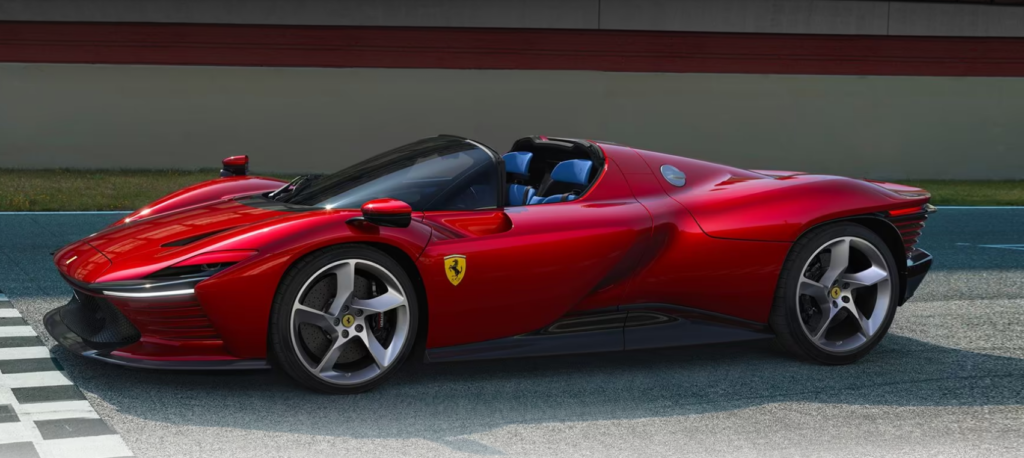
The company’s history is inextricably linked to Scuderia Ferrari and Formula 1. This racing DNA doesn’t just sell cars; it validates the technical and emotional superiority that allows the brand to command prices that defy the logic of utility. When I look at the Prancing Horse, I see an asset that has survived wars, oil crises, and financial bubbles, consistently maintaining its status as a Veblen Good—an item for which demand increases as the price rises, precisely because the high price reinforces the owner’s status.
Ferrari’s mysticism lies in its ability to be both aspirational and inaccessible. Unlike other premium brands that succumbed to the temptation of “democratizing” luxury to please Wall Street in the short term, Ferrari has maintained a iron discipline of always producing “one car less than the market demands.” This deliberate scarcity is what sustains the resale value of its models, making many of the brand’s vehicles appreciating assets over time—a feat almost unheard of in the traditional automotive sector.
1.1. Brand Power and Client Selection
One of the points that most fascinates me as an investor is that Ferrari earns the luxury of choosing its customers. To access limited-edition models, such as the Icona series, having the money is not enough; one must have a documented history of loyalty to the brand. This business model creates a closed ecosystem where the client becomes an ambassador and a guardian of the brand. Exclusivity is the real product; the car is merely the physical vessel for that exclusivity.
2. The Unassailable Moat: Where Luxury Meets Entry Barriers
When we discuss an economic moat, Ferrari’s is, in my view, one of the deepest in the global capital markets. It is not just a matter of engineering; it is a matter of consumer psychology.
Ferrari operates in a regime of emotional monopoly. If a customer wants a Ferrari, a Lamborghini or a McLaren is not a perfect substitute; they are merely alternatives. This distinction is vital. In 2026, in a world saturated with technology and screens, what Ferrari sells is a visceral experience and entry into an elite club.
- Waiting Lists as a Leading Indicator: While other companies suffer from inventory overhang, Ferrari has revenue visibility for the next 24 to 36 months. Waiting lists are, in practice, a recession insurance policy.
- Pricing Power: In an inflationary environment or during monetary instability, Ferrari has a proven ability to pass on costs and increase margins without losing a single customer. Its target audience—Ultra-High-Net-Worth Individuals (UHNWIs)—is virtually immune to interest rate fluctuations from the ECB or the Fed.
3. Financial Radiography: Looking at the Numbers Through a Magnifying Glass
As an investor, I don’t let myself be carried away by passion alone. The numbers must support the thesis. Analyzing the Q3 2025 reports and projections for 2026, it is clear that the company’s financial health is robust—almost monolithic.
3.1. Margins and Profitability
Ferrari delivers margins that would make software companies envious. By late 2025, EBITDA margins remained consistently above 38%, with EBIT margins hovering around 28-29%. To put this in perspective, most “standard” luxury brands struggle to maintain operating margins of 15%.
3.2. Cash Flow and Debt
Free Cash Flow (FCF) generation is another metric where Ferrari shines. The company utilizes its cash to reinvest in R&D (essential for the hybrid/electric transition without losing its soul) and to reward shareholders via dividends and share buybacks. Net Industrial Debt has been kept under strict control, often offset by a strong liquidity position.
| Financial Metric (Est. 2025/2026) | Observed / Projected Value | Sector Average (Média) |
| EBITDA Margin | 38.4% | 12% – 15% |
| EBIT Margin | 28.5% | 7% – 9% |
| Revenue Growth (YoY) | +6.5% to +9% | Stagnant / Volatile |
| EPS (Earnings Per Share) | Consistently Growing | High Cyclicality |
| P/E Ratio (Current) | ~30x – 35x | 10x – 15x (Auto Sector) |
3.3. Valuation Multiples
Historically, Ferrari shares trade at luxury multiples, not automotive ones. The fact that the P/E (Price-to-Earnings) Ratio has retreated to more reasonable levels following the 40% correction is what triggers my action now. We were used to seeing RACE trading above 50x earnings; seeing the company at multiples near 30x, considering its organic growth and earnings predictability, represents a generational opportunity for those with a long-term horizon.
4. The Future and Resilience Amidst Electrification
It is 2026, and the automotive market is being flooded by Chinese EVs and traditional premium brands fighting for thin margins. Ferrari, however, sails in a “Blue Ocean.”
4.1. Ferrari vs. the Massification of EVs
My thesis is that the more the market “commoditizes” with silent electric cars focused solely on software technology, the more valuable Ferrari’s proposition becomes. Ferrari is not selling transportation; it is selling performance and sound. Even in its transition to its first 100% electric model and its hybrid range (like the SF90), the brand has ensured that the “driving emotion” remains central.
Unlike Porsche, which must compete with Tesla and Lucid in higher-volume segments, Ferrari is in a league of its own, shared only with Hermès. They are the only two ultra-luxury brands listed on the stock exchange that can maintain absolute scarcity as a business model. If the world enters a deep crisis, the buyer of a Mercedes S-Class might postpone their purchase; the customer waiting two years for a Purosangue will not give up their allocation, knowing that losing that spot in line is losing a privilege that money alone cannot buy.
5. Technical Analysis: Opportunity in the 40% Drawdown
The RACE chart has been a textbook example of resilience over the last decade, but no asset moves up in a straight line forever. After reaching peaks of euphoria, the stock underwent a severe technical correction, losing over 40% of its market value from its highs.
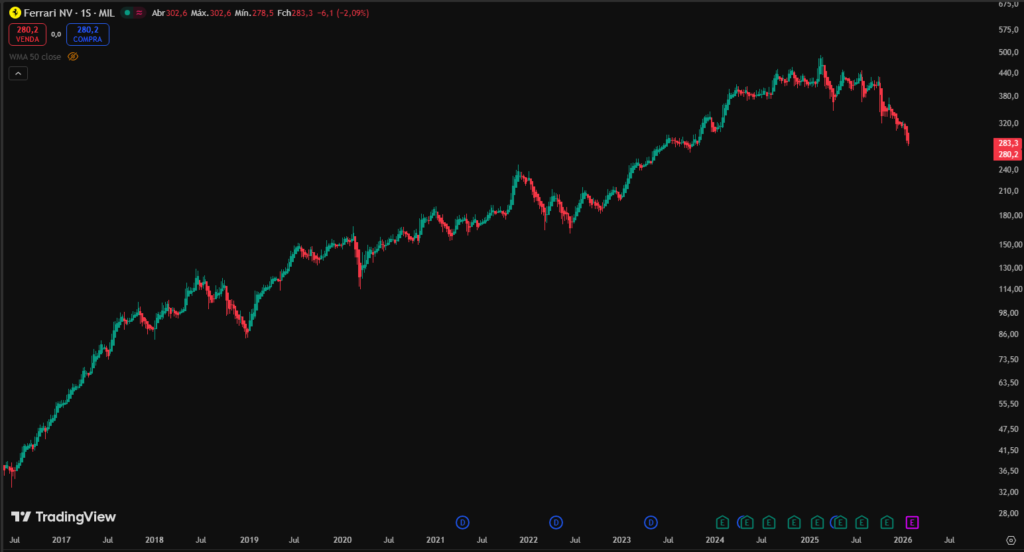
Why am I initiating a position now?
I believe the current price already discounts much of the global macroeconomic uncertainty and anxiety surrounding the energy transition. In financial markets, patience is rewarded. When I see a company with unchanged fundamentals and protected margins being sold at a 40% “discount,” my value-investing instinct kicks in.
However, I follow my golden rule: scaling into the position. The market can remain irrational longer than I can predict, and if the stock drops another 10% or 15%, I will have the liquidity to lower my cost basis. I am not trying to time the exact bottom, but rather buy quality at a fair price. Currently, Ferrari is in what I consider the sweet spot between fair valuation and future growth potential.
FAQ: Frequently Asked Questions About Investing in Ferrari
Is Ferrari a car company or a luxury company?
For investment analysis purposes, Ferrari should be classified as an ultra-luxury company. Its market behavior, margins, and customer loyalty are much more similar to LVMH or Hermès than to BMW or Ford.
How does the transition to electric vehicles affect RACE stock?
Ferrari uses electrification to enhance performance (instant torque) rather than just for efficiency. The brand holds patents for sound and driving dynamics that ensure its DNA remains intact, protecting the stock’s value even as internal combustion engine bans loom in some markets.
Why did the stock drop 40% if the company is so solid?
The drop was primarily due to a generalized multiple compression across the tech and luxury sectors, combined with profit-taking after years of exponential growth. Fundamentally, the company continues to break revenue and profit records.
Is it safe to invest in Ferrari during a recession?
Historically, Ferrari is one of the most resilient assets. Its customers belong to the world’s 0.1%, whose consumption is less affected by economic cycles, making RACE an excellent portfolio hedge.
Conclusion: A Thesis of Conviction and Exclusivity
In summary, my decision to buy Ferrari stock in 2026 is not a short-term speculative move, but a strategic allocation into one of the most perfect business models ever created. We are talking about a company that masters the art of scarcity, possesses unprecedented industrial profit margins, and operates in a niche where competition is almost irrelevant.
The 40% correction opened a window of opportunity I could not ignore. By investing in Ferrari, I am buying a piece of Italian history, unquestionable technological leadership, and, above all, the resilience of a brand that only appreciates with time. I will continue to build my position gradually, focused on the long term and the certainty that, just like its cars, Ferrari shares are destined for those who know how to appreciate rarity.
This philosophy of investing in exceptional quality and unassailable moats is not limited to the luxury sector. In fact, Ferrari shares the spotlight in my high-conviction portfolio with a tech giant that operates under a similarly rigorous logic of capital allocation and operational efficiency. While Maranello represents the pinnacle of exclusivity, Constellation Software is the gold standard for compound growth in vertical markets. I invite you to read my detailed analysis on why Constellation Software is my only choice, as both companies form the core of my strategy for capital preservation and growth over the next decade.
For more detailed analyses on the luxury sector and investment strategies, consult the official reports at Ferrari Investor Relations and follow my upcoming portfolio updates here on the site.
Related posts:
 Investment Strategy 2026: The 6 Wide-Moat Stocks I’m Watching for My Long-Term Portfolio
 Constellation Software (CSU): Why I Am Aggressively Doubling Down on This Generational Opportunity Amidst Extreme Market Fear
 Is Novo Nordisk (NVO) Still a Buy in 2026? My Deep Dive into the Giant Curing Obesity
 Why Constellation Software is My Only Choice: The Death of Horizontal Software and the Resilience of VMS