
In January 2026, precious metals hit historic milestones: Gold nears $5,000/oz and Silver breaks $100/oz. This rally is fueled by the U.S. withdrawal from the WHO and the “Greenland Agreement” geopolitical deadlock. Despite the bullish backdrop, the Silver/Gold ratio RSI has reached an extreme 94.78, signaling a massive technical exhaustion. I anticipate a 30-40% correction in silver, recommending partial profit-taking and caution against new accumulation at these levels.
1. The Twilight of Fiat: Gold at $5,000$ and the Global Currency Crisis
I have been tracking these markets for over two decades, but what we are witnessing in this third week of January 2026 is a tectonic shift that will be studied for generations. Gold hitting $5,000$ per ounce is no longer a “black swan” prediction from gold bugs; it is the market’s ultimate verdict on the systemic failure of global fiat currencies. As I sit at my terminal today, the sentiment across trading floors from New York to Singapore is unanimous: the debt-based, unbacked monetary experiment is hitting its mathematical limit.
The catalyst for this parabolic move isn’t just standard inflation—it is the widespread realization that all fiat currencies are designed to debase. I must emphasize a crucial nuance for my American readers: while we are seeing a flight from paper to hard assets, the U.S. Dollar remains the “cleanest shirt in the dirty laundry.” Compared to the collapsing Yen or the politically fractured Euro, the Dollar still commands a liquidity premium that grants it a temporary lease on life. However, being the “least bad” fiat currency is a hollow victory when your purchasing power is being eviscerated by Gold at $5,000$.
The final straw for this market panic was yesterday’s formalized U.S. exit from the World Health Organization (WHO). This move, coupled with the suffocating uncertainty surrounding the Greenland Agreement, signals to the world that multilateral cooperation is effectively dead. When nations no longer trust each other for global health or territorial sovereignty, investors stop trusting the “promises to pay” issued by those nations. This is the fundamental fuel behind the relentless bid for precious metals.
2. Silver at $100$: Speculative Euphoria and the RSI Danger Zone
If gold is the judge of the monetary system, silver is currently the defendant being tried for excessive speeding. Seeing Silver at $100$ an ounce is a milestone I’ve long anticipated, but the vertical nature of this move triggers every warning light on my dashboard. I spend my days staring at charts, and I have rarely seen a technical distortion as severe as the one we face today. Silver has benefited from a “perfect storm” of industrial scarcity and a mad dash for real assets, but its intrinsic volatility is now reaching “blow-off top” proportions.
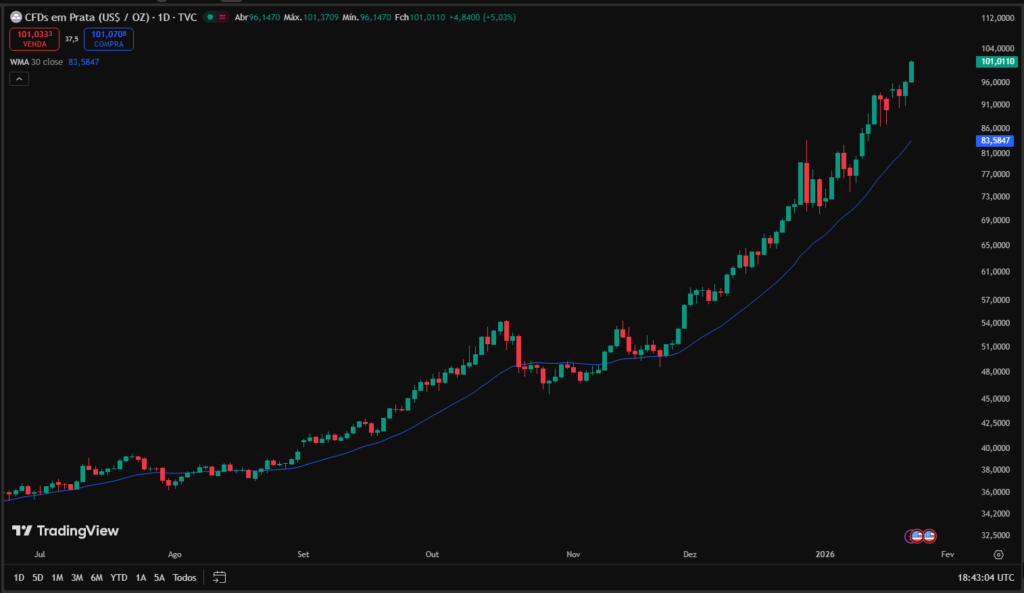
When I pull up the Silver/Gold ratio chart, the data is screaming for caution. As you can see from the technical analysis I’ve prepared, the weekly RSI (Relative Strength Index) has reached a staggering 94.78. For any serious institutional trader, an RSI above 70 is overbought; a value above 90 is “black swan” territory for technical indicators. I vividly remember the silver peaks of 2011 and the 2021 squeeze—every time the ratio between these two metals overextends to this degree, the subsequent “cleansing” is both swift and merciless.
My fundamental analysis suggests that silver is currently “decoupled” from its short-term reality. While the long-term case for silver in the 2026 green-energy economy is undeniable, the current price incorporates a “panic premium” that is rarely sustainable. I believe the risk of a sudden 30% to 40% drawdown in silver is not just possible—it is imminent. For a deeper dive into why this setup is so treacherous, you should review my previous analysis on why Silver in 2026 might be a short-term trap.
3. The Math of Mean Reversion: Why I Trust the $94.78$ RSI
To understand why Silver at $100$ makes me so uncomfortable as a senior analyst, we must look at the Silver/Gold ratio. Traditionally, this ratio acts as a thermometer for the health of the precious metals bull market. When silver outruns gold to this extent—while gold is still consolidating its path to $5,000$—the financial “rubber band” is stretched to its breaking point.
Historical Extremes: RSI on the Silver/Gold Ratio
| Year | Peak Weekly RSI | Subsequent Silver Performance | Timeframe |
| 2011 | 88.5 | 35% Correction | 3 Weeks |
| 2021 | 82.0 | 20% Drawdown | 1 Month |
| 2026 (Now) | 94.78 | Projected: 30-40% Crash | Immediate Risk |
I see retail investors piling into silver right now, blinded by the $100 headline, ignoring the fact that the U.S. Dollar, despite its fiat flaws, still exerts gravitational force. Because the USD is the “least bad” of the fiat bunch, any minor relief rally in the Dollar Index (DXY) will act as a sledgehammer to over-leveraged silver positions. If the Fed intervenes to stabilize the global panic, silver will be the first “liquidity sponge” to be squeezed dry.
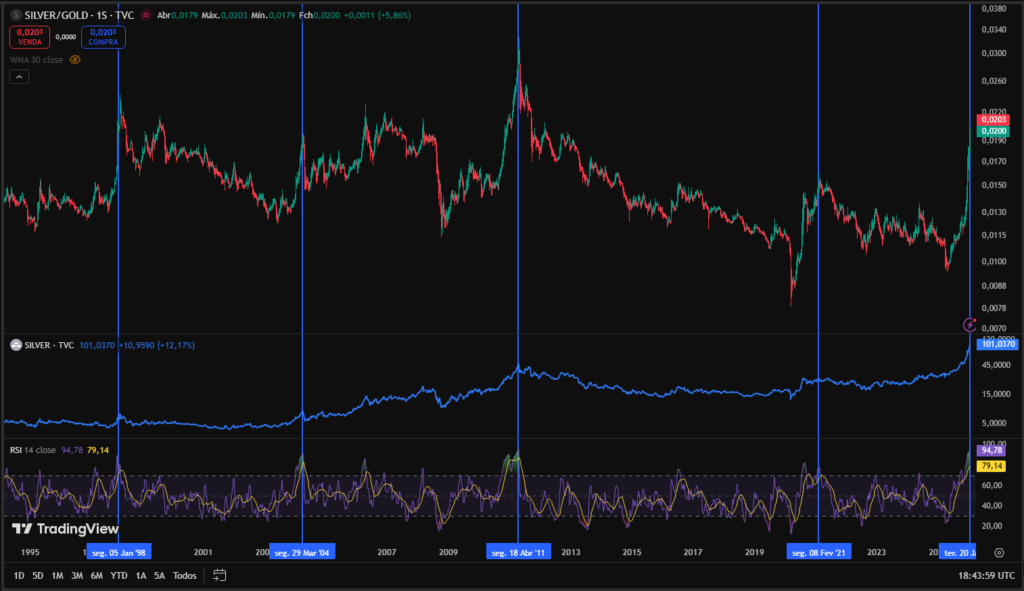
The chart doesn’t lie: an RSI of 94.78 is one of the most aggressive “Sell” signals I have seen in my career. Betting against this level of technical exhaustion is betting against financial mathematics. I am not a “silver bear”—on the contrary, I believe the metal has a bright future—but I am a pragmatist when it comes to risk management.
4. 2026 Geopolitics: Greenland, the WHO, and the Death of Diplomacy
We cannot analyze Gold at $5,000$ in a vacuum. The 2026 economy is defined by the death of the old world order. The U.S. withdrawal from the WHO, finalized yesterday, is more than just a policy shift; it is a systemic confidence shock. It signals that the world’s largest economy is prioritizing internal survival over global stability.
Simultaneously, the Greenland Agreement deadlock has ignited a “Cold War for Resources.” The struggle between the U.S. and its former European allies over Arctic minerals has created a permanent risk premium in the gold market. According to recent IMF (International Monetary Fund) stability reports, this “geoeconomic fragmentation” could permanently impair global GDP. In a world of shrinking trust, assets that cannot be printed become the only viable store of value.
However, be wary of the “death of the dollar” narrative. What we are seeing is the death of fiat as a concept, but the Dollar remains the refuge within the garbage. As the Euro and Yen face even more severe liquidity crises, capital flows into the Dollar as a temporary transit point before moving into physical gold. This “whipsaw” dynamic creates extreme price swings that can wipe out retail silver traders. For more on central bank reserves, I highly recommend the World Gold Council’s latest data.
5. My Personal Strategy: Why I Am Selling Silver Now
Many of you have asked me: “If the world is in chaos and gold is going to $5,000, why would you sell the scarcest metal?” The answer is simple: Discipline over Greed.
Here is my exact position right now:
- Partial Silver Liquidation: I have started selling 30% of my physical and paper silver positions. At $101/oz, the profit is too significant to ignore in the face of a 94.78 RSI.
- Rotating into Gold: I am moving a portion of those silver profits into Gold. While gold is approaching $5,000, its price action is much more stable and less dependent on retail FOMO (Fear Of Missing Out).
- Holding USD for Liquidity: I am keeping a cash reserve in Dollars. As the “least bad” fiat, it provides the dry powder I need to buy the 40% silver dip I expect in the coming months.
- No New Accumulation: I strongly advise against buying silver here. The time to accumulate was in 2024 and 2025. Entering at $100 is buying the top of a parabolic move.
I would rather be “early” to take profits than “late” to the exit. In a market this volatile, patience pays more than conviction.
Asset Comparison Table: Hard Assets vs. Fiat (Jan 2026)
| Asset / Currency | YTD Performance | Confidence Level | Technical Indicator (RSI) | Portfolio Status |
| Gold (XAU) | +18% | Maximum | 74.0 (Strong) | Hold / Add on Dips |
| Silver (XAG) | +45% | Volatile | 94.78 (Extreme) | Aggressive Profit Taking |
| U.S. Dollar (USD) | -5% | Medium (Best Fiat) | 35.0 (Oversold) | Hold for Liquidity |
| Euro (EUR) | -12% | Low | 28.0 (Crisis) | Avoid Long Exposure |
| Bitcoin (BTC) | +22% | High | 68.0 (Healthy) | Hold |
6. FAQ: Navigating the 2026 Financial Crisis
Is it still safe to hold U.S. Dollars?
The Dollar is the “least bad” fiat currency in 2026. It is useful for immediate liquidity and as a tool to buy asset crashes, but it is no longer a long-term store of value compared to Gold at $5,000.
Why is the Silver/Gold ratio RSI so critical?
At 94.78, the RSI indicates that silver has outpaced gold at an unsustainable rate. Historically, such extremes have almost always led to a 30% to 40% correction in silver prices.
How does the WHO exit affect my portfolio?
It increases global geopolitical risk and weakens the multilateral trust required for the Dollar to function as a reserve currency, which serves as a long-term bullish tailwind for gold.
7. Conclusion: Surviving the Storm with Intelligence
In conclusion, the 2026 financial landscape does not forgive amateurs. Gold at $5,000 is the watermark of a new era, one where fiat promises are being replaced by tangible reality. However, the mania that pushed Silver to $100 has created a technical trap that I refuse to walk into.
My stance is clear: protect your gains. The RSI at 94.78 is the market’s way of shouting “Stop.” Do not fall for the “silver to the moon” hype at these levels, or you risk holding the bag during a 40% retracement. Take partial profits, keep your eyes on the “least bad” fiat for liquidity, and wait for the ratio to mean-revert. In 2026, Gold is king, but the investor who knows when to sell is the one who keeps the crown.
Would you like me to analyze the specific support levels for major silver mining stocks to find the best entry point for the coming correction?
Disclaimer: This article reflects my personal opinion and technical analysis. Trading precious metals involves high risk. This is not official financial advice. Always perform your own due diligence before investing.
Related posts:
 The Civil War at the Federal Reserve: Is Jerome Powell’s Resistance the Last Stand for Economic Stability?
 Trade War 2.0 Greenland: How to Shield Your Portfolio Against New NATO Tariffs and Arctic Volatility
 The Greenland Crisis: How Trump’s New Tariffs Could Wreck Your Tech Portfolio Today
 Netflix Earnings Q4 2025: The Giant Between Exponential Growth and the Reality of Multiples