
In January 2026, Japanese 10-year Treasury Bonds (JGBs) reached a 27-year high of 2.16%, forcing the Bank of Japan (BoJ) to hike interest rates to 0.75%. With a debt-to-GDP ratio exceeding 260%, the Yen’s devaluation (USD/JPY at 157) has decimated the purchasing power of the middle class. Meanwhile, Bitcoin in Yen has surged over 300% in five years. The reversal of the yen carry trade now threatens global financial liquidity.
The financial world is currently witnessing a tectonic shift that most Western investors have yet to fully internalize. As a senior observer of global capital flows, I believe we are staring at the most significant macroeconomic event of the decade. At the center of this maelstrom are the Japanese 10-year Treasury Bonds (JGBs), which have finally shattered the shackles of financial repression imposed by the Bank of Japan (BoJ) for nearly thirty years. When I look at the yields on these bonds crossing the 2.1% threshold, I see the official death certificate of the era of “free and infinite liquidity” that began in Tokyo.
1. The Breakout of JGB 10-Year Yields: Ending the Era of Zero Interest
Technical analysis rarely lies, and the chart for Japanese 10-year Treasury Bonds serves as a stark visual testament to a paradigm shift. For decades, the BoJ utilized its Yield Curve Control (YCC) framework to pin rates near zero, effectively subsidizing the world’s appetite for cheap debt. However, by January 2026, market reality has finally overwhelmed central bank manipulation. The climb to 2.16% is not merely an incremental rise in borrowing costs; it is the total capitulation of a policy that attempted to defy the fundamental laws of economic gravity.
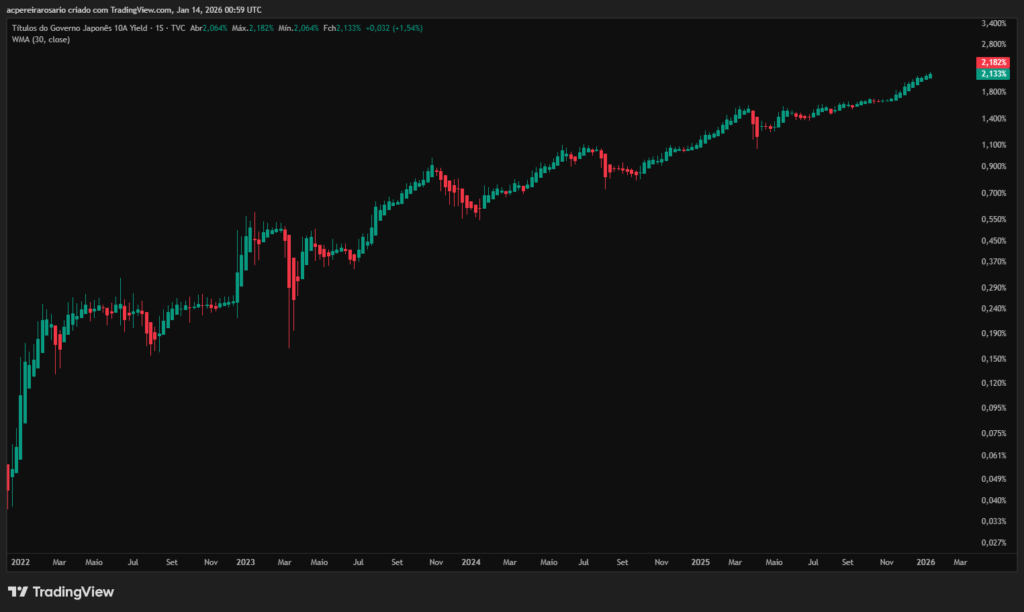
When I analyze this movement, I don’t just see a yield spike; I see a massive capital flight masquerading as policy normalization. For a market conditioned to negative or near-zero returns, a shock of this magnitude is comparable to a 9.0 magnitude earthquake on the financial Richter scale. The Japanese banking sector, bloated with government debt, is now struggling to balance books that lose value every time rates tick higher. It is a cruel irony: the very rate hikes intended to stabilize the currency are exposing the technical insolvency of a hyper-leveraged state.
2. The Yen’s Devaluation: The High Cost of Procrastination
As I write this, the USD/JPY pair is hovering dangerously between 157 and 160. For the average citizen in Tokyo or Osaka, this isn’t just a ticker on a Bloomberg terminal; it is the sound of their standard of living evaporating. The devaluation of the Yen has become a hemorrhage that the BoJ seems unable—or perhaps unwilling—to stop. Japan, a nation that imports the vast majority of its energy and food, is effectively exporting its real wealth in exchange for fiat paper that is losing its utility by the day.
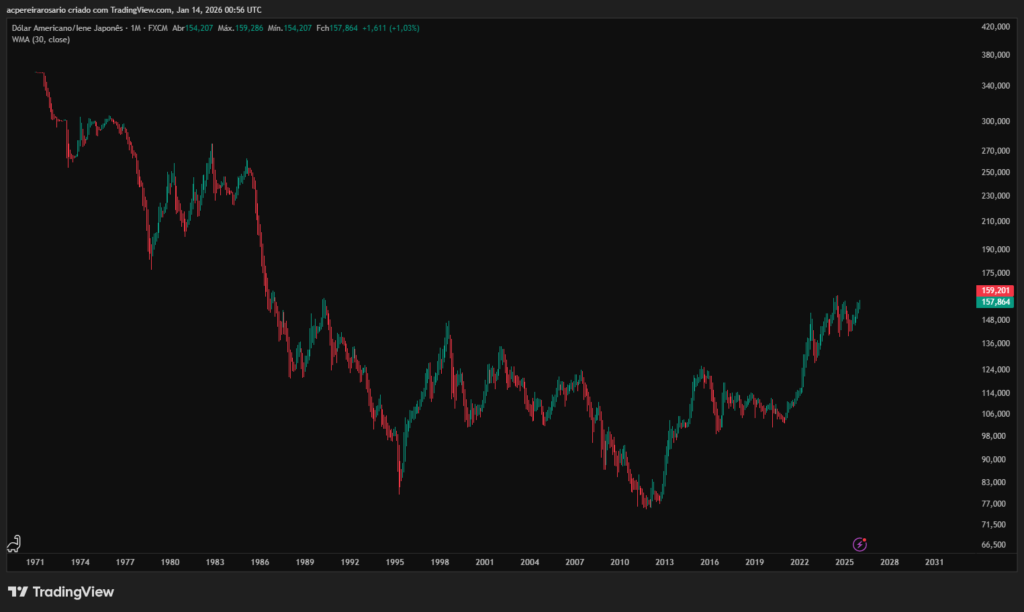
My position on this is clear: the Yen has forfeited its status as a “safe haven.” The classical theory that the JPY appreciates during global crises has been pulverized by the reality of 2026. Anyone who kept their savings exclusively in Yen over the last five years has been effectively confiscated by their own central bank. Inflation, which the BoJ spent years trying to manufacture, has arrived with a vengeance, hitting 3% and eroding wages that have remained stagnant since the 1990s.
3. The Impoverishment of the Japanese Middle Class: A Lesson in Asset Allocation
There is a silent tragedy unfolding in Japanese households. Historically, Japanese families are known for their high savings rates, but these savings are massively concentrated in bank deposits and cash—the proverbial “money under the mattress.” In today’s environment of currency debasement, this traditional conservatism has turned into a poverty trap.
Those who failed to diversify into international assets or scarce digital commodities are watching their purchasing power vanish against the Dollar, the Euro, and Bitcoin. The impoverishment of the Japanese middle class is the direct result of a monetary policy that punished savers to keep a zombie government afloat. I often ask myself: how long can a civilized society endure this level of financial repression before we see a total breakdown in the social contract or a radical political upheaval?
4. Bitcoin in Yen: The Final Hedge Against the Printing Press
If we look at the performance of Bitcoin denominated in Yen (BTC/JPY), the picture is both clear and devastating for proponents of fiat currency. In January 2021, one Bitcoin cost approximately 3.7 million Yen. Fast forward to January 2026, and we are trading near 15.1 million Yen.
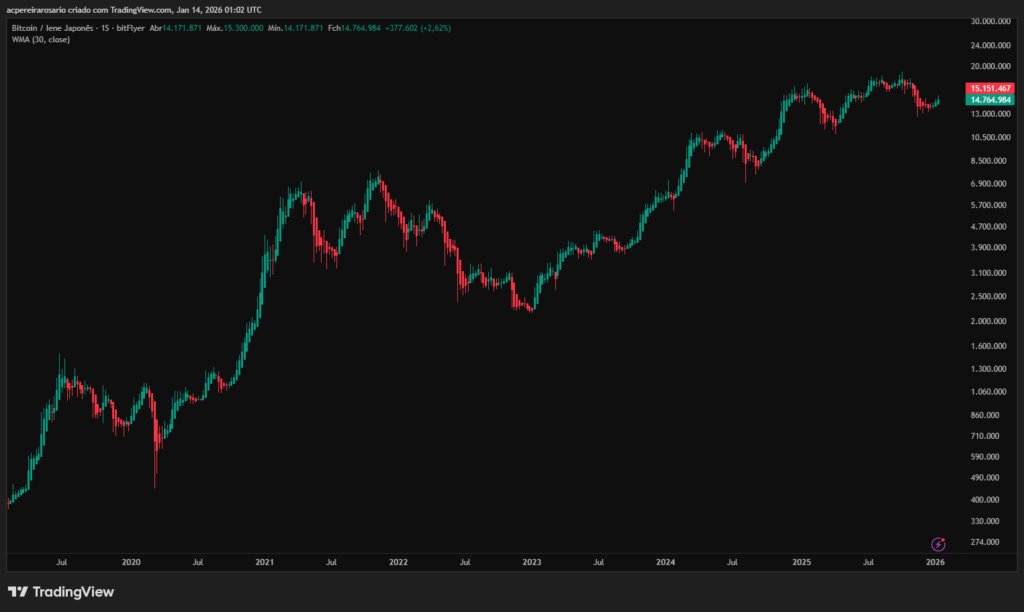
This represents a surge of over 300% during a period when Japan’s real economy barely moved. But what this chart truly reveals is that Bitcoin is acting as a thermometer for the destruction of the Yen. It isn’t just that Bitcoin is gaining value; it’s that the Yen is losing its function as a store of value. For the modern Japanese investor, Bitcoin has transitioned from a speculative asset to an essential insurance policy against the BoJ’s mismanagement.
| Asset | Value Jan 2021 (JPY) | Value Jan 2026 (JPY) | Appreciation (%) |
| Bitcoin (BTC) | ~3,738,000 | ~15,148,000 | +305% |
| Gold (Oz) | ~195,000 | ~360,000 | +84% |
| USD/JPY (Currency) | 103.50 | 158.20 | -34% (Purchasing Power Loss) |
| S&P 500 | ~380,000 | ~850,000 | +123% |
If you would like to learn about my strategy for investing in Bitcoin, read this article: Bitcoin DCA Strategy.
5. The Debt Spiral: 260% GDP and the BoJ’s Impossible Choice
Here lies the Gordian knot of the global economy. Japan boasts a public debt that exceeds 260% of its Gross Domestic Product. For decades, this was “sustainable” because the BoJ purchased nearly all issued debt at zero interest. But now, with Japanese 10-year Treasury Bonds yielding 2.1%, the service on that debt is beginning to consume a terrifying portion of the national budget.
The BoJ is caught between a rock and a hard place. If they raise interest rates aggressively to save the Yen, they drive the government into insolvency and trigger a domestic banking crisis. If they keep rates low, the Yen collapses entirely, destroying the population’s remaining wealth. Governor Kazuo Ueda is attempting a “soft exit,” but in my view, there is no such thing as a soft exit when you have 260% debt-to-GDP and the inflation genie is out of the bottle.
6. The End of the Carry Trade: Draining Global Liquidity
This is the point that worries me most for global markets in 2026. Japan has long been the world’s primary financier. Through the yen carry trade—where investors borrow in cheap Yen to invest in higher-yielding assets in the US, Europe, and Emerging Markets—trillions of dollars have flowed into the S&P 500, the Nasdaq, and global real estate.
As rates rise in Japan and JGBs become more attractive, this flow is reversing. Capital is coming home. When Japan “sneezes,” the global financial system catches pneumonia. The reduction in global liquidity, as Japanese investors repatriate funds to take advantage of the 2% (finally positive) yields in their own country, is putting massive selling pressure on all other financial assets. We are witnessing the end of the era of easy money.
7. Conclusion: The Awakening of a Sleeping (and Dangerous) Giant
My final analysis is somber but necessary. Japan is not an isolated case of monetary mismanagement; it is a mirror reflecting what could happen to other developed nations that have followed the path of infinite debt. The breach of technical levels in the Japanese 10-year Treasury Bonds is the alarm bell that every investor should be hearing.
For you, the investor, the lesson is clear: geographic diversification and exposure to scarce assets like Bitcoin and Gold have never been more vital. The Yen is teaching the world, in the harshest way possible, that no currency is “safe” if the central bank issuing it is attempting to monetize an unpayable debt. Japan is the canary in the coal mine of global liquidity. And the canary has just stopped singing.
FAQ Section
What happens if Japanese 10-year Treasury Bonds keep rising?
A continued rise increases the government’s debt-servicing costs, potentially leading to a fiscal crisis and forcing the BoJ to either print even more money (hyper-devaluation) or allow the technical insolvency of certain financial institutions.
Why is the Yen still weak despite rising interest rates?
The interest rate differential between Japan and the US remains significant. Furthermore, the market fears that Japan cannot sustain higher rates due to its massive debt-to-GDP ratio, leading to a “risk premium” being priced into the currency.
Is Bitcoin a viable protection for Japanese citizens?
Absolutely. Over the last 5 years, Bitcoin in Yen has appreciated over 300%. It has proven to be a highly effective hedge against the devaluation of the Yen and the loss of domestic purchasing power.
This article was written based on market data as of January 2026 and reflects my personal analysis of the fragility of the Japanese financial system. For deeper technical insights, consult official reports from the Bank of Japan and follow our internal updates on the crypto-asset markets.
Related posts:
 The Civil War at the Federal Reserve: Is Jerome Powell’s Resistance the Last Stand for Economic Stability?
 CPI Predictions Today and the Reality Shock: Why I Believe We Are Entering an Unprecedented Deflationary Era
 The Jamie Dimon Paradox and Trump’s Populism: Why JPM’s Profits Don’t Convince Me in 2026