In today’s global economic landscape, where relentless money printing and skyrocketing inflation erode the purchasing power of millions every single day, I have decided that I cannot simply sit idle and watch my savings melt away in a bank account. This is why, today, I am sharing my personal, technical, and extremely disciplined approach to investing in Bitcoin intelligently. My focus here is not wild speculation or “get-rich-quick” schemes, but rather building solid, long-term wealth using a tool many overlook: DCA (Dollar Cost Averaging) filtered by the visual analysis of Heikin Ashi candles. I firmly believe that financial survival in the 21st century requires, by necessity, exposure to scarce assets that are decoupled from the traditional banking system.
In this article, I will break down the mathematical and visual rules I have set for my weekly purchases, explaining the fundamental difference between my investment portfolio and my trading activity. I will also explain why the IBIT ETF has become my tool of choice for this plan and why I consider holding Bitcoin the only realistic way to combat the constant devaluation of the Euro and the Dollar. This is my battle plan, designed to remove emotion from the equation and focus exclusively on consistency.
1. The Slow Death of Fiat Money and the Role of Bitcoin
Before explaining the technique, it is vital that I share my vision regarding the current state of the financial world. We live in an era where the system is built on debt and fiat currencies—currencies that have no backing in physical assets and can be created at the push of a button by central banks. History is relentless: all fiat currencies, without exception, tend to lose their intrinsic value until they hit zero. Since the gold standard was abandoned in 1971, the purchasing power of global currencies has suffered an unprecedented monetary degradation. What 100 dollars bought ten years ago barely covers half of that today.
Bitcoin, on the other hand, was designed to be the antidote to this centralized and inflationary system. With a mathematically limited supply of 21 million units, it represents, in my opinion, the purest form of private property ever created. To me, Bitcoin isn’t just a chart that goes up and down; it is an insurance policy against government mismanagement and currency debasement. In my global portfolio, I maintain what I consider a prudent and strategic position: I believe that having a maximum of 5% of your total net worth in BTC is the “sweet spot.” It is enough to capture asymmetric upside that can change a person’s life, without exposing the investor to volatility that would prevent them from sleeping at night.
2. My Golden Rule: Weekly DCA with Heikin Ashi Candles
An investor’s greatest enemy is their own brain. When the price rises, the fear of missing out (FOMO) pushes people into impulsive buying at the top. When the price drops, panic sets in and many sell at the bottom. To avoid this trap, I use a DCA (Dollar Cost Averaging) strategy adapted with a trend filter. My vehicle of choice is the IBIT (iShares Bitcoin Trust) ETF, due to its liquidity and ease of management.
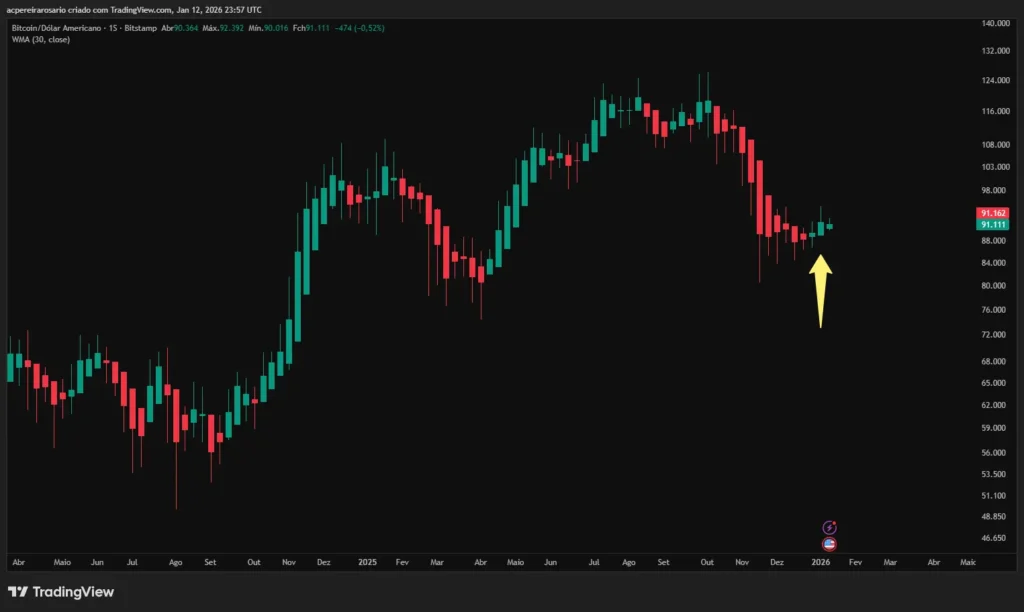
My rule for long-term investment is visual and binary, based on the weekly chart using Heikin Ashi candles. Unlike standard Japanese candlesticks, Heikin Ashi filters out the noise and shows the actual direction of the trend. My rules are:
- Buy Signal (Green Candle): Every week, if the weekly Heikin Ashi candle closes green, I execute an automatic purchase. It doesn’t matter if the price rose a little or a lot; if the weekly trend shows strength, I accumulate.
- Pause Signal (Red Candle): If the market turns and the candle closes red, I immediately stop all purchases. I do not try to “catch falling knives.” I prefer to preserve my liquidity and wait for the market to show a new signal of recovery.
- The Accumulation Cycle: I only inject capital again when the chart prints another green weekly candle. This allows me to remain on the sidelines during prolonged 40% or 50% drawdowns, resuming purchases only when the bullish structure is re-established.
3. Bitcoin Trading: Discipline Above the Moving Average
It is crucial to distinguish my “investor self” from my “trader self.” While DCA is a passive accumulation strategy, my Bitcoin trading follows much more aggressive rules that depend on momentum indicators. I do not trade based on intuition; I follow the price.
In my trading setup, the primary rule is the Weighted Moving Average (60-period weekly). For me, this line is the frontier between a bull market and a bear market.
- Longs Only (Buys): I only accept opening trading positions when the Bitcoin price is trading above the 60-period moving average. Below that, the risk of being caught in a deep correction is too high.
- Trend Management: Above this average, I look for continuity entries. If the price breaks below the average, I close my trading positions and stick only to my investment portfolio (the aforementioned 5%).
- Price Projection: Although I believe Bitcoin could reach values like $150,000 or $200,000, my exit plan is not based on “magic numbers,” but rather on the breach of trend structures or long-term trendlines.
4. Why the IBIT ETF and Not Direct Custody?
Many ask me why I use an ETF instead of buying directly on an exchange and storing it in a hardware wallet. The answer is simple: operational and tax efficiency. For a weekly DCA strategy involving frequent transactions, BlackRock’s IBIT ETF offers incomparable execution ease within a regulated brokerage account.
Furthermore, for those managing a diversified portfolio with stocks and other ETFs, having Bitcoin integrated into the same environment makes rebalancing and capital gains reporting much simpler. The transparency is absolute: as shown in my recent videos, the start of this DCA strategy coincided with a strong weekly close, and I will follow the plan with military-grade rigor. If the candles change color, I stop. If they stay green, I continue building my position imperturbably.
Conclusion: The Future Belongs to the Disciplined
Investing in Bitcoin through a DCA plan with technical filters is, in my view, the safest way to navigate the extreme volatility of cryptocurrencies. I don’t want to be “right” about tomorrow’s price; I want to be positioned for the reality of the next decade. The devaluation of fiat currencies is a mathematical certainty driven by expansionary monetary policies; Bitcoin’s scarcity is a cryptographic guarantee.
My position is clear: Bitcoin must be viewed as a digital store of value. By limiting exposure to 5% and buying only when the weekly trend is in our favor (green candles), we turn a volatile asset into a predictable wealth-building tool. To track fundamental network data, the Glassnode portal is my external recommendation for any serious investor.
The path to financial freedom is not made with bets, but with plans. My plan is set. What about yours?
Relevant article: The Civil War at the Federal Reserve
Disclaimer
The information provided in this article is for informational and educational purposes only and does not constitute financial, investment, or legal advice. Investing in commodities and precious metals involves significant risk. You should conduct your own research or consult with a qualified financial professional before making any investment decisions. The author is not responsible for any financial losses resulting from the use of this information.